
The Chemistry of Hard water Scalp: Why Your Pipes Matter
You rinse. You lather. You rinse again. And still your scalp feels tight, prickly, faintly sore by midday. Not flakes. Not oil. Just a low-grade reactivity you can’t place. This is the hard water scalp pattern: minerals left behind after washing that bind to skin and hair, disrupt the barrier, and turn even mild formulas into irritants.
Hard water doesn’t look aggressive, so you don’t question it. But calcium and magnesium deposits shift scalp pH, dull surfactants, and leave a film that traps residue. Your routine stays the same; your scalp changes. The itch feels “random.” The tenderness feels unexplained. It isn’t.
If your products once felt fine and now sting, pull, or leave you tight within hours, consider the water touching them. A hard water scalp reacts to buildup, not just ingredients. Until you address that layer, every wash can quietly set off the same loop.
Identifying the Symptoms: Is It Dryness or Buildup?
Mineral film presents as dryness because sensation dulls and tightens. But its signals differ from lipid loss.
Hair feels coated even after washing. Fingers meet drag, not slip. Moisturizers sit on the surface without change. Tightness persists through the day. Color fades faster. Volume collapses at the root.
These are friction problems as much as barrier ones. Mineral deposits increase the coefficient of friction along the cuticle. Shafts catch, tangle, lift. Mechanical breakage follows. The scalp beneath remains filmed, slightly alkaline, prone to itch that does not resolve with oil.
The distinction matters. Dryness needs lipid. Buildup needs removal.
Chelation for Hard water Scalp: Why Clarifying Falls Short
Clarifying shampoos remove oils and styling residues. They do little to minerals. Calcium salts resist ordinary surfactants. Without a binding agent, they remain anchored to keratin and skin.
Chelating agents solve this differently. Molecules such as tetrasodium EDTA or sodium phytate act like molecular claws. They encircle Ca²⁺ and Mg²⁺ ions, forming soluble complexes that rinse away. The film lifts. The surface resets.
Used periodically, chelation restores true clean — not stripped, but unobstructed. The acid mantle can re-form. Sebum redistributes. Sensation quiets.
A supplemental method exists: a diluted acidic rinse. Apple cider vinegar, at pH roughly 2.5–3.5, can dissolve superficial calcium deposits. It works by shifting mineral salts toward solubility. But acidity also perturbs a sensitized barrier. Use sparingly, brief contact, followed by thorough rinse. It is an adjunct, not routine care.
Chelation removes the cause. Clarifying alone does not.
Preventing Hard water Scalp: The Environmental Audit
If minerals arrive each wash, removal alone cannot hold. Prevention must intercept the source.
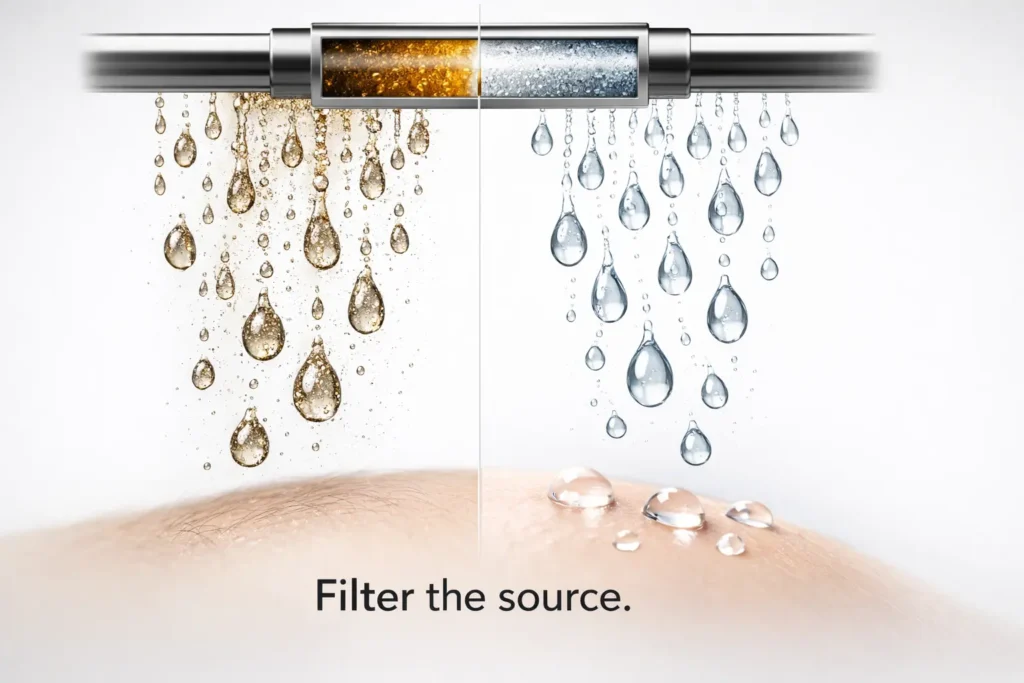
Shower filtration offers this interception. Media such as KDF-55 use redox reactions to reduce chlorine and bind heavy metals before they contact scalp and hair. Mineral load drops. Oxidative stress decreases. Residue forms more slowly.
Water hardware often sits outside beauty thinking, yet it shapes every wash. Fixing water quality lowers baseline irritation before any product acts. For irritant patterns linked to environment, see Contact Dermatitis on the Scalp to trace how external load compounds sensitivity.
The scalp barrier reflects its water supply.
Integrating Into Your 5-Day Reset
Hard water belongs in the reset’s environmental audit. Day 2 identifies external triggers; mineral load sits among them. Day 5 installs preventative tools — filters, chelation cadence, rinse control.
If mineral buildup is present, also examine product burden. Some shampoos add irritants atop residue. See Is Your Shampoo Causing More Harm? to audit preservatives and surfactant harshness so removal begins on a clean base.
Environment and formula act together. Both must clear.
Hard Water vs. Soft Water Effects
| Feature | Hard Water (Ca²⁺/Mg²⁺) | Soft Water (Na⁺/K⁺) |
|---|---|---|
| Scalp sensation | Tight, itchy, filmed | Slippery, clean, hydrated |
| Hair texture | Stiff, straw-like, tangles | Soft, manageable |
| Product efficacy | Low — minerals block action | High — surfactants lather |
| Barrier impact | Disruptive, alkaline drift | Neutral to low disruption |
Don’t Let Your Shower Sabotage You
You cannot out-product a water problem. Where mineral load is high, chelation becomes structural care, not optional. Remove the film and the barrier can regulate. Leave it and irritation returns despite routine.
Your environment sets the baseline for scalp homeostasis. Download the 5-day scalp reset guide for step-by-step relief and a full environmental audit of your bathroom so water supports, rather than undermines, recovery.