
Why Dandruff Keeps Coming Back in 48 Hours
The Introduction: The 48-Hour Betrayal
You know the ritual.
You stand in the shower, the scent of medicinal menthol filling the air. You scrub until your scalp feels “squeaky clean,” convinced that this time the bottle of blue liquid has finally won the war. For 24 hours, you feel liberated. You wear the black sweater. You stop checking your shoulders.
Then, the clock strikes 48.
Like a cruel, invisible tide, the tightness returns. First, a faint itch behind the ears. Then, the inevitable “snowfall” on your desk. You haven’t changed your diet. You haven’t skipped a wash. So, why dandruff keeps coming back in 48 hours despite your best efforts?
The truth is, you aren’t suffering from “dirty hair.” You are trapped in a biological stalemate.
While your shampoo rinses away the surface flakes, it leaves behind a microscopic “fortress” known as a biofilm. Beneath this shield, the Malassezia fungus isn’t just surviving—it’s feasting. It waits for the exact moment your scalp’s natural oils hit their peak (usually at the two-day mark) to trigger a massive inflammatory rebound.
If you feel like you’re losing a game that’s rigged against you, you’re right. But once you understand the hidden 48-hour cycle of sebum oxidation and fungal resilience, you can stop “managing” the flakes and start dismantling the mechanism that creates them.
Here is the science of why your scalp is rebelling, and the “Rotation Protocol” that finally breaks the cycle.
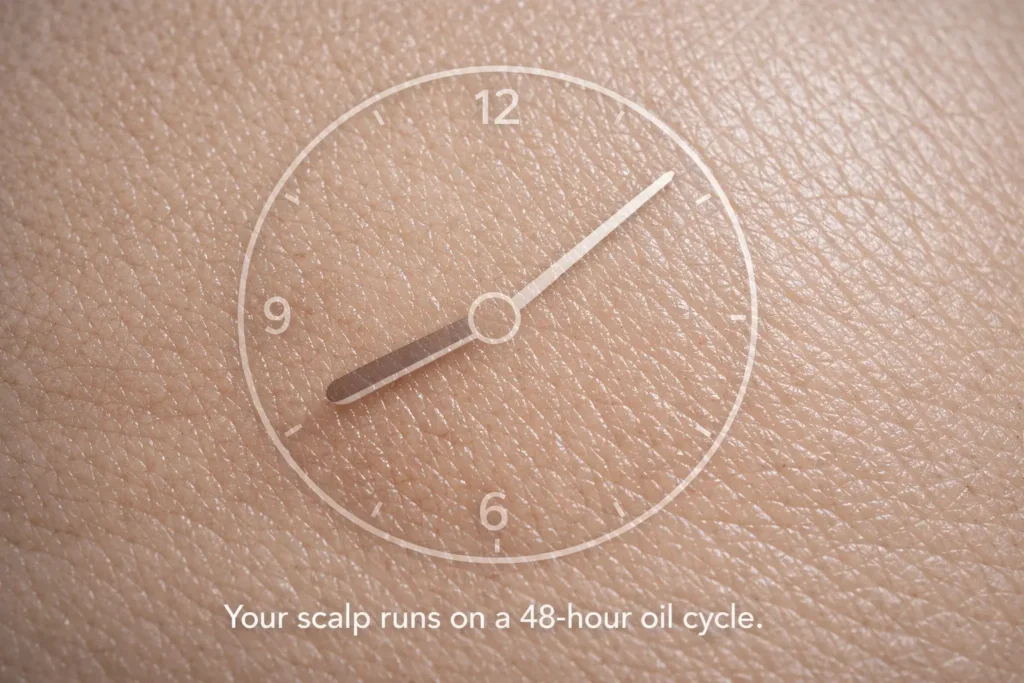
The Frustrating Truth: Why Dandruff Keeps Coming Back in 48 Hours
Flakes returning fast feels personal. You washed carefully. You used treatment. Still, dandruff resets.
This happens because washing removes loose scale, not the cause. Colonies remain attached. Oil chemistry resets. Irritation restarts.
Therefore, visible flakes lag behind invisible biology. The scalp looks clear briefly. Yet the conditions for dandruff persist. By day two, they surface again.
This predictable relapse creates scalp despair. You wash more often. Barrier weakens. Flaking worsens. The loop tightens.
Beyond the Surface: How Biofilms Drive the 48-Hour Relapse
Dandruff is not just shedding skin. It is a structured microbial layer.
On the scalp, yeast cells cluster. They embed in oil and debris. Then they secrete a matrix. This forms a biofilm.
Biofilm acts like glue. It anchors colonies to skin. It shields them from shampoo. Actives struggle to penetrate.
Consequently, washing lifts flakes but leaves structure intact. After rinsing, colonies regrow fast. Scale reforms. Dandruff returns.
Disrupting biofilm is essential. Without it, treatments remain surface-level. Relapse timing stays unchanged.
The Sebum Clock: Why Dandruff Reappears in 48 Hours
Sebum secretion follows a rhythm. Fresh oil protects. Aged oil irritates.
Over time, scalp lipids oxidize. Triglycerides break down. Oleic acid rises. This shift peaks near 48 hours after washing.
Oleic acid disrupts barrier cohesion. Cells loosen. Turnover accelerates. Yeast feeds on altered lipids.
Therefore, the 48-hour mark is not random. It is the sebum cycle reaching its irritant phase. Flaking increases exactly then.
This explains the timing pattern. Clear on day one. Reactive by day two. Dandruff reappears on cue.
The Chemical Trap: Why Your Shampoo Fails the 48-Hour Cycle
Medicated shampoos help initially. Then results fade. Flakes return sooner.
This is microbial adaptation. Repeated exposure reduces antifungal impact. Colonies tolerate the same active.
Meanwhile, strong surfactants strip protective lipids. Barrier thins. pH may rise. Yeast conditions improve.
Consequently, daily medicated washing can backfire. Irritation increases. Oil rebounds faster. The relapse window shortens.
One formula cannot stop a cyclical biology. Static routines allow dandruff to adapt and persist.
How to Stop the Cycle: Fixing Why Dandruff Keeps Coming Back in 48 Hours
Breaking relapse requires rotation. Different mechanisms target different layers.
First, loosen scale and film. Keratolytics like salicylic acid soften adhesion. Biofilm thins. Colonies expose.
Next, apply antifungal A. Ketoconazole reduces yeast density. Contact time matters. Rinse thoroughly.
Later, rotate antifungal B. Selenium sulfide alters cell turnover and ecology. Colonies face new stress.
Alternation prevents adaptation. Biofilm disruption improves penetration. Yeast load drops deeper.
Spacing also matters. Avoid daily stripping. Use gentle acidic washes between actives. Support lipid recovery.
Over weeks, relapse timing shifts. Flakes reduce. The 48-hour loop breaks. Remission extends.
Summary: Reclaiming Control from the 48-Hour Dandruff Loop
Recurring dandruff is not neglect. It is a synchronized cycle of oil oxidation and microbial resilience.
Biofilm protects colonies. Sebum shifts to irritant lipids. Static treatments lose impact. Together, they drive relapse at 48 hours.
When you disrupt structure, rotate actives, and protect the barrier, the cycle weakens. Flakes fall less. Intervals extend.
Consistent strategy restores stability. Scalp clears longer. Confidence returns.
You are not stuck in relapse. You are seeing biology repeat. With targeted rotation, the loop can stop.
“Persistent flakes follow a biological clock. Break the 48-hour dandruff cycle with our step-by-step scalp reset system. Download the full guide to disrupt biofilm, rebalance oil, and achieve long-term remission.”