
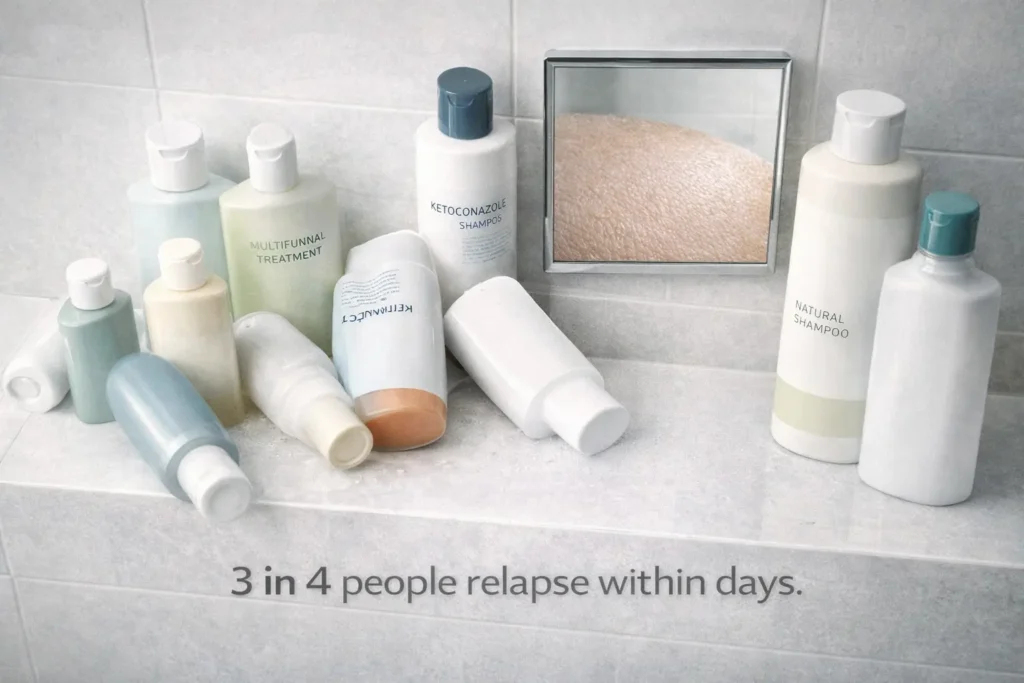
The 75% Relapse Rate No One Warns You About With Dandruff Shampoos
If you’ve noticed your flakes return like clockwork, you’re not alone. The dandruff shampoo relapse rate for standard treatments sits at a staggering 75%. That means three out of four people experience flakes returning within days of treatment.
This isn’t your fault. It’s a predictable, biological loop. Your scalp isn’t defective. It’s responding to a system designed to suppress, not reset.
Understanding this cycle matters. Otherwise, every wash feels like a temporary fix. For the full science behind this pattern, see the hidden 48-hour dandruff cycle no one talks about. [Link to Post 1]
The Profit in the Flakes: Why 75% Relapse is Good Business
Here’s the uncomfortable truth: recurring dandruff is profitable. Big Shampoo earns billions from temporary fixes. If the dandruff shampoo relapse rate were zero, the $20 billion industry would collapse.
They don’t need a permanent cure. They need repeat customers. Each relapse triggers another purchase. Each cycle reinforces dependence.
This is the financial engine behind the $20 billion dandruff cycle Big Shampoo doesn’t want you to escape. [Link to Post 18]
If you want to stop being a statistic, you need to see the pattern for what it is: engineered repetition.
The Biological Mechanism: Why the Dandruff Shampoo Relapse Rate is So High
The moment you stop your medicated shampoo, your scalp reacts. The fungus isn’t gone. It hides beneath a biofilm shield. Lipid barriers remain stripped. Oil production spikes. Inflammation flares.
This is the post-treatment flare-up. Even the strongest antifungal can’t rewrite the environment. It suppresses symptoms while present. But it doesn’t stabilize the scalp barrier.
Repeated stripping worsens the problem. Harsh shampoos remove protective oils, causing scalp barrier damage. Sebum floods the surface, feeding residual yeast.
This is why harsh shampoos create the rebound cycle—the science of stripping. [Link to Post 5]
And why the fungus survives beneath the surface through biofilm rebound. [Link to Post 6]
The Business of Itch: Why a 75% Dandruff Shampoo Relapse Rate is Profitable
Most patients notice the pattern in hours. Relief on day one. Flakes return on day two. The timing isn’t coincidence.
The 48-hour window aligns with fungal repopulation rates. Surviving colonies divide. Biofilm reforms. Sebum rebounds. Flakes appear.
Even gold-standard treatments fail here. Dandruff returns after stopping ketoconazole because the scalp environment remains unchanged. [Link to Post 2]
Understanding the timing reframes frustration. This isn’t random. It’s biological precision. [Link to Post 1]
Breaking the Math: How to Join the 25% Who Recover
You can stay in the 75%—or you can act differently. The path isn’t more shampoo. It’s a rotation protocol.
Step one: disrupt biofilm. Periodic keratolytic phases weaken reservoirs.
Step two: rotate actives. Alternate antifungals prevent protected colonies from repopulating.
Step three: restore the scalp barrier. Balanced lipids reduce oil spikes. Microbiome stability follows.
These steps move you from dependency to control. You create a long-term remission strategy.
You can learn how to finally escape the ‘only works while I use it’ trap. [Link to Post 15 or 17]
Conclusion: Your Deliverance from the Numbers
The 75% relapse rate feels personal. It’s not. It’s a game engineered by product cycles and biology.
You can choose a different path. Stabilize your scalp. Break the cycle. Extend remission beyond a single wash.
Follow the exact sequence in how to go from 24-hour relief to 30-day clear scalp. [Link to Post 17]
Dandruff isn’t a failure. Temporary treatments are. Understanding the numbers is your first step to lasting control.