
The Mirage of a Clean Slate: Why Your Scalp Calm After Washing Then
The Mirage of the Clean Slate
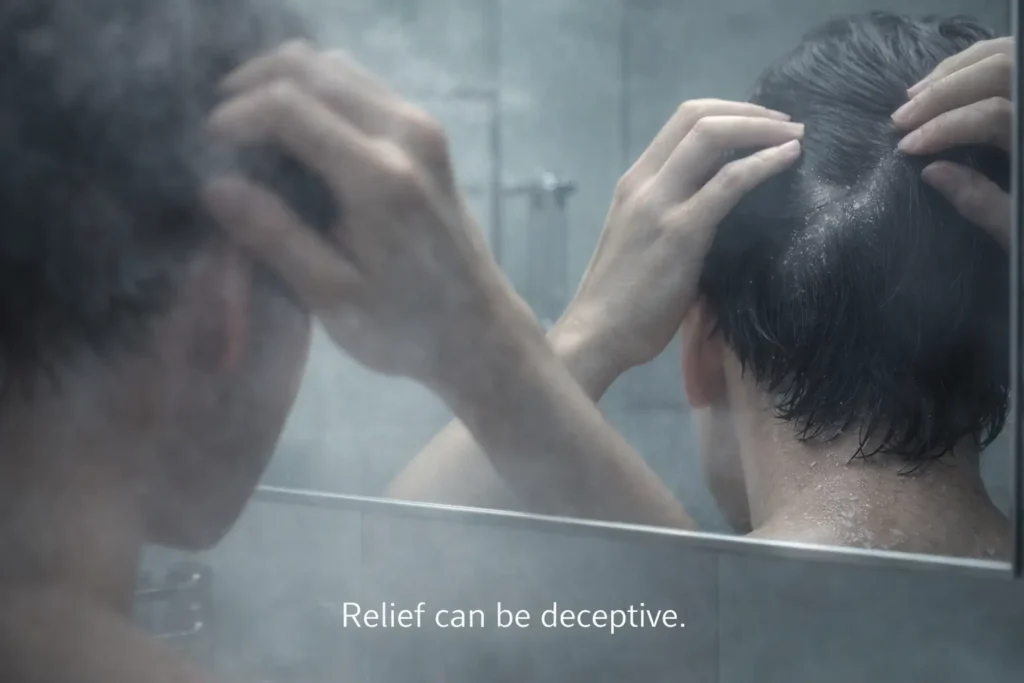
You step out of the shower and everything looks clear. The itch is gone. Your shoulders feel safe again. For a moment, it feels like you’ve finally won.
But you’ve lived this pattern before. You know how your scalp calm after washing then flakes return on cue about 48 hours later. Therefore that clean, quiet window never feels secure.
So the shower wasn’t a cure. It was a pause. A brief truce before the same biological tide moves back in.
The Science of Relief: Why Your Scalp Feels Calm After Washing Then Flakes Return
Washing creates relief through subtraction. Surfactants dissolve surface lipids. Loose flakes detach. Irritant residues dilute. Consequently, surface yeast density falls.
Inflammation signals drop. Nerve irritation quiets. Therefore itch perception decreases. The scalp feels neutral again.
However, this calm is superficial. Cleansing removes exposed material. It does not remove follicular reservoirs. Organisms remain embedded below the lipid film.
Therefore relief reflects trigger removal, not cause removal. Biological drivers persist. The relapse clock begins once rinsing ends.
This distinction matters. Mechanical clearance gives short comfort. Ecological change gives lasting control. Most routines achieve the first, not the second.
The 24-Hour Pivot: Why Oil Returns Before Flakes
After washing, the scalp enters a brief low-lipid state. Surface sebum is reduced. Barrier lipids thin. Meanwhile microbial activity pauses.
Sebaceous glands respond quickly. Lipid replenishment begins within hours. Consequently, detectable oil returns between 12 and 24 hours.
Over-stripped scalps often overshoot baseline. Output temporarily exceeds pre-wash levels. Therefore rebound creates a short lipid surplus window.
Fresh sebum oxidizes in air. Lipids fragment. Free fatty acids rise. These fractions irritate weakened barriers more easily.
Simultaneously, residual Malassezia exploit renewed lipids. Follicular reservoirs reseed the surface. Yeast density begins expansion.
Thus relapse begins biologically while the scalp still feels clean. Symptoms lag behind growth. This rebound dynamic explains why harsh shampoos create the rebound cycle — the science of stripping.
The Biological Explosion: When Scalp Calm After Washing Then Flakes Return
By roughly 36–48 hours, microbial density nears symptomatic thresholds. Biofilm structures reform across lipid zones. Adhesion strengthens. Persistence increases.
Metabolic byproducts accumulate. Oleic acid fractions rise. Consequently barrier disruption deepens. Corneocyte cohesion weakens.
Inflammatory signaling amplifies. Turnover accelerates. Shedding becomes visible. Therefore flakes suddenly appear.
Importantly, this is not sudden onset. It is delayed visibility. Expansion occurred earlier during rebound. The 48-hour mark reflects threshold crossing.
This structural rebound is the same mechanism detailed in the biofilm rebound. It also explains why scalp calm after washing then flakes return with consistent timing.
Dismantling the Trap: How to Maintain the Calm Beyond Wash Day
Breaking the cycle requires shifting from removal to regulation. The target is not zero yeast. Instead, the target is stable ecology.
First, reduce lipid volatility. Avoid repeated stripping cleansers. Preserve partial barrier lipids. Consequently rebound amplitude drops.
Second, disrupt reservoirs periodically. Keratolytic phases loosen matrix. Biofilm adherence weakens. Therefore reseeding slows.
Third, stabilize pH and microbiome balance. Mild acidity supports barrier enzymes. Microbial composition steadies. Volatility decreases.
Fourth, rotate antifungal pressure when needed. Alternating actives prevents protected persistence. Density remains sub-threshold without chronic stripping.
Together, these shifts convert transient calm into sustained stability. This transition is outlined in how to finally escape the “only works while I use it” trap.
Beyond the Cycle: Ending the Scalp Calm After Washing Then Flakes Return Loop
The shower is not a reset. Instead, it is a subtraction event. Relief occurs because triggers are removed faster than they regenerate.
Regeneration then follows biology. Lipids return. Microbes expand. Irritation thresholds reappear. Consequently symptoms follow.
Once environment stabilizes, timing changes. Lipid rebounds flatten. Reservoirs shrink. Expansion slows. Therefore relapse intervals widen.
You move from oscillation to regulation. From wash-dependent relief to baseline control. Calm persists between cleanses rather than ending at them.
The full stabilization sequence appears in how to go from 24-hour relief to 30-day clear scalp (exact sequence). The broader recurrence system is explained in the $20 billion dandruff cycle Big Shampoo doesn’t want you to escape.