
The Plateau of Despair: When Your Scalp Biofilm Dandruff Treatment Stops Working
You found a shampoo that finally seemed to work. For three weeks, your scalp was calm. Flakes disappeared, and itch felt like a distant memory. Relief felt real, almost permanent.
Then, without warning, it wasn’t. The flakes returned. The itch came back. Your routine hadn’t changed. Somehow, your dandruff treatment stopped working, leaving you frustrated and questioning what went wrong.
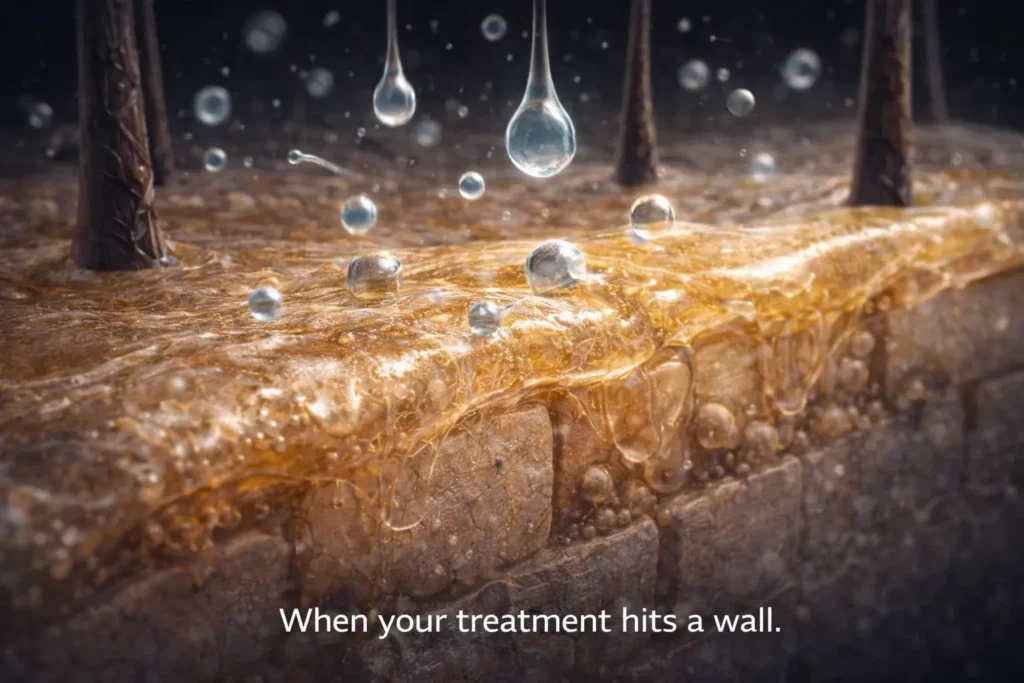
This isn’t a flaw in your scalp. It’s not that your hair “resisted” the medicine. Rather, it’s the moment when a microscopic biofilm shields the fungus, blocking the treatment from reaching the root cause. What feels like failure is actually a predictable biological rebound.
Recognizing this plateau is the first step to breaking the cycle. This is part of the hidden 48-hour dandruff cycle no one talks about, where short-term relief ends as soon as the biofilm regains control.
Understanding Why Your Scalp Biofilm Dandruff Treatment Stops Working
The scalp is not just skin. It’s a microscopic city, and Malassezia has an architecture all its own. The fungus secretes an extracellular matrix, a sticky slime that binds dead skin, oil, and minerals into a dense layer.
This matrix is more than glue. It forms a living, self-reinforcing microbial community, a shield that protects the fungus from external attacks. Medicinal actives like ketoconazole or zinc pyrithione cannot penetrate effectively. The biofilm acts as armor.
This shield is exactly why harsh shampoos create the rebound cycle – the science of stripping, as stripping can temporarily remove the outer layer but rarely dismantles the entire biofilm.
The Blockade: Why Actives Can’t Reach Your Scalp
Even the strongest antifungal only works where it lands. The biofilm creates a physical barrier, preventing the active molecules from reaching the skin underneath.
Ketoconazole sits on the “roof” of the fortress. Zinc pyrithione cannot reach the base. This is why scalp biofilm dandruff treatments stop working, despite perfect compliance.
This biological armor protects the chronic scalp inflammation that never fully resets, making each wash a temporary reprieve rather than a cure.
The 48-Hour Re-Colonization Window
Once the biofilm is in place, the fungus waits patiently. Minutes after rinsing, the surface begins to repopulate. Within 48 hours, the familiar flakes and inflammation return.
This microscopic relapse follows a predictable clock. Fungal repopulation aligns perfectly with the inflammatory rebound, making your scalp feel like it’s failing again.
You will recognize this as the same inflammation you see returning in 48 hours, a hallmark of the chronic relapse cycle that traps so many users.
Breaking the Fortress: The Biofilm Dissolution Protocol
Temporary stripping won’t dismantle the fortress. The solution lies in targeted biofilm disruptors. These include specific acids or chelating agents that break down the extracellular matrix, allowing the antifungal to reach its target.
Pairing these agents with pH-balanced recovery products ensures the scalp barrier isn’t compromised further. This method clears the shield before applying treatment, stopping the cycle before it starts.
This is the missing recovery step that ends the biofilm cycle, converting temporary relief into lasting control.
Your Exit Plan for When Scalp Biofilm Dandruff Treatment Stops Working
Stop chasing stronger chemicals. Start dismantling the shield. Focus on restoring the scalp environment, breaking the biofilm, and supporting the microbiome.
By following a structured protocol, you move from treatment dependency to long-term control. Relief becomes consistent. Flakes slow, then stop. Inflammation fades.
Finally, learn how to go from 24-hour relief to 30-day clear scalp (exact sequence) and understand the $20 billion dandruff cycle Big Shampoo doesn’t want you to escape.
Your scalp’s fortress can be dismantled. And when it is, freedom from chronic dandruff isn’t just possible—it’s sustainable.