
Chronic Scalp Inflammation – Why Symptoms Keep Returning
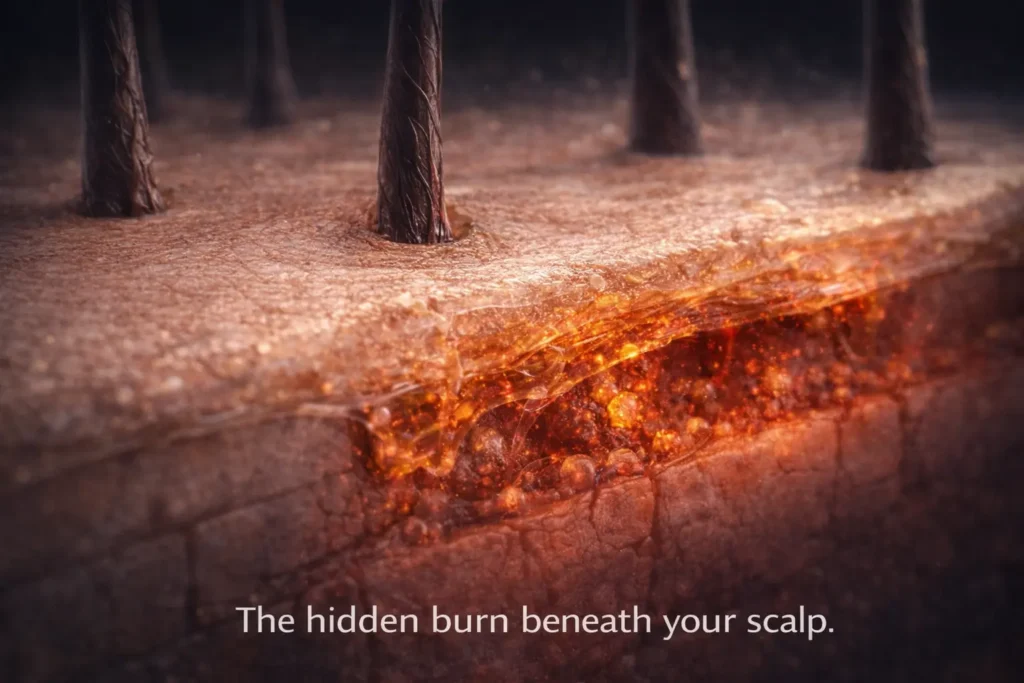
The Invisible Fire: When Scalp Inflammation Never Resolves
You’ve cleared the flakes. Your scalp even feels clean. Yet the tightness lingers. That subtle burning or tugging sensation isn’t minor. In fact, it drives the relapse.
This is the chronic scalp inflammation that never fully resets. If you feel like your scalp inflammation never resolves, you’re witnessing a biological feedback loop. Ordinary shampoos and treatments fail to address it. They focus on flakes, not the underlying immune triggers.
Even after treatment, dormant micro-inflammation persists. These hidden signals irritate nerve endings and fuel sebum overproduction. Consequently, the flakes and itch return on a predictable 48-hour cycle.
This persistent fire is the foundation of why dandruff keeps coming back in 48 hours. Understanding this mechanism is the first step toward interrupting the loop.
The Industry Mistake: Treating Dandruff as Surface Dirt
Big Shampoo frames dandruff as a surface hygiene issue. Yet cytokine responses inside your scalp tell a different story. Immune signals react to fungal metabolites. Inflammation persists, even when flakes are gone.
Harsh surfactants remove oil and temporarily mask irritation. However, the root cause remains. Over time, repeated stripping worsens barrier damage. The scalp becomes hyper-reactive, signaling more oil production. Consequently, post-treatment flare-ups are inevitable.
This misunderstanding fuels the $20 billion dandruff cycle Big Shampoo doesn’t want you to escape. The more you wash, the more the scalp signals relapse. Consumers chase relief while the underlying inflammation remains protected.
Even experienced users are caught in this cycle. They believe treatments fail due to “resistance.” In reality, the immune system and dormant inflammatory triggers govern the return of flakes. Recognizing this is critical before attempting long-term solutions.
How Biofilm Shields Hidden Scalp Irritation
Beneath visible flakes lies a hidden defense: the scalp biofilm. This extracellular matrix binds dead skin, oils, and fungal colonies. It acts like a microscopic shield. Consequently, treatments often fail to penetrate the deeper layers.
This protective matrix allows fungal survival even when medicated shampoos are used correctly. The result is a persistent inflammatory state. Barrier failure compounds the problem. Oils spike. Nerves fire. Symptoms reappear.
For example, ketoconazole or zinc pyrithione can reduce surface colonies but rarely dismantle the biofilm entirely. This is why your dandruff treatment suddenly stops working after a few weeks. The biofilm preserves both fungus and the chronic inflammation underneath.
Understanding this structural protection changes your approach. Surface cleaning alone will never break the loop. Instead, the focus must shift to strategies that destabilize the biofilm while calming inflammation.
The Rebound Spike: When Scalp Inflammation Never Resolves After Washing
Even when the scalp feels clean, a hidden storm is brewing. Harsh surfactants strip lipids and acids that stabilize the barrier. Initially, this creates a “numbing” effect. The scalp feels soothed.
Within hours, however, compensatory hyper-seborrhea begins. Oil production surges. The lipids oxidize, creating the perfect fuel for Malassezia. Inflammatory signals spike. Consequently, flakes and itch return faster and more intensely.
This post-wash relapse is predictable. In fact, it aligns with the 48-hour microbial clock observed in chronic dandruff cycles. Understanding the oil rebound after dandruff shampoo explains why the flare-up is almost guaranteed.
Repeated stripping worsens the cycle. The barrier never recovers. Nerve endings remain hyper-sensitive. In short, the scalp inflammation never resolves because the biofilm and sebum dynamics reinforce one another.
Breaking the Burn: Strategies if Scalp Inflammation Never Resolves
Escaping this cycle requires a different approach. Instead of relying on stronger antifungals, shift to anti-inflammatory scalp care. Look for pH-balanced cleansers and soothing botanicals. They calm the immune response without stripping lipids.
Next, restore the scalp microbiome health. Rotate gentle actives to prevent fungal refuges from forming. The goal is stabilization, not elimination. When the barrier is rebuilt, the inflammatory triggers reduce. Flare-ups become less severe.
A restorative protocol combines targeted biofilm disruptors with calming treatments. This dual approach addresses both fungal protection and the chronic inflammatory signals beneath. Gradually, the scalp learns to maintain balance.
You can see this strategy in action in how to go from 24-hour relief to 30-day clear scalp (exact sequence). The process moves beyond temporary numbing and addresses the source of persistent inflammation.
Ending the Cycle: Steps Toward Lasting Scalp Calm
Chronic scalp inflammation is not a hygiene problem. It is a biological signal. Barrier damage, microbial biofilms, and immune triggers work together to keep symptoms alive.
The solution is to stop chasing flakes with harsher chemicals. Instead, cool the scalp and rebuild its resilience. Stabilize lipids. Disrupt biofilms gently. Calm the immune response.
When implemented correctly, flare-ups diminish. Relief lasts beyond a single wash. Ultimately, you break free from the $20 billion dandruff cycle Big Shampoo doesn’t want you to escape. Control replaces suppression. Calm replaces chaos.