
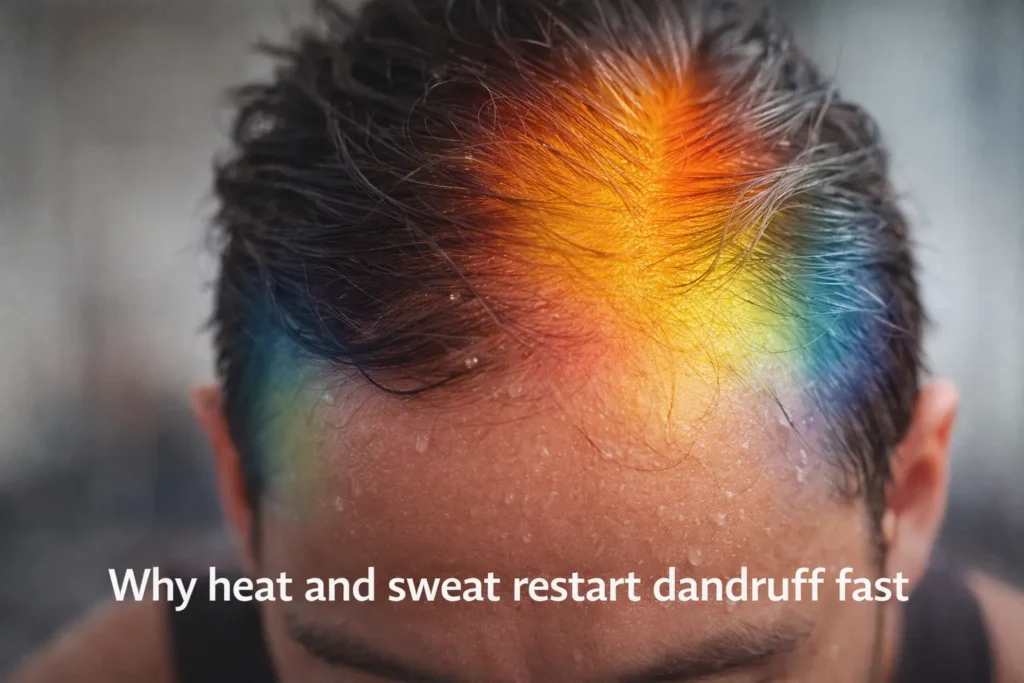
Why Dandruff Comes Back After Every Workout or Stressful Day
The Reward for Your Hard Work
You finish your workout. Or you close the laptop after a long, tense day. Your body feels spent. Yet your scalp feels hot, tight, and suddenly itchy.
This flare feels unfair. You did something healthy. Still, your scalp reacts.
In reality, this reaction rarely reflects hygiene. Instead, it reflects biology. Heat, sweat, and hormonal shifts act as dandruff workout stress triggers, accelerating the same relapse clock that drives recurring flakes. As a result, irritation rises faster than expected.
The 48-Hour Dandruff Cycle: Why Antifungals Often Fail You. This is why flares often appear within hours of heat or stress exposure. The pattern mirrors why dandruff keeps coming back in 48 hours, only sped up by physiology. Sweat, temperature, and hormones shift the scalp environment at once.
So the flare is not random. It is triggered timing.
The Sweat Accelerator: How Heat Feeds the Cycle
Exercise changes the scalp climate immediately. Temperature rises. Sweat accumulates. Evaporation slows under hair density. Consequently, a warm, humid layer forms across the scalp surface.
This microclimate softens the outer barrier. Corneocytes swell. Lipid cohesion loosens. Meanwhile, salt from sweat irritates exposed nerve endings. The scalp begins to sting before flakes even appear.
Fungal activity responds quickly to this shift. Malassezia thrives in heat and lipid-rich moisture. Therefore expansion begins during the post-exercise window, not hours later.
Notice the sensation sequence. First warmth. Then itch. Then tightness. This progression matches the same phase seen when the scalp calm after washing then explodes stage begins. Only here, heat replaces surfactant stripping as the trigger.
Sweat also interacts with sebum. It spreads oil across follicles and oxidizes surface lipids. That process mirrors the rebound described in oil-rebound after dandruff shampoo, where fresh lipids feed microbial growth.
So sweat does not just irritate. It prepares fuel.
Managing Biological Dandruff Workout Stress Triggers
Stress affects the scalp as directly as sweat. The pathway runs through cortisol.
During psychological strain, cortisol rises systemically. Skin immunity drops. Lipid synthesis slows. Barrier repair weakens. Consequently, the scalp becomes more reactive even without visible flakes.
This shift explains why flares follow deadlines, conflict, or poor sleep. The scalp enters a vulnerable window. Triggers that were previously tolerated now provoke inflammation.
Cortisol also alters sebaceous activity. Oil output increases yet composition shifts. Free fatty acid ratios change. That altered lipid mix irritates faster once metabolized by microbes.
You experience this as delayed itch after stress. Often the scalp feels normal during the event. Symptoms emerge the next day. This delay aligns with the 48-hour itch after stress pattern, where hormonal shifts precede visible dandruff.
So stress does not create fungus. It lowers defense.
Why Traditional Cleaning Often Fails the Flare
Most people react predictably to a flare. They wash harder. They scrub longer. They reach for stronger shampoo.
This response feels logical. However it restarts the same stripping cycle that caused relapse initially. Surfactants remove sweat and oil, yet they also dissolve residual barrier lipids. As a result, post-wash dryness rises while sebum rebound accelerates.
The scalp then overcompensates. Oil output spikes. Oxidation increases. Microbial metabolism intensifies. Within a day, irritation returns stronger than before.
Seasonal stress magnifies this loop. Cold air already reduces lipid fluidity. Therefore winter dryness weakens the barrier baseline. Add sweat or stress, and the scalp crosses its tolerance threshold faster. This interaction mirrors how winter dryness compounds barrier damage, amplifying relapse risk.
So aggressive cleansing treats the symptom. It worsens the trigger.
Breaking the Pattern: The Post-Flare Protocol
A flare requires neutralizing conditions, not stripping them. The goal is to restore equilibrium before microbial expansion peaks.
First, cool the scalp quickly after heat exposure. A lukewarm rinse lowers surface temperature and salt concentration. This interrupts the sweat-driven microclimate.
Second, rebalance pH. Mild acidic rinses compress corneocyte swelling and tighten lipid packing. Consequently barrier cohesion improves within minutes.
Third, restore moisture without occlusion. Lightweight humectant layers reduce nerve irritation while avoiding excess lipid fuel.
These steps shift the scalp out of the relapse window. They prevent the cascade that normally follows sweat or stress triggers. Without intervention, the cycle continues. This is why the loop persists without targeted intervention after each trigger event.
Consistency matters more than intensity. Small corrections immediately after exposure prevent delayed flares.
Reclaiming Your Active Lifestyle
Workouts and stress do not cause dandruff. They accelerate existing biology. Heat softens the barrier. Sweat spreads lipids. Cortisol lowers defense. Together, these forces compress the relapse timeline.
Understanding dandruff workout stress triggers changes the response. Instead of scrubbing harder, you stabilize faster. Instead of reacting late, you intervene early.
Then exercise stops predicting flares. Stress stops dictating scalp comfort. The cycle weakens because the environment stabilizes before microbes expand.
You remain active. Your scalp remains calm.
If you want the full sequence, see how to go from 24-hour relief to 30-day clear scalp (exact sequence) and understand the $20 billion dandruff cycle Big Shampoo doesn’t want you to escape.
Your triggers are manageable once you stop feeding the clock.