
The “Treatment Resistant” Scalp Myth – It’s Actually a Cycle Design
The Label That Makes You Think Your Scalp Is Broken
You’ve tried prescription washes. Rotated actives. Followed instructions exactly. Still, the flakes return. At some point, you were told or assumed you have a treatment resistant dandruff scalp.
That label feels clinical. Final. Almost genetic.
But here’s the shift: that conclusion isn’t based on scalp biology. It’s based on repeat relapse inside a predictable treatment loop. What looks like resistance is usually rebound.
In practice, many people aren’t failing treatment. They’re stuck inside a fast version of the same 48-hour dandruff cycle that standard care unintentionally maintains. The cycle creates the illusion that your scalp is unresponsive, when it’s actually reacting.
So before you accept the idea that your scalp is defective, it helps to see how this pattern forms—and why it keeps repeating.
Why “Treatment Resistant” Often Points to a System Design Flaw
If most users relapse, the user isn’t the anomaly.
Clinical observations and consumer data consistently show that dandruff control drops quickly once antifungal use stops. Many return to baseline within days. Some rebound worse than before.
That pattern matters. When roughly three out of four people experience relapse, the model itself deserves scrutiny.
This is why the idea of a treatment resistant dandruff scalp deserves reframing. In many cases, the scalp isn’t resisting treatment; it’s reacting to an approach built on short-term suppression. Strip yeast. Suppress oil. Pause. Rebound. Repeat.
The outcome looks like stubborn pathology. In reality, it’s dependency architecture.
You can see the same dynamic in relapse curves discussed in the 75% dandruff return data. The failure pattern clusters around withdrawal phases, not during active suppression. That distinction changes where you place blame—and where you apply solutions.
When Treatments “Stop Working”: The Biofilm Barrier Problem
Another reason dandruff can appear resistant is simple physics.
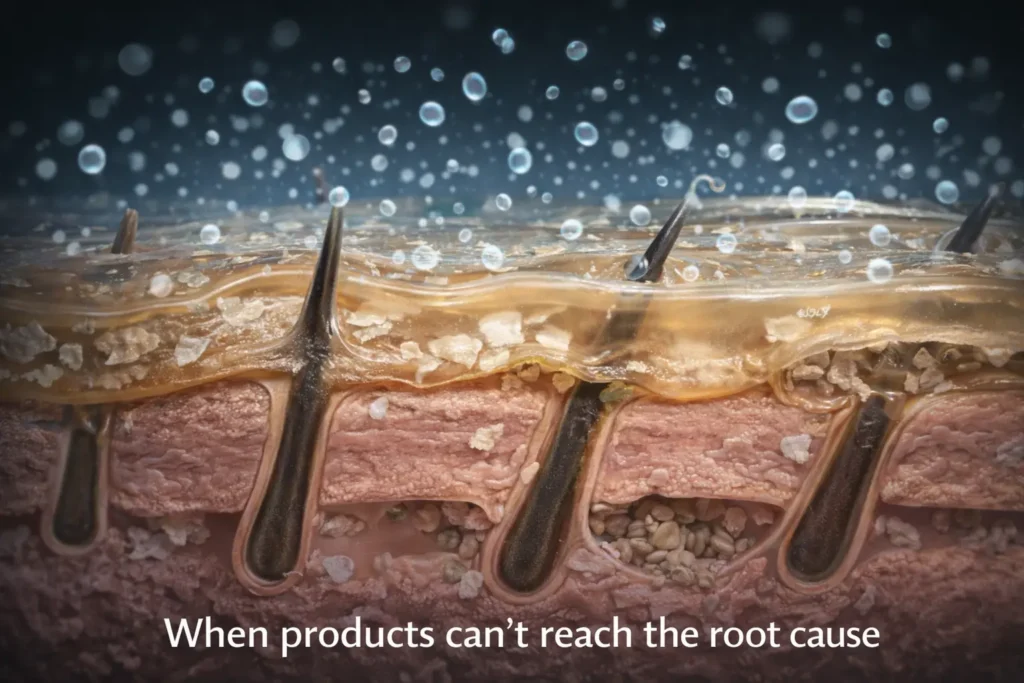
On many chronically flaky scalps, yeast and bacteria live inside a structured film composed of oil residues, shed keratin, and microbial polymers. This layer behaves like a shield. It reduces penetration of antifungal agents applied briefly during washing.
So the product reaches the surface—but not the organism.
This is often misread as microbial resistance. In reality, it’s delivery failure. The active ingredient never reaches sufficient contact depth or duration to disrupt the colony.
That’s why dandruff treatment can work initially, then fade after weeks. The scalp environment reorganizes. The film thickens. Contact drops. Efficacy appears to vanish.
Patients then escalate: stronger actives, more frequent use, harsher surfactants. Each escalation increases barrier disruption and oil rebound, which feeds the same microbial habitat the treatment aimed to suppress.
The pattern again mimics a treatment resistant dandruff scalp. Mechanistically, it’s penetration failure inside an unstable surface environment.
Real Success Stories with a Treatment-Resistant Dandruff Scalp
Many people labeled “resistant” weren’t failing treatment. Their scalp environment kept resetting the problem. When routines shifted from killing fungus to managing oil, pH, and barrier health, remission followed. These dandruff success stories show the pattern.
Case 1: Chronic flaking despite medicated rotation
Before: Weekly antifungal plus frequent clarifying washes. Flakes cleared briefly, then rebounded within days. Tightness and itch persisted.
Change: Switched to non-stripping cleansers, reduced surfactant frequency, added post-wash hydration. Antifungal kept but spaced.
After: Oil rebound dropped within two weeks. Flake cycles lengthened, then stabilized. By week six, shedding normalized. Barrier comfort returned.
Takeaway: Healing the barrier reduced the relapse trigger more than stronger actives.
Case 2: Oily scalp with post-workout flares
Before: Daily shampoo after exercise. Scalp felt clean but greasy by evening. Visible flakes along hairline.
Change: Alternated gentle rinse days with pH-balanced cleansing. Added quick post-workout rinse to remove sweat–sebum film. Light scalp hydration at night.
After: Midday oil surge eased. Flares after workouts stopped. Scalp stayed calm between washes.
Takeaway: Managing the microclimate prevented the rebound loop.
Case 3: “Nothing works” after years of treatment
Before: Long history of medicated products and exfoliating tonics. Redness and sensitivity increased. Flakes constant.
Change: Two-week reset: barrier repair only, no actives. Then gradual re-introduction of mild antifungal within a rebalancing routine.
After: Redness resolved first. Flakes reduced as turnover slowed. By month two, maintenance with low-frequency actives held remission.
Takeaway: What looked like resistance was irritation-driven shedding.
Across cases, before-and-after scalp care shifted the outcome. Once lipid balance and pH stabilized, fungal load became manageable without escalation. Many found that harsh shampoos create the rebound cycle which looks like resistance but is actually just irritation.
Transitioning to the Solution: Ending the Label
“Resistant” sounds clinical. In practice, it often describes a scalp stuck in irritation and rebound. The label shifts attention toward stronger actives. Meanwhile, the barrier remains disrupted. Lasting change starts by discarding the label and treating the environment that drives relapse.
Why the resistance label misleads
When cleansing strips lipids and raises pH, the barrier weakens and turnover accelerates. Flakes persist, so treatment intensity increases. However, escalation compounds irritation and sebum rebound. The pattern looks like drug failure. In reality, it’s barrier injury with secondary overgrowth.
Reframe the target: barrier and microbiome
Scalp barrier repair stabilizes hydration gradients and lipid structure. As cohesion returns, shedding slows. At the same time, gentle pH control supports a microbiome reset without force. Fungal load declines because the habitat normalizes, not because actives intensify.
What long-term flake control requires
Sustainable control comes from rebalancing cycles: non-stripping cleansing, spaced actives, and post-wash barrier support. Over weeks, oil output recalibrates and inflammation drops. Consequently, maintenance replaces escalation. The scalp stops behaving “resistant.”
Learn how to finally escape the “only works while I use it” trap.
Beyond the Treatment-Resistant Dandruff Scalp Label
Your scalp is not defective. It’s reactive. Years of stripping and rebound can make flaking look permanent. Yet the biology points the other way. When lipid loss slows, pH stabilizes, and hydration returns, turnover normalizes. The same scalp that seemed “resistant” begins to repair.
Throughout this guide, you’ve seen the drivers: degreasing that triggers oil surge, sweat–sebum films that trap heat, and irritation that accelerates shedding. Once those loops break, fungal load becomes manageable. Inflammation drops. Flakes space out, then settle. Healing follows the environment.
If you want the full path, start with how to go from 24-hour relief to 30-day clear scalp (exact sequence) (see Post 17). Then understand the system behind relapse in the $20 billion dandruff cycle Big Shampoo doesn’t want you to escape (see Post 18).
The label ends here. Your scalp’s future responds to what you change next.