
Why Symptoms Return Worse in Winter or Dry Weather: The Seasonal Rebound
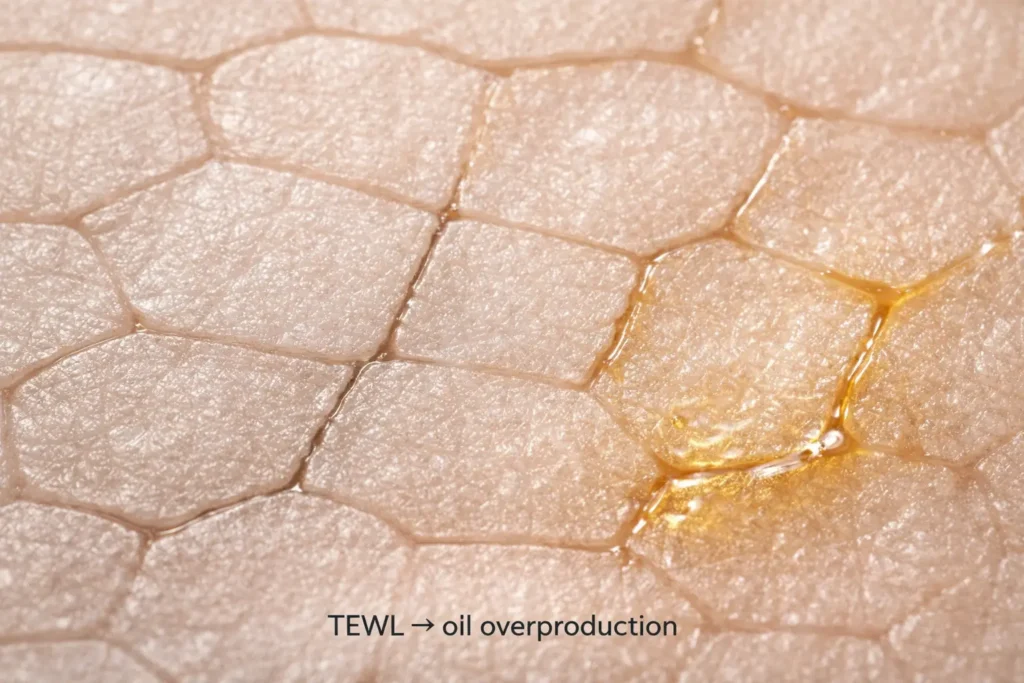
The “Dry Skin” Mirage
You blame wool hats. You blame low humidity. You assume your scalp is simply dry, so you layer oils and heavy creams. Yet the itch intensifies, and flakes shift from light to greasy yellow.
This pattern feels contradictory. Dry air should cause dry flakes. Instead, inflammation rises and oiliness increases.
The reality is more complex. When you notice your dandruff worse in winter, you aren’t dealing with simple dryness. You’re seeing a large-scale barrier disruption that accelerates fungal turnover. The scalp loses water rapidly, overproduces oil to compensate, and feeds Malassezia at the same time.
In other words, winter isn’t just a dry season. It’s the seasonal expression of the hidden 48-hour dandruff cycle, where barrier loss triggers oil rebound and fungal expansion in rapid sequence.
The Humidity Trap: Why Dandruff Worse in Winter Starts with TEWL
Cold air holds less moisture. As temperatures drop, environmental humidity falls sharply. This shift drives transepidermal water loss (TEWL)—the passive evaporation of water from the scalp surface.
When TEWL rises, the outer barrier shrinks and cracks. Lipid layers thin. Corneocytes separate. Microscopic gaps appear across the scalp.
These changes matter because the barrier normally regulates both hydration and microbial balance. Once disrupted, the scalp becomes permeable and reactive. Irritants penetrate faster, and inflammation thresholds fall.
This is why your dandruff worse in winter often begins before flakes appear. The process starts with invisible dehydration and structural weakening.
Barrier cracks also change cleansing response. In summer, stripping shampoos already provoke oil rebound. In winter, the same surfactants act on an already-damaged surface. Oil compensation accelerates faster and harder.
That’s why harsh shampoos create the rebound cycle even more aggressively in cold months.
So the first winter trigger isn’t fungus. It’s water loss.
Indoor Heat & the Sebum Spike: Compounding Why Dandruff Worse in Winter
Winter rarely exposes your scalp to steady conditions. Instead, you move between freezing outdoor air and heated indoor spaces. This repeated thermal swing creates physiological shock at the skin surface.
Cold thickens sebum. Heat liquefies it. Each transition alters viscosity and flow. As sebum softens, it spreads across the scalp and down follicular openings.
This matters because Malassezia doesn’t just sit on the surface. It thrives in lipid-rich follicular zones. Liquified sebum allows deeper penetration and faster colonization.
So when your dandruff worse in winter, part of the cause is thermal cycling—not just dryness. Indoor heat effectively mobilizes oil reserves and redistributes them into fungal growth zones.
This indoor heat–driven oil surge mirrors the oil rebound after dandruff shampoo loop (Post 10). Both processes increase lipid availability and accelerate fungal metabolism.
Add sweat from hats or heated rooms, and the scalp microclimate becomes warm, moist, and occluded. Under these conditions, fungal growth rates rise sharply.
Winter therefore amplifies oil and fungus simultaneously.
The Winter Cleansing Error: Fuelling the Dandruff Worse in Winter Loop
Behavior shifts in winter compound biology. Showers become hotter and longer. Washing frequency often increases to counter perceived dryness or oiliness.
Hot water dissolves surface lipids quickly. It also disrupts the acid mantle—the pH-regulated film that stabilizes microbial balance.
Once stripped, the scalp enters emergency repair mode. Sebaceous glands increase output to restore waterproofing. This compensatory oil production occurs within hours.
So while winter feels dry, cleansing response drives oil rebound. This paradox explains why flakes often become greasier in cold months.
The pattern becomes clear:
- Cold air → barrier dehydration
- Hot washing → lipid stripping
- Sebum rebound → oil surge
- Malassezia feeding → flare
This stripped environment also accelerates biofilm formation. Within 48 hours, fungal colonies build protective matrices that reduce treatment penetration (Post 6).
That’s why antifungal shampoos often seem to “stop working” faster in winter. The barrier fails sooner, oil rises faster, and biofilm shields develop earlier.
So the winter cleansing mistake isn’t over-washing alone. It’s stripping an already compromised surface.
Breaking the Seasonal Flare: Strategies for When Dandruff Gets Worse in Winter
Cold air, indoor heating, and hot showers shift scalp physiology in winter. Barrier lipids deplete faster. Water loss rises. Irritation thresholds drop. The result: tighter skin, faster flake turnover, and rebound oil signaling.
Your goal in winter changes. You move from oil removal to barrier stabilization.
The Winter Rotation Protocol targets three drivers behind winter dandruff flares: hydration retention, lipid balance, and inflammatory load.
1. Lower thermal stress
Heat dissolves surface lipids and accelerates water loss. Hot showers amplify dryness and trigger rebound sebum output.
- Wash with lukewarm water
- Shorten wash time
- Avoid steam exposure on the scalp
You reduce lipid stripping at the source.
2. Maintain pH balance
Cold stress and harsh cleansing raise scalp pH. A higher pH disrupts the acid mantle, shifts microbiome behavior, and increases irritation signaling.
- Use pH-balanced cleansers
- Avoid alkaline or clarifying formulas in winter
- Keep cleansing gentle and brief
Stable pH supports microbial balance and lowers oil rebound.
3. Restore hydration gradients
Winter air increases transepidermal water loss (TEWL). Corneocytes lose cohesion. Flakes release faster.
- Apply lightweight humectant hydration post-wash
- Focus on the scalp surface, not hair lengths
- Seal with minimal occlusion if needed
Hydration retention stabilizes the barrier and slows shedding.
4. Reduce surfactant frequency
Frequent cleansing in winter compounds lipid loss and irritation. The scalp compensates with excess oil and faster turnover.
- Alternate wash days with water-only or gentle rinse days
- Space out active shampoos
- Use minimal product per wash
Lower surfactant load reduces compensatory sebum activation.
5. Add anti-inflammatory cool-downs
Inflamed skin sheds faster and itches more. Cooling phases after washing quiet cytokine activity and support recovery.
- Use soothing scalp phases post-wash
- Choose calming, non-sensitizing actives
- Allow time for absorption before styling
When inflammation drops, barrier repair accelerates.
These steps interrupt the seasonal rebound loop that makes dandruff worse in winter. Many people see flakes ease once hydration stabilizes—often before antifungal intensity increases. Fungal expansion slows when lipid and barrier signals normalize.
You can see the full winter escape sequence in Post 15.
Winter Biology: Why Dry Air Creates Greasy Flakes
At first glance, winter dandruff seems paradoxical. Dry climate should reduce oiliness. Yet clinical observation shows the opposite: flakes often become thicker and more yellow.
This occurs because barrier damage and oil rebound are linked responses.
When hydration drops, sebaceous glands increase output to prevent fissuring. The scalp prioritizes waterproofing over dryness.
So the sequence becomes: dehydration → oil compensation → fungal feeding.
This is why winter flakes often look greasy despite low humidity. Oil production isn’t responding to environment alone. It’s responding to barrier distress.
Once Malassezia metabolizes this oil, irritant by-products like oleic acid rise. Inflammation increases. Flakes clump and adhere.
So visually, flakes shift from dry white to waxy yellow.
That shift is a marker of barrier-driven oil rebound—not simple dryness.
Why Oils and Heavy Creams Often Backfire in Winter
Many winter routines add plant oils or occlusive creams to counter dryness. While logical, this often worsens dandruff.
External oils add lipid fuel without repairing barrier structure. Malassezia readily metabolizes these triglycerides.
So instead of reducing flakes, oil layering increases fungal resources.
Occlusive creams create another issue. They trap heat and moisture at the scalp surface, producing a microclimate similar to sweat occlusion.
This environment accelerates fungal growth and inflammation.
So the winter instinct to “moisturize heavily” can intensify symptoms when dandruff worse in winter.
Barrier repair requires hydration balance and lipid normalization—not surface oil loading.
Seasonal Timing: Why Winter Relapses Feel Sudden
Many people report that dandruff seems stable until late autumn, then worsens rapidly. This timing reflects cumulative barrier decline.
Early cold exposure increases TEWL gradually. Indoor heating then adds thermal cycling. Washing behavior shifts. Oil rebound intensifies.
Once the barrier crosses a disruption threshold, fungal expansion accelerates quickly.
So the flare feels sudden. But biologically, it’s the endpoint of weeks of progressive destabilization.
Understanding this timing reframes winter relapse from random to predictable.
The Barrier-First Model of Winter Dandruff Control
Traditional dandruff care focuses on antifungal suppression. While useful, winter flares often persist despite treatment.
That’s because antifungal action doesn’t repair barrier dysfunction.
A barrier-first model reverses priorities:
- Stabilize hydration
- Normalize lipids
- Reduce inflammation
- Then suppress fungus
This order matches winter biology. When the barrier stabilizes, oil rebound declines and fungal growth slows naturally.
So treatment effectiveness improves without increasing drug intensity.
Behavioral Triggers Unique to Winter
Several lifestyle shifts worsen winter scalp stability:
- Frequent hat wearing → occlusion and sweat
- Indoor heating → low humidity exposure
- Hot showers → lipid stripping
- Reduced UV exposure → slower antimicrobial activity
Each factor alone is modest. Combined, they reinforce the same rebound loop.
So winter dandruff reflects environment plus behavior plus biology—not dryness alone.
Reframing Winter: From Dryness to Barrier Management
Seeing winter dandruff as dryness leads to oil loading and over-washing. Both intensify rebound.
Seeing winter dandruff as barrier instability changes strategy. Hydration retention replaces degreasing. Cooling replaces stripping.
This shift is the key to preventing dandruff worse in winter patterns year after year.
Conclusion: Winter Does Not Have to Mean Flakes
Cold weather doesn’t inherently worsen dandruff. Barrier disruption does.
When you recognize winter as a season of hydration loss, thermal cycling, and oil rebound, the pattern becomes manageable.
A stable barrier reduces sebum spikes, limits fungal feeding, and slows the 48-hour relapse loop.
So winter control isn’t about stronger antifungals. It’s about restoring scalp equilibrium.
You can start the full seasonal reset with “how to go from 24-hour relief to 30-day clear scalp (exact sequence)” and see why the $20 billion dandruff cycle persists in “the $20 billion dandruff cycle Big Shampoo doesn’t want you to escape.”