
The 48-Hour Itch Cycle: From Calm to Scratching in Two Days
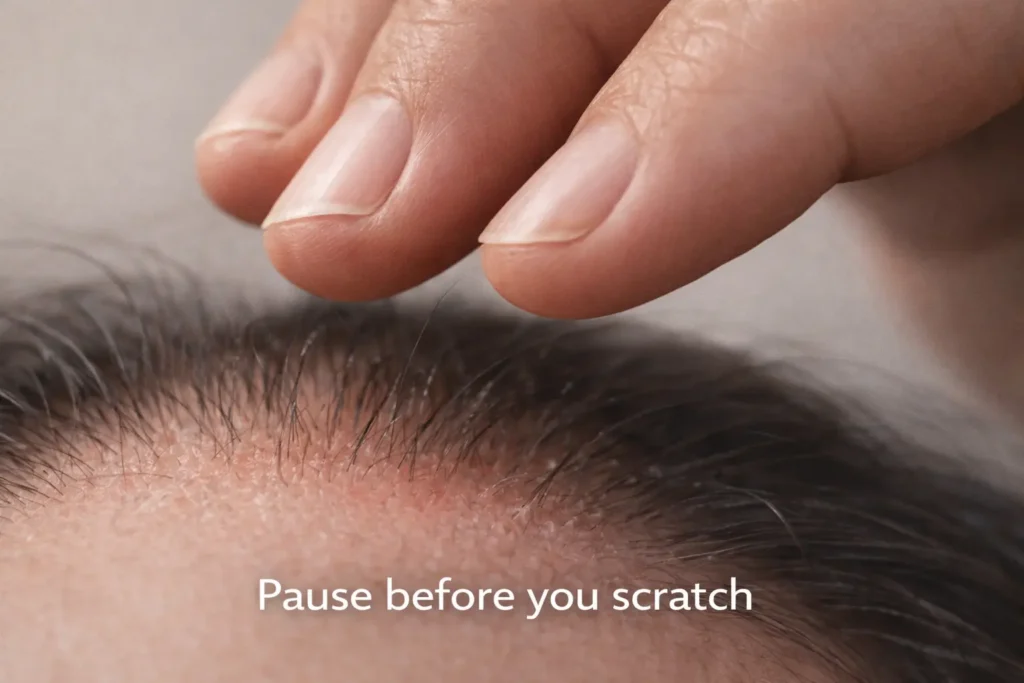
The Mirage of the Quiet Scalp
You step out of the shower feeling free. The burning fades. For a few hours, you forget your scalp exists.
Then the clock starts. Around hour 24, a faint tingle returns. Subtle at first. Easy to ignore. By hour 48, it escalates into the familiar urge—sharp, insistent, impossible to dismiss.
This pattern feels personal. It feels like you didn’t wash well enough or missed a spot. Yet the timing is too precise to be hygiene.
Persistent scalp itching is not caused by residue or dirt. Instead, underlying inflammation is quietly being rebuilt beneath the surface after washing.
So relief fades on schedule. The same 48-hour dandruff cycle reactivates, and sensation returns before visible flakes do.
In that sense, itch is the earliest alarm. It appears before scale, redness, or oil rebound. And it marks the exact moment the Invisible Fire begins rising again.
The Cytokine Surge: Why Scalp Itching Intensifies at 48 Hours
Inflammatory itch rarely appears instantly. It develops in phases.
Malassezia metabolizes scalp lipids continuously. During this process, it releases byproducts such as oleic acid. These molecules penetrate weakened barrier zones and interact with immune cells.
The immune system does not react immediately. Instead, it initiates a delayed-type hypersensitivity response. Cytokines accumulate gradually. Histamine pathways activate downstream.
This buildup typically peaks around 36–48 hours.
That timing explains why scalp itching intensifies two days after washing rather than right away. The inflammatory cascade needs time to reach sensory thresholds.
So the itch surge at 48 hours is not random. It reflects cytokine density reaching a neural activation point.
This is also why anti-dandruff shampoos can appear effective for a day, then suddenly fail. They reduce surface fungus temporarily, yet cytokine signaling continues rising underneath.
The sensation you feel is therefore delayed inflammation—not immediate contamination.
This is the same Invisible Fire described in the chronic scalp inflammation model .
The Itch-Scratch-Biofilm Loop: Managing Persistent Scalp Itching
Once itch begins, scratching follows almost reflexively.
Scratching disrupts the epidermal barrier. Even light friction creates micro-tears across already inflamed skin. These breaks leak serum and inflammatory mediators onto the surface.
That fluid changes the microbial environment. Serum contains proteins and lipids that nourish fungal communities. It also promotes adhesion, helping colonies anchor more firmly.
So scratching doesn’t just damage skin. It strengthens fungal residence.
Over repeated cycles, these micro-injuries help stabilize biofilm architecture—a protective matrix that shields microbes from cleansing and treatment.
This is why persistent scalp itching often becomes harder to resolve over time. Each scratch reinforces the physical environment sustaining inflammation.
The loop becomes self-reinforcing:
itch → scratch → barrier breach → microbial growth → inflammation → more itch
Within 48 hours, the cycle resets stronger than before.
Every scratch therefore accelerates biofilm formation .
External Accelerants: When Scalp Itching Reacts to Stress and Sweat
Internal inflammation sets the stage. External triggers amplify it.
Sweat is a major accelerant. It increases moisture, salt concentration, and surface pH. These changes soften the barrier and enhance irritant penetration.
At the same time, sweat creates a warm microclimate. Heat and humidity favor fungal metabolism.
So during exercise or hot environments, inflammatory signals rise faster.
Stress compounds this effect. Elevated cortisol alters immune regulation and lipid balance. Barrier repair slows. Sensory nerves become more reactive.
Under stress, the itch threshold drops.
That’s why scalp itching often spikes during workouts, emotional strain, or heat exposure. The cytokine baseline may be unchanged, yet neural sensitivity increases.
So the itch feels stronger even without more flakes.
This explains why dandruff returns after workout or stress faster than usual .
Why Washing Feels Like Relief but Isn’t Resolution
Washing interrupts several itch drivers at once. It removes sweat, surface lipids, and inflammatory residues. Temperature shifts also numb nerve endings briefly.
These effects create immediate comfort.
However, washing rarely restores barrier integrity. Surfactants strip protective lipids and raise TEWL. The scalp becomes temporarily cleaner but structurally weaker.
So after washing, inflammation decreases briefly, then rebounds faster.
This explains the paradox: washing relieves scalp itching instantly yet shortens the time until it returns.
The relief is sensory suppression, not inflammatory resolution.
Sensory Memory: Why the Itch Feels Familiar Before It Starts
Chronic itch alters neural processing. Over time, sensory nerves become sensitized.
Repeated inflammation lowers activation thresholds. Signals that once felt neutral begin registering as itch.
So you may feel scalp itching before visible irritation appears.
This anticipatory sensation reflects neural priming. The brain recognizes the pattern and amplifies perception earlier in the cycle.
Thus, itch can precede flakes by hours or days.
The Barrier Collapse Behind Recurring Scalp Itching
Barrier stability determines itch intensity.
Healthy scalp lipids prevent irritant penetration and regulate microbial balance. When lipids thin, permeability rises.
Oleic acid and inflammatory mediators then reach nerve endings more easily. Sensory firing increases.
So recurring scalp itching reflects barrier collapse more than fungal load alone.
This distinction matters. Killing fungus without restoring lipids leaves nerves exposed. Sensation returns quickly even if microbes decline.
Barrier repair therefore reduces itch sensitivity directly.
The Role of Oil Rebound in Itch Reactivation
After cleansing, sebaceous glands often increase output to restore surface protection.
This rebound oil is unstable and easily metabolized by Malassezia. Irritant byproducts rise again.
So oil rebound indirectly reignites scalp itching.
The sequence becomes predictable:
wash → lipid stripping → oil surge → fungal metabolism → cytokine rise → itch
This pattern fits the 48-hour clock precisely.
External Conditions That Shorten the Itch Cycle
Several factors accelerate recurrence:
- Heat and humidity
- Occlusive hats or helmets
- Stress elevation
- Over-washing
- Harsh surfactants
Each reduces barrier resilience or increases microbial activity.
Combined, they compress the interval before scalp itching returns.
Breaking the Sensory Trap: Relief for Scalp Itching Beyond the Wash
Long-term itch relief requires calming inflammation and stabilizing the barrier simultaneously.
The Anti-Itch Rinse model focuses on non-stripping regulation rather than antifungal intensity.
1. pH normalization
Balanced pH reduces irritant penetration and microbial imbalance. Sensory nerves stabilize when acidity returns to baseline.
2. Hydration restoration
Lightweight humectant hydration reduces TEWL and improves corneocyte cohesion. Barrier continuity improves.
3. Anti-inflammatory cooling
Botanical or mineral soothing phases lower cytokine signaling without suppressing immunity.
4. Lipid replenishment
Targeted barrier lipids restore surface protection without feeding fungus.
Together, these steps reduce scalp itching by lowering both stimulus and sensitivity.
This approach differs from numbing agents. Instead of masking sensation, it reduces the cause.
You can see the full sequence in our blog about the scratch cycle
Why Antifungal Strength Alone Doesn’t Stop the Itch
Many treatments focus on killing Malassezia aggressively. While fungal reduction helps, itch often persists.
That’s because inflammation can continue after microbial decline. Cytokines already present still activate nerves.
Also, strong antifungals often strip lipids. Barrier loss increases nerve exposure.
So paradoxically, stronger treatment can prolong scalp itching if barrier repair is absent.
Effective control therefore balances antifungal action with structural restoration.
The Psychology of the 48-Hour Clock
Predictable recurrence shapes perception.
When itch returns on schedule, it creates anticipation. The brain expects discomfort and heightens attention to scalp sensation.
This vigilance amplifies perceived intensity.
So scalp itching feels worse partly because it is expected.
Breaking the cycle reduces not only inflammation but also anticipatory focus.
From Symptom to Signal: Reframing Scalp Itching
Itch is often treated as the problem. In reality, it is information.
Recurring scalp itching signals that barrier decline and inflammatory rebound are underway.
Seen this way, itch becomes an early warning rather than a failure.
Intervening at the itch stage prevents later flaking and oil surge.
The 48-Hour Cycle Mapped to Sensation
0–12 hours: calm after wash
12–24 hours: barrier thinning begins
24–36 hours: cytokine accumulation
36–48 hours: itch threshold reached
48+ hours: scratching and flare
This sensory timeline mirrors microbial and lipid shifts precisely.
Understanding it explains why symptoms follow the same rhythm repeatedly.
Conclusion: Reclaiming Peace from the 48-Hour Clock
Recurring scalp itching is not random. It follows a biological clock driven by inflammation, barrier loss, and microbial rebound.
Washing interrupts the surface briefly. Yet without barrier stabilization, cytokine signaling rebuilds. Sensation returns on schedule.
Breaking this cycle requires calming inflammation and restoring structure—not just removing flakes.
When the barrier stabilizes, oil rebound declines. Cytokine peaks soften. Neural sensitivity drops.
The 48-hour clock slows, then stops.
You can begin that reset with “how to go from 24-hour relief to 30-day clear scalp (exact sequence)” and understand the larger system in “the $20 billion dandruff cycle Big Shampoo doesn’t want you to escape.”