
Dandruff Shampoo Temporary Relief: Why It Stops Working (2026 Fix)
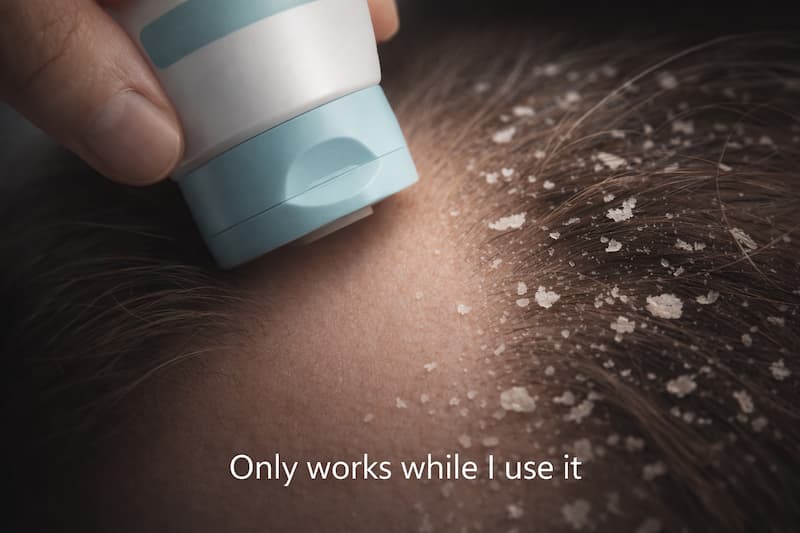
The “Day 3” Betrayal
You wash. The flakes disappear. The itch fades. Your scalp feels calm.
Then you skip a wash. By the next day, tightness creeps back. By day three, flakes return fast. Often worse than before.
You’ve been told this means the shampoo works. That you just need to keep using it.
But this pattern is not healing. It’s dependency.
This is the pattern of dandruff shampoo temporary relief. Symptoms pause while the product is present. They rebound when it stops.
Understanding this is the first step toward real scalp recovery. “…this fleeting window of calm is the hallmark of the hidden 48-hour dandruff cycle no one talks about.”
Recurring scalp flakes and shampoo reliance are not random. They follow a predictable biological loop. Until that loop is broken, relief remains temporary.
The Red Flag: Why Dandruff Shampoo Temporary Relief Never Lasts
Temporary relief often reflects barrier dysfunction.
Antifungal shampoos suppress yeast quickly. However, they also disrupt the scalp’s acid mantle. Over time, this natural defense weakens.
This creates what we can call barrier laziness. The scalp stops regulating itself. It relies on external chemistry instead.
Acid mantle suppression changes pH balance. Lipid layers thin. Protective microbes decline. The surface becomes reactive.
As a result, antifungal tolerance develops. Stronger products are needed for the same effect. Relief windows shorten.
“This is the inevitable result of why harsh shampoos create the rebound cycle, you are cleaning the surface while destroying the foundation.”
The pattern is clear. The more aggressively you treat, the more dependent the scalp becomes.
Temporary calm does not equal restoration.
The Biofilm Bunker: The Reason Behind Dandruff Shampoo Temporary Relief
Temporary relief also reflects microbial protection.
Fungal communities on the scalp rarely exist alone. They live within a biofilm. This is a structured matrix of proteins, lipids, and polysaccharides.
Think of it as a shield.
Shampoo penetrates the outer layer. Surface yeast dies. Flakes loosen. Symptoms drop quickly.
However, the core colony remains intact beneath the biofilm. Once treatment stops, repopulation begins.
Fungal density rises again within days. Inflammation resumes. Flakes reform.
This cycle explains treatment plateau. Early success fades. The same bottle seems weaker over time.
“This is exactly why your dandruff treatment suddenly stops working after a few weeks, the biofilm remains untouched.”
Switching shampoos rarely solves this. Most actives target similar pathways. The shield persists.
As long as the biofilm remains stable, relief remains temporary.
The $20 Billion Cycle: Why the Industry Prefers Dandruff Shampoo Temporary Relief
Temporary relief also aligns with the business model.
A permanently curative shampoo would be purchased briefly. A dependency-based product is purchased for decades.
Most dandruff formulas prioritize rapid visible results. Flake reduction within 24 hours drives satisfaction.
However, long-term barrier repair is rarely addressed. Neither is microbiome balance.
This keeps recurrence predictable. Consumers interpret relapse as personal failure. They try stronger variants.
The cycle continues:
- Symptoms return
- New bottle purchased
- Relief resumes briefly
- Relapse follows
This loop creates profitable relapse.
“We go deeper into this in our exposé on the $20 billion dandruff cycle Big Shampoo doesn’t want you to escape.”
The goal here is not conspiracy. It is structural incentive. Temporary relief sustains recurring demand.
From a consumer perspective, this is shampoo dependency disguised as treatment.
The Exit Strategy: Moving Beyond Dandruff Shampoo Temporary Relief
Breaking dependency requires a shift in approach.
Instead of constant antifungal suppression, the scalp environment must change. Yeast thrives in disrupted barriers and unstable pH. Restore those, and fungal survival declines naturally.
This is the logic behind the Rotation Protocol.
First, antifungal use becomes strategic, not continuous. It reduces excess yeast without chronic disruption.
Second, restorative rinsing supports barrier repair. Mild acidity stabilizes the acid mantle. Lipids replenish surface structure.
Third, microbiome-friendly care encourages protective microbes. Competition limits fungal overgrowth.
Together, these steps shift the ecosystem. The scalp becomes less hospitable to relapse.
“Discover the exact sequence to go from 24-hour relief to 30-day clear scalp.”
Over time, wash frequency can decrease without rebound. Itch and flakes no longer surge after missed washes.
Relief transitions from temporary to stable.
Reclaiming Your Scalp Autonomy
Temporary relief is a signal. It shows suppression without resolution.
A healthy scalp does not require constant medicated washing. It maintains balance independently.
The aim is not stronger control. It is restored regulation.
Once barrier function normalizes, yeast levels stabilize. Inflammation quiets. Flake production slows.
At that point, relief is no longer needed.
You regain autonomy from products. Your scalp remains calm between washes.
That is the endpoint of real treatment.
Continue the Reset
- How to go from 24-hour relief to 30-day clear scalp (exact sequence)
- The 39-page PDF guide to breaking the cycle