
From 24-Hour Relief to 30-Day Control: Breaking the Relapse Pattern
The Difference Between “Clean” and “Controlled”
Most people judge scalp care by immediate relief. If itch stops for a day, the product feels successful.
However, from a long-term clinical perspective, that metric is misleading. A scalp that depends on daily suppression is not controlled. It is temporarily silenced.
True control looks different. The scalp stays calm even if washes are skipped. Symptoms do not rebound on schedule. Inflammation remains low without constant intervention.
Therefore, to break dandruff relapse pattern behavior, the target must shift. The flakes themselves are not the enemy. The repeating 48-hour biological clock is.
“…this transition is the only way to escape the hidden 48-hour dandruff cycle no one talks about.”
Long-term control depends on extending the symptom-free window. Instead of chasing visible flakes, the strategy must stabilize the underlying environment.
Once stability replaces suppression, remission becomes possible.
Case Study: The 30-Day Sequence to Break Dandruff Relapse Pattern
A consistent pattern appears across chronic dandruff users. Daily medicated scrubbing creates short relief, followed by rapid rebound. Over months, relapse accelerates.
In contrast, staged recovery protocols show the opposite trend. Wash frequency declines while stability increases.
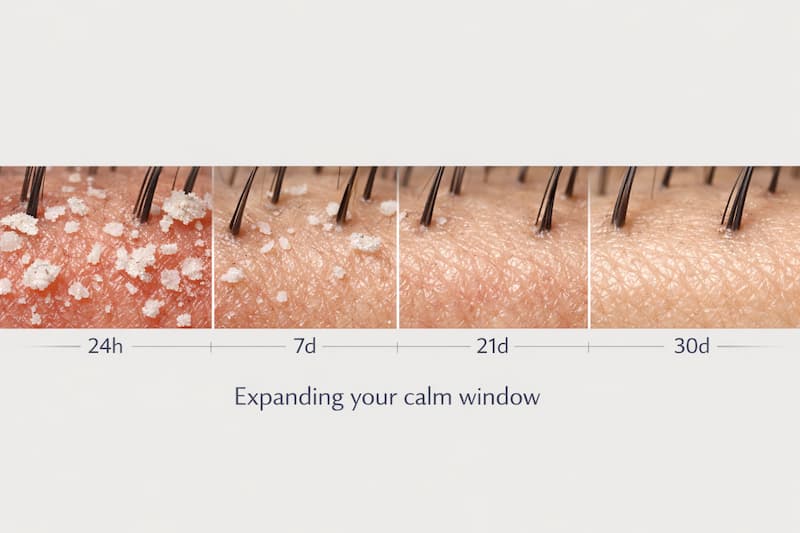
One representative case illustrates the shift.
Baseline (Month 0)
Daily antifungal wash required. Itch returns within 24–36 hours. Visible flakes by day two. Tenderness persists between washes.
After Stage 1 (Day 7)
Itch latency extends to ~48 hours. Flake density reduced. Scalp sensitivity begins to drop.
After Stage 2 (Day 21)
Wash interval increases to 4–5 days. Redness largely resolved. Heat sensation minimal. Flakes sparse.
After Stage 3 (Day 30)
Maintenance wash once weekly. No rebound itch. No visible flaking. Barrier tolerance restored.
This progression reflects physiological recovery, not product switching.
“This exact rebound pattern and recovery data is visualized in our free 39-page guide.”
Therefore, the sequence demonstrates a principle. To break dandruff relapse pattern cycles, environment repair must precede maintenance.
Stage 1: The Biofilm Dissolution (Days 1–7)
The first barrier to recovery is structural. Chronic dandruff rarely exists as free yeast alone. Instead, microbes organize into a protective biofilm matrix.
This matrix behaves like a physical shield. Antifungal actives contact the surface yet fail to penetrate fully. Consequently, inner colonies survive each wash.
Without disruption, treatment plateaus occur. Relief fades despite continued use.
“Without this step, your dandruff treatment suddenly stops working after a few weeks because the actives never reach the skin.”
Therefore, Stage 1 focuses on dissolution. The goal is not killing. The goal is access.
Biofilm disruption uses three mechanisms.
Chelation
Mineral binding loosens matrix cohesion. Calcium-dependent adhesion weakens. Structure destabilizes.
Mild keratolysis
Surface scale layers thin. Channels open toward follicles. Penetration improves.
Hydration cycling
Water flux expands and contracts matrix layers. Mechanical stress fractures architecture.
Across days 1–7, this combination exposes previously protected microbes. Treatment resistance drops. Relapse latency begins to extend.
Thus, the first requirement to break dandruff relapse pattern loops is structural exposure.
Stage 2: Extinguishing the Invisible Fire (Days 8–21)
Once biofilm protection declines, inflammation becomes the primary driver. Cytokine activity often remains elevated even after microbial load falls.
This persistent signaling explains delayed rebound. The immune system stays primed. Minor triggers reignite symptoms.
Therefore, Stage 2 shifts emphasis. Instead of increasing antifungal strength, the protocol introduces anti-inflammatory cooling phases.
“This stage targets the hidden inflammation beneath the flakes that traditional shampoos ignore.”
Cooling focuses on three responses.
Cytokine dampening
Calming rinses reduce inflammatory mediators. Heat sensation drops. Tenderness declines.
Barrier hydration
Water retention improves lipid enzyme activity. Repair accelerates.
pH normalization
Acid mantle recovery stabilizes microbiome composition. Irritation thresholds rise.
During days 8–21, wash intervals extend naturally. Because inflammation falls, itch latency lengthens.
Consequently, symptom-free windows expand from 48 hours toward several days.
Thus, Stage 2 extinguishes the invisible fire sustaining relapse.
Stage 3: The Barrier Lock (Days 22–30)
After inflammation subsides, stability still depends on defense. A recovered scalp must maintain its own equilibrium.
However, chronic dandruff disrupts the lipid baseline. Sebum distribution becomes erratic. Acid mantle function weakens. Microbial balance destabilizes easily.
Therefore, Stage 3 establishes the barrier lock. The objective is autonomy.
“This is the final exit from dandruff shampoo dependency, where you finally regain control.”
Barrier locking involves three consolidations.
Lipid baseline restoration
Surface oils redistribute evenly. Hydrophobic sealing improves. Water loss declines.
Acid mantle continuity
pH stability supports resident flora. Opportunistic overgrowth decreases.
Wash spacing consolidation
Intervals extend to weekly or longer. Natural regulation replaces forced suppression.
Across days 22–30, relapse probability drops sharply. Because the barrier now self-defends, triggers fail to escalate into symptoms.
Therefore, the scalp transitions from treated to stable.
This phase completes the effort to break dandruff relapse pattern physiology.
Why Traditional Routines Can’t Break Dandruff Relapse Pattern Cycles
Most routines follow the same loop. Scrub aggressively. Achieve short relief. Experience rebound. Switch products. Repeat.
However, each step reinforces instability.
Frequent scrubbing strips lipids repeatedly. Barrier repair resets to zero.
Rapid rebound then confirms perceived severity. Stronger products feel justified.
Product switching adds variability. Active overlap occurs without structural repair.
“This is why the dandruff shampoo rotation trap is so profitable for Big Shampoo.”
Therefore, the loop persists because the core drivers remain untouched. Biofilm persists. Inflammation persists. Barrier deficit persists.
Since none resolve, relapse remains inevitable.
Thus, traditional routines cannot break dandruff relapse pattern cycles by design.
Your 30-Day Roadmap Starts Here
Long-term control is not random. It follows predictable biology.
First, structural shields must dissolve. Then inflammation must cool. Finally, barrier autonomy must return.
When these stages occur sequentially, relapse timing shifts. Instead of 48-hour rebound, stability extends weeks.
Therefore, success in break dandruff relapse pattern recovery depends on sequence, not strength.
Once the environment stabilizes, maintenance becomes minimal. Wash frequency drops. Symptoms remain absent.
That is remission.
Continue
- The $20 billion dandruff cycle Big Shampoo doesn’t want you to escape
Download the free 39-page protocol to implement the full 30-day sequence.