
20 Essential Dry Scalp Tips for Everyday Health
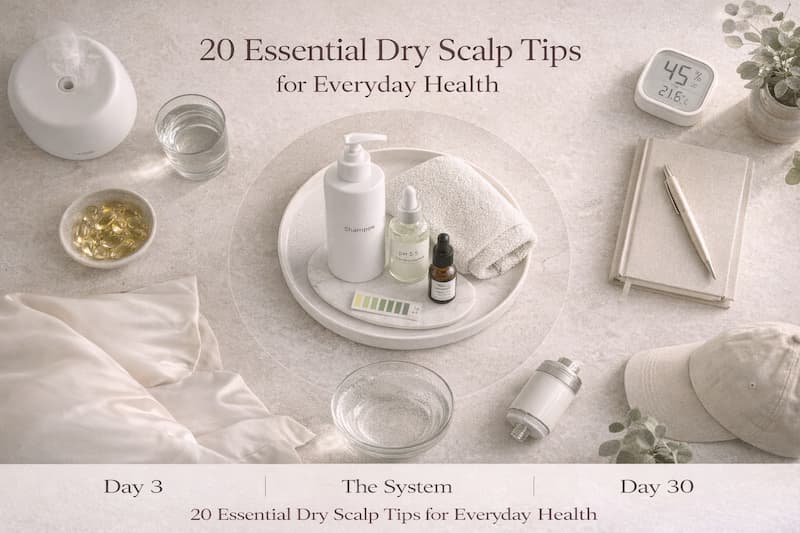
Most people can quiet a dry scalp for a weekend. A stronger shampoo. A heavier oil. A brief sense of relief. And then, almost imperceptibly, the flaking returns as steady as breath, as cyclical as the seasons.
Maintenance is the real mastery.
In medicine, we speak of remission and relapse. In ecology, of balance and disruption. In philosophy, of practice, the small, repeated acts that shape a life. The scalp is no different. It responds not to drama, but to discipline. Not to miracles, but to micro-habits that guard its fragile barrier while you sleep, sweat, think, and move through the ordinary weather of your days.
Today, we distill decades of pattern and proof into 20 essential dry scalp tips, the kind that transform a 30-day improvement into something steadier, quieter, and self-sustaining. This is where autonomy begins: not in a bottle, but in what you choose to repeat.
The Daily 20: Essential Dry Scalp Tips for Barrier Defense
A healthy scalp is less an achievement than a rhythm, a quiet choreography between water, skin, air, and habit. What protects it is rarely dramatic. It is structural. And structure, repeated, becomes resilience.
We can think of your barrier defense in three concentric circles: The Wash, The Lifestyle, and The Environment. Each layer either weakens or steadies the one beneath it.
The Wash (Tips 1–5)
Where contact begins.
Water, though gentle in appearance, can be disruptive in excess. The goal is not intensity, but equilibrium.
- Use lukewarm water only.
Heat dissolves surface lipids — the very oils that shield your scalp. Lukewarm water cleans without stripping. - Keep wash time brief.
Prolonged soaking swells the skin barrier and increases transepidermal water loss once dry. - Adopt the “double-rinse” rule.
Rinse once to remove visible residue. Rinse again to clear microscopic buildup along the hairline and crown. - Blot, don’t rub.
Friction inflames. Press a soft towel gently against the scalp instead of scrubbing it dry. - Let the scalp finish drying naturally when possible.
If you use a dryer, keep it on cool. Heat accelerates moisture evaporation beyond what the barrier can regulate.
The wash sets the tone. It can either disturb the barrier daily or quietly defend it.
The Lifestyle (Tips 6–15)
Where internal rhythms shape external skin.
The scalp is not separate from the body. It is fed by your bloodstream, governed by your nervous system, and influenced by your sleep.
- Track hydration intentionally.
Aim for steady intake across the day rather than large, infrequent volumes. Consistency supports skin elasticity. - Monitor urine color as a hydration cue.
Pale straw suggests balance. Darker tones often signal insufficiency. - Prioritize protein intake.
Keratin production depends on amino acids. Undereating protein weakens strand and scalp structure alike. - Include omega-3 sources regularly.
These support anti-inflammatory pathways that calm chronic dryness. - Stabilize blood sugar.
Rapid spikes can intensify inflammatory signaling, affecting scalp sensitivity. - Choose silk or satin pillowcases.
Reduced friction protects both the hair shaft and the skin barrier overnight. - Wash pillowcases frequently.
Oil and product residue accumulate invisibly and re-contact the scalp nightly. - Develop a stress-response ritual.
Breathwork, prayer, journaling — what matters is repetition. Cortisol shifts sebum production and immune response. - Protect sleep duration.
Barrier repair peaks at night. Chronic sleep loss delays recovery cycles. - Limit alcohol excess.
Alcohol dehydrates systemically and can increase inflammatory cascades.
Lifestyle determines the baseline from which your scalp must recover. A stable internal climate reduces the burden on topical care.
The Environment (Tips 16–20)
Where air, light, and exposure test your defenses.
The scalp is often overlooked in environmental planning. Yet it sits directly beneath the sky.
- Maintain indoor humidity between 40–50%.
Air that is too dry pulls moisture from the scalp. A humidifier in arid seasons can restore balance. - Avoid over-humidifying.
Excess moisture encourages microbial imbalance. Moderation matters. - Protect exposed parts from UV radiation.
The scalp can burn, especially along widening parts. Use a lightweight SPF mist designed for hairlines. - Choose breathable hats.
Tight, non-ventilated fabrics trap heat and sweat, increasing irritation risk. - Allow periodic “air time.”
When safe, let the scalp breathe without constant covering to regulate temperature and moisture naturally.
Environment exerts quiet pressure. The right adjustments reduce daily assault on the barrier.
Troubleshooting Common Issues: The “Emergency Brake”
No system, however thoughtful, escapes interruption. A delayed wash. A week tightened by stress. A hotel shower with hard water and recycled air. The scalp, like any living tissue, registers disruption quickly.
The instinct is understandable: reach for the strongest bottle in the cabinet. The one that promises instant control. But escalation often trades short-term quiet for long-term fragility. Harsh surfactants silence symptoms by dismantling the very barrier that must recover.
Instead, apply the Cooling Sequence — a deliberate pause rather than a forceful reset.
When You Miss a Wash
Oil buildup can create the sensation of heaviness and itch.
Do this:
- Rinse with lukewarm water only.
- Perform a slow double-rinse to remove surface residue.
- Blot dry gently.
- Avoid adding new products that evening.
You are reducing load, not restarting war.
During a High-Stress Week
Stress alters cortisol levels, which in turn influence sebum production and inflammatory signaling. The scalp may feel tighter, more reactive.
Do this:
- Shorten showers.
- Skip heat styling.
- Increase hydration slightly.
- Add a 5-minute nightly breathwork routine to regulate nervous system response.
Lower internal agitation first. The skin often follows.
Travel-Induced Flare-Ups
Airplane cabins dehydrate. Climate shifts confuse. Hard water leaves mineral residue.
Do this:
- Use lukewarm water exclusively.
- Extend your rinse time to counter mineral buildup.
- Apply a lightweight, non-occlusive scalp serum if needed.
- Sleep on a clean, smooth fabric surface.
The goal is recalibration, not intensity.
If a flare-up produces immediate itching, treat the sensation without dismantling your barrier. Use these quick relief tips for itching from Day 7 to calm the cytokine surge — the biochemical “fire alarm” beneath the itch — while preserving the integrity you’ve worked to build.
An emergency brake does not reverse direction. It simply slows momentum long enough for balance to return.
Community Shares: Real Results from These Essential Dry Scalp Tips
Every sustained practice gathers questions along the way. Over these thirty days, patterns have emerged — not only in scalp recovery, but in uncertainty. What follows are the three most recurring questions, and the principles beneath them.
1. “Can I ever go back to my old fragrance shampoo?”
Fragrance, in itself, is not a moral failing. It is chemistry. And chemistry interacts with skin.
If your barrier is stable, you may use your former shampoo occasionally — as one might enjoy a rich dessert after months of steady eating. But make it rare. Not routine.
Frequent exposure to heavily fragranced formulas increases the likelihood of irritation, especially in a scalp that has previously shown sensitivity. What once felt harmless may, over time, reignite subtle inflammation.
Think in terms of rhythm:
- Daily care protects.
- Occasional indulgence tests stability.
If flakes or tightness return within 48 hours, you have your answer.
2. “How do I handle hard water when traveling?”
Hard water leaves behind mineral deposits that cling invisibly to both hair shaft and scalp. Over several washes, this residue can mimic dryness, dullness, or itch.
When traveling:
- Extend your rinse time by 30–60 seconds.
- Use lukewarm water to reduce mineral adherence.
- Consider a gentle chelating wash once during longer stays.
- If possible, install a portable shower filter for extended trips.
Travel is disruption by definition. Your aim is mitigation, not perfection. Reset gently when you return home rather than escalating in the moment.
3. “What’s the one thing I should never skip?”
If everything else falters, protect the barrier during washing.
Temperature control.
Thorough rinsing.
Gentle drying.
These three behaviors determine most outcomes. You can miss a supplement. You can forget a humidifier. But aggressive washing erodes progress quickly.
The scalp repairs slowly and forgets slowly. Consistency writes its memory.
We’ve compiled the most significant community breakthroughs, patterns, refinements, and small adjustments that made outsized differences, into our complete 30-day plan recap, releasing tomorrow. It is less a conclusion than a consolidation: a way of seeing the whole architecture at once.
The Checklist: Is Your Environment Scalp-Friendly?
Healing rarely fails from a single dramatic mistake. It erodes through unnoticed conditions — the air too dry, the water too mineral-rich, the rinse too alkaline. Before adjusting products again, audit your environment.
Answer Yes or No to each:
Water Quality
- Is your shower head filtered?
Hard water deposits can cling to the scalp, creating buildup that mimics dryness and dullness. - Do you replace or clean the filter regularly?
A neglected filter returns minerals and impurities back into circulation. - Do you rinse for at least 60 seconds after shampooing?
Residual surfactants often cause more irritation than the wash itself.
Air & Humidity
- Is your bedroom humidity consistently above 40%?
Air below this threshold increases transepidermal water loss overnight. - Do you monitor humidity with a simple hygrometer?
Perception is unreliable; measurement clarifies. - Is your scalp exposed to direct air conditioning or fans while you sleep?
Continuous airflow accelerates surface dehydration.
Barrier Chemistry
- Are you using a pH-balanced recovery rinse after washing?
The scalp thrives slightly acidic. An alkaline environment prolongs barrier disruption. - Does your rinse fall within the 4.5–5.5 pH range?
This supports the acid mantle — the skin’s biochemical shield. - Do you avoid layering multiple new products at once?
Overcorrection confuses cause and effect.
Integrating Essential Dry Scalp Tips Into Your Final Recap
What began as irritation became observation. What felt random became patterned. Over these days, you have moved from reaction to recognition — and from recognition to method.
Tomorrow marks the close of this series. But endings in biology are rarely final. They are recalibrations. A wound seals and becomes skin again. A disrupted barrier restores its rhythm. The work shifts from correction to continuity.
This is your new baseline.
You now understand that dryness is not an isolated event. It is an interaction — between water and lipid, stress and sebum, climate and chemistry. You have learned to see signals before they swell into symptoms. That awareness is the quiet form of mastery.
Tomorrow, we unify everything into the Ultimate Dry Scalp Care Routine — a single, integrated structure where wash habits, lifestyle inputs, and environmental controls work in concert rather than competition.
And before you complete the series, make sure you’ve secured the 39-page PDF strategy guide. Inside, you’ll find the clinical research, barrier science, and inflammatory pathways that ground these practices in data — so your routine rests not on trend, but on evidence.