The Kitchen Apothecary: 7 DIY Dry Scalp Treatments for Lasting Relief
Introduction: The Fallacy of the “Quick Fix”
Many people treat a dry scalp like a dirty window. They try to wipe the flakes away and move on. However, your scalp is not a surface to clean. It is a living ecosystem that can fall into a state of drought when the barrier loses moisture and balance.
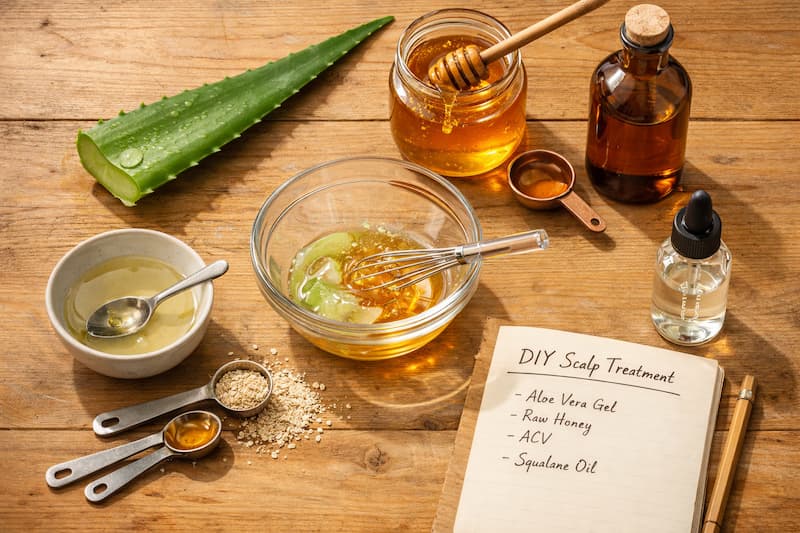
This is where DIY dry scalp treatments come in. The goal is not just to save money. Instead, the focus is on removing the synthetic fragrances, harsh sulfates, and other irritants often found in commercial shampoos. By switching to DIY dry scalp treatments, you reduce the triggers that fuel the hidden irritation many experts call the “invisible fire.”
The Biology of Dermal Thirst: Why DIY Works
To calm the “invisible fire,” you first need to understand how your scalp works. Your scalp is not just skin under hair. Instead, it acts like a living barrier that protects your body and holds moisture inside.
Many people struggle because they treat every flake the same way. However, not all flakes come from the same problem. In most cases, the issue falls into two categories: dehydration or dryness.
First, let’s look at dehydration. A dehydrated scalp lacks water, not oil. This happens when the skin loses moisture faster than it can replace it. Scientists call this process Transepidermal Water Loss (TEWL).
When TEWL is high, the scalp feels tight and uncomfortable. It may feel similar to dry paper. Interestingly, the scalp can still produce oil during dehydration. The real problem is water loss inside the skin cells.
For this situation, the scalp needs humectants. Humectants attract water and help the skin hold it. Ingredients such as raw honey and aloe vera work well because they pull moisture from the air and guide it into the skin.
Now consider the second problem: dryness. A dry scalp lacks oil, also known as sebum. Sebum forms part of the lipid barrier that keeps moisture inside the skin.
When sebum levels drop, the barrier becomes weak. Moisture escapes more easily, and the scalp begins to flake. In this case, the solution is different. The scalp needs emollients, which are gentle oils that help rebuild the barrier.
Examples include squalane and jojoba oil. These oils closely match the structure of natural sebum. Because of this similarity, they support the skin without clogging pores.
Another key factor involves the acid mantle. The acid mantle is a thin protective film on the scalp’s surface. It works like a shield that keeps harmful bacteria away.
For this shield to function properly, the scalp must stay slightly acidic. The healthy range sits between pH 4.5 and 5.5. Unfortunately, many commercial shampoos have a pH of 7.0 or higher.
When the pH rises too much, the acid mantle weakens. As a result, the barrier becomes easier to damage. This is one reason DIY care often helps. Ingredients like apple cider vinegar can gently restore the scalp’s natural pH balance.
Finally, the scalp also depends on something called Natural Moisturizing Factors (NMF). These are tiny substances inside your skin cells that hold water. They include amino acids, salts, and other small molecules.
Think of NMF as tiny moisture magnets. They attract water and keep the skin hydrated. Many DIY ingredients work in a similar way. For example, raw honey acts like a natural NMF because it pulls water toward the skin.
As a result, DIY treatments support the scalp in several ways at once. They restore pH balance, protect the lipid barrier, and improve hydration inside the skin cells. Over time, this approach helps calm the invisible fire and rebuild a healthier scalp environment.
The Malassezia-Safe Oil List
Sometimes a “dry scalp” is not dry at all. Instead, the real issue is an overgrowth of Malassezia, a yeast that naturally lives on the scalp. In small amounts, it causes no trouble. However, when it grows too quickly, it can lead to itching, redness, and flakes.
This fungus feeds on certain fatty acids found in many natural oils. Most plant oils contain carbon chains between C12 and C24. Unfortunately, these chains are exactly what Malassezia likes to eat.
Because of this, the oils you choose matter a lot. Some oils feed the fungus. Others sit on the skin without becoming food. The goal is simple. You want oils that hydrate the scalp while starving the yeast.
Below are three options often considered Malassezia-safe.
1. Squalane Oil – The Bio-Identical Hero
Squalane is one of the safest oils for sensitive scalps. It closely matches the structure of your natural sebum. As a result, the skin accepts it easily.
Unlike squalene, which is unstable, squalane is fully saturated and very stable. More importantly, Malassezia cannot use it as a food source.
Because of this, squalane supports hydration without feeding the yeast. Many dermatology routines treat it as the gold standard for maintaining a balanced scalp barrier.
2. MCT Oil – The Lightweight Option
MCT oil can also work well when chosen carefully. However, not every MCT oil is safe.
Look for formulas that contain C8 (Caprylic Acid) or C10 (Capric Acid). These fatty acids have short carbon chains. As a result, Malassezia cannot break them down for energy.
This means the oil can provide smooth glide and moisture without increasing fungal growth.
One important warning exists. Some MCT blends contain C12 (Lauric Acid). Unfortunately, this is one of the fungus’s favorite food sources. Always check the label before using MCT oil on the scalp.
3. Mineral Oil – The Clinical Barrier
Mineral oil often gets criticized in DIY beauty circles. However, from a chemistry point of view, it has one useful property.
Mineral oil is chemically inert. In simple terms, it does not react with the skin or microbes. Because it does not come from plants, Malassezia cannot recognize it as food.
For this reason, mineral oil can work as a short-term emergency occlusive. It creates a protective layer that helps calm a very irritated scalp.
The “Avoid at All Costs” List
If you suspect a fungal flare-up, it helps to pause certain oils. These oils often act like a buffet for Malassezia.
Coconut Oil
Coconut oil contains high levels of Lauric Acid (C12). This fatty acid is one of the yeast’s favorite food sources. As a result, it can make fungal dandruff worse.
Olive Oil
Olive oil is rich in Oleic Acid. In some people, this fatty acid weakens the skin barrier and increases flaking.
Castor Oil
Castor oil contains very long fatty acid chains. These chains can slowly feed fungal colonies over time.
The Key Takeaway
Choosing the right oil can change how your scalp behaves. Oils like squalane and C8/C10 MCT support hydration without feeding yeast. Meanwhile, heavy plant oils may encourage fungal growth.
Therefore, if flakes refuse to disappear, it may be time to review your oil shelf. A small change in ingredients can often calm the scalp and restore balance.
Conclusion: Graduation to Scalp Sovereignty
DIY dry scalp treatments are the first step toward taking control of your scalp health. Instead of relying only on store products, you begin to understand how your skin actually works. As a result, you move from being just a consumer to becoming a careful curator of your own routine.
Each small change adds up. When you adjust pH, choose the right oils, and hydrate the scalp properly, the barrier slowly rebuilds. Over time, the itching, flaking, and tightness begin to calm down.
This process takes patience. However, the reward is a scalp that stays balanced without constant rescue treatments.
Next, we move deeper into fast-response solutions. Tomorrow’s guide focuses on the Emergency Triage phase , where you learn what to do when irritation appears suddenly.
If you want a simple reference for all the recipes mentioned so far, download the 39-page PDF strategy guide. It includes the DIY Recipe Card, which lists the exact ingredient ratios for different hair types and seasonal changes.