The Great Debate: Dry Scalp vs Dandruff and How to Tell the Difference
Introduction: The Identity Crisis of the Flake
White flakes on your shoulders can feel alarming. As a result, many people immediately grab a strong anti-dandruff shampoo. However, flakes do not always mean dandruff. In many cases, the scalp is simply dry and lacking moisture.
This confusion creates a common problem. People often mix up dry scalp vs dandruff, even though the two conditions behave very differently. One happens when the skin lacks hydration. The other develops when excess oil and yeast build up on the scalp.
Because of this difference, the wrong treatment can make things worse. For example, dandruff products often remove oil aggressively. Meanwhile, a dry scalp actually needs gentle hydration and barrier repair.
Therefore, understanding the difference between dry scalp vs dandruff is the first step toward fixing the problem. Once you know what your scalp truly needs, you can treat the flakes correctly and stop the cycle from repeating.
The Biological Root: Dry Scalp vs Dandruff Causes
At first glance, flakes from dry scalp vs dandruff can look the same. However, the causes behind them are very different. Understanding the root problem helps you choose the right treatment.
Dry Scalp Causes: Understanding the Barrier Lipid Deficiency
Dry scalp usually begins with a moisture problem. In simple terms, the outer layer of your skin—called the stratum corneum—loses water and protective oils. As a result, the skin barrier weakens.
Tiny cracks may form in the surface. Consequently, the skin begins shedding small white flakes.
This process works like a drought in soil. When the ground lacks water, it becomes dry and brittle. Similarly, the scalp starts to lose its protective lipids.
Experts call this problem barrier lipid deficiency. Because the barrier weakens, the skin cannot hold moisture effectively.
Dandruff Causes: The Role of Malassezia Fungus and Sebum.
Dandruff develops through a completely different pathway. Instead of dryness, the issue begins with excess oil on the scalp.
This oil feeds a yeast-like fungus called Malassezia globosa.
Normally, this microorganism lives harmlessly on human skin. However, when oil production increases, the fungus multiplies rapidly.
As it breaks down sebum, it releases substances that irritate the scalp. Consequently, inflammation appears and visible flakes begin to form.
The Core Difference: Dehydration vs Microbiome Imbalance
The distinction between dry scalp vs dandruff becomes clear once you look at the biology.
- Dry scalp comes from dehydration and barrier damage.
- Dandruff develops from microbiome imbalance and oil buildup.
Because the causes differ, treatments must also differ. Hydration supports dry scalp recovery. Meanwhile, dandruff treatments focus on controlling oil and fungal activity.
Understanding this difference prevents many common scalp treatment mistakes.
Dry Scalp vs Dandruff Symptoms: How to Identify Your Flake Type
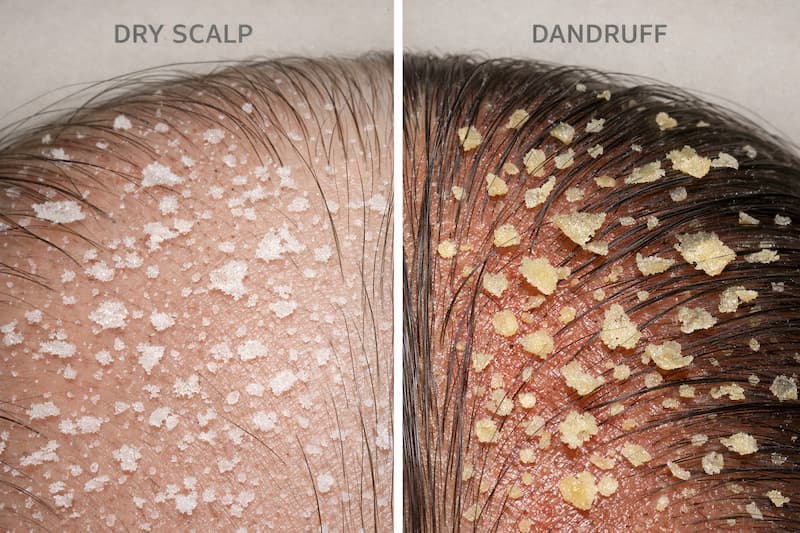
At first glance, flakes from dry scalp vs dandruff may look identical. However, small details often reveal the true cause. Color, texture, and behavior of the flakes tell an important story about what is happening on your scalp.
Dermatologists often study these clues during a scalp skin analysis. Fortunately, you can perform a simple version of this audit at home. By observing the flakes before your next wash, you can learn whether the issue relates to dehydration or fungal imbalance.
The Visual Audit: Distinguishing Small White Flakes from Oily Yellow Clumps.
| Feature | Dry Scalp (Dehydration) | Dandruff (Fungal Overgrowth) |
|---|---|---|
| Flake Color | Translucent to bright white | Yellowish, grey, or off-white |
| Texture | Dry, papery, and dust-like | Oily, waxy, and chunky |
| Adhesion | Falls easily onto shoulders (“shoulder snow”) | Sticks to the hair shaft and scalp |
| Scalp Condition | Feels tight, stretched, and dry | Often feels greasy or heavy |
| Inflammation | Mild pinkness with light itching | Visible redness with stronger itching |
| Response to Oil | Absorbs oil and feels calmer | Oil makes flakes softer and itchier |
Sensation Differences: The Prickly Itch of Dry Scalp vs. the Inflammatory Heat of Dandruff.
Many people believe only dandruff causes itching. However, dryness can also trigger strong scalp sensations. The difference lies in how the itch feels.
Dry scalp itching usually feels tight and prickly. It often resembles the sensation your skin experiences after a long airplane flight. This feeling happens because the scalp barrier lacks moisture.
Dandruff itching behaves differently. Instead of tightness, the scalp may feel irritated, inflamed, and warm. This reaction occurs when the yeast Malassezia breaks down scalp oil and releases irritating byproducts.
Because of this process, the scalp inflammation can feel deeper and more persistent.
What Happens When You Scratch
Scratching also reveals clues about the condition.
When you scratch a dry scalp, you usually remove tiny flakes of skin that were not fully ready to shed. These flakes fall away quickly and feel dry.
However, scratching dandruff often dislodges thicker material. This material may include yeast biofilm mixed with oxidized sebum. As a result, flakes appear larger and may cling to hair strands.
The Simple “Oil Test” You Can Try
One practical test involves applying a tiny drop of oil to the itchy area. For example, a light oil such as squalane works well.
If the oil absorbs quickly and the itch calms down, the scalp likely lacks moisture. In that case, dryness is the main problem.
On the other hand, if the itch becomes heavier or slightly worse, dandruff may be the cause. This reaction happens because oil can feed yeast activity on the scalp.
Using the Audit to Guide Your Next Step
This simple audit helps you avoid guessing. Once you understand the symptoms, you can choose the correct treatment approach.
If your scalp feels tight and prickly instead of oily, the barrier may be compromised. In that situation, reviewing the environmental triggers in dry scalp itching causes (Day 7) can help you begin restoring scalp balance.
How to Tell the Difference: Dry Scalp vs Dandruff Self-Diagnosis
Sometimes flakes alone do not give a clear answer in the dry scalp vs dandruff question. In that situation, it helps to stop looking at the flakes and start paying attention to how the scalp feels. Dermatology experts often rely on simple physical clues such as dermal turgor, which describes how elastic and hydrated the skin is.
By checking the scalp’s elasticity and oil behavior, you can learn a great deal about its internal condition. The following tests offer a simple way to perform a basic scalp skin analysis at home.
The Pinch Test: Using Dermal Turgor to Identify a Dehydrated Scalp.
The first method examines the hydration level of your scalp skin.
Healthy scalp tissue usually feels soft, flexible, and slightly bouncy. This elasticity appears because hydrated skin cells hold enough water to maintain structure.
To perform the test, place the pads of your fingers on the top of your head. Then gently pinch or push the skin together.
Observe how the skin behaves when you release it.
If the skin feels tight or difficult to move, dehydration may be present. In this case, the skin might return slowly to its normal position. This reaction suggests the scalp lacks moisture and flexibility.
However, the sensation can differ when dandruff is the cause. The skin usually moves easily in this situation. Yet the surface may feel thicker or slightly swollen underneath. This feeling often appears when inflammation develops from fungal activity.
The 48-Hour Oil Check: Determining if Your Flakes are Sebum-Driven.
The second test focuses on how your scalp reacts after washing.
Begin by washing your hair with a gentle pH-balanced cleanser. Avoid styling products during this short experiment so the scalp remains undisturbed.
Then observe the scalp for the next two days.
When dryness is the main issue, flakes usually appear quickly. In many cases, they return within the first 24 hours after washing. These flakes normally look small, dry, and powder-like.
Dandruff behaves differently. The flakes often appear later, sometimes after 48 to 72 hours. This delay occurs because the yeast Malassezia needs time to feed on the oil your scalp produces.
As the yeast breaks down sebum, it releases irritating substances. Eventually, this process triggers inflammation and visible flaking.
The Spot-Check Sensation
Finally, pay attention to the type of itch your scalp produces.
Dry scalp often causes a prickly feeling. The sensation resembles wearing a sweater that feels slightly scratchy on the skin.
Dandruff itching usually feels deeper and warmer. The scalp may feel irritated or “hot” in certain spots. As a result, the urge to scratch can feel stronger and more persistent.
By combining these three tests—the pinch test, the oil check, and the sensation check—you gain a clearer picture of your scalp condition. Once the cause becomes clear, choosing the correct treatment becomes much easier.
Why Anti-Dandruff Shampoos Fail on Dry Scalps
Many people see flakes and immediately reach for a strong anti-dandruff shampoo. However, this decision can create a bigger problem. When the flakes actually come from dryness, these products often make the scalp worse instead of better.
Anti-dandruff formulas are designed to remove oil and control fungal growth. For dandruff conditions, this strategy can help. Yet a dry scalp already lacks moisture and protective oils. Because of this, aggressive cleansing ingredients may damage the scalp barrier even further.
If your flakes increase after using a clinical antifungal shampoo, the problem may not be the product’s quality. Instead, the issue may be that the treatment does not match your scalp’s biology.
Surfactant Aggression: How Anti-Dandruff Soaps “Unzipper” Scalp Lipids.
Most anti-dandruff shampoos combine antifungal ingredients with strong cleansing agents. Common antifungal ingredients include zinc pyrithione and selenium sulfide. These compounds help control microorganisms that cause dandruff.
However, these formulas often contain powerful surfactants such as sodium lauryl sulfate (SLS). Surfactants work like tiny magnets with two ends. One end binds to water, while the other attaches to oil and dirt.
On an oily scalp, this action removes buildup effectively. Yet on a dry scalp, the same process removes the few protective oils that remain.
Dermatologists sometimes describe this effect as “lipid unzippering.” The protective lipids between skin cells act like mortar between bricks. When surfactants dissolve these lipids, the cells lose their structural support.
As a result, the scalp barrier weakens. The skin surface may then crack, peel, and shed larger flakes.
The $pH$ Conflict: Why Alkaline Shampoos Destroy the Acid Mantle ($pH \approx 5.5$).
Another problem appears with ingredients designed to kill yeast. For example, ketoconazole is a common antifungal used in clinical dandruff treatments.
This ingredient works well when fungal overgrowth is present. Yet ketoconazole also tends to dry skin tissue.
When dandruff is the real cause, removing the fungus helps the scalp recover. In contrast, applying a drying agent to an already dehydrated scalp creates a harmful cycle.
The scalp may react defensively. In some cases, the skin becomes extremely dry and irritated. In other situations, the body responds with reactive seborrhea, where the scalp suddenly produces low-quality oil in an attempt to protect itself.
This oil often feels waxy and uncomfortable. Consequently, irritation continues instead of improving.
The pH Disruption Problem
Healthy scalp skin also depends on proper pH balance. The scalp maintains a thin protective layer called the acid mantle.
This barrier functions best when the pH stays close to:
[
pH \approx 5.5
]
At this level, the scalp can defend itself against bacteria and maintain hydration.
However, many clinical shampoos are more alkaline, often exceeding pH 7.0. When such products contact the scalp, the acid mantle may temporarily break down.
Once this barrier weakens, moisture escapes from the skin through transepidermal water loss (TEWL). At the same time, environmental irritants can enter more easily.
Why Ingredient Choice Matters
Understanding ingredient behavior helps explain why some treatments fail on dry scalps.
| Ingredient | Intended Goal | Effect on Dry Scalp |
|---|---|---|
| Zinc Pyrithione | Reduce fungal growth | Can increase dryness |
| Sodium Lauryl Sulfate (SLS) | Deep cleansing | Removes protective lipids |
| Ketoconazole | Antifungal treatment | May weaken the acid mantle |
Because of these effects, antifungal shampoos work best for true dandruff conditions. Dry scalp, however, usually requires a different approach.
Hydration, gentle cleansing, and barrier repair support recovery much more effectively. Once the scalp regains balance, flaking often decreases naturally.
Tactical Solutions for Both Dry Scalp and Dandruff
After identifying dry scalp vs dandruff, the next step is adjusting your wash routine. The goal is not aggressive cleaning. Instead, the focus should be restoring balance to the scalp’s microbiome while protecting the skin barrier.
When the scalp becomes irritated or flaky, harsh washing can make the situation worse. Therefore, a safe-wash routine focuses on gentle cleansing, hydration, and barrier support.
The Dry Scalp Protocol: Rehydrating with Co-washing and Squalane.
If your pinch test revealed tight or less elastic skin, dehydration is likely the main issue. In this situation, the scalp needs ingredients that attract moisture and lock it into the skin.
Humectants help draw water toward the scalp. Meanwhile, occlusive ingredients slow moisture loss by forming a light protective layer.
One helpful method is co-washing. This technique involves washing hair with a cleansing conditioner instead of traditional shampoo. Because these formulas contain fewer surfactants, they clean the hair while protecting the natural lipid layer on the scalp.
After washing, sealing in moisture becomes important. While the scalp is still slightly damp, apply a few drops of squalane or MCT oil (C8).
These oils resemble the natural sebum produced by your scalp. As a result, the skin receives a signal that protection already exists. This reaction can reduce the tight feeling that often appears after washing.
The Dandruff Protocol: Using $pH$ Balancing and Antifungal Botanicals.
If your 48-hour oil check revealed waxy flakes, dandruff may be the main cause. In this case, the routine should focus on controlling fungal activity without damaging the scalp barrier.
One useful method is an apple cider vinegar rinse. To prepare it, mix one part apple cider vinegar with four parts water.
Use this mixture as a final rinse after washing. Because apple cider vinegar is naturally acidic, it helps restore the scalp to a balanced environment.
Healthy scalp skin usually functions best at approximately
[
pH \approx 5.5
]
At this level, fungal organisms such as Malassezia struggle to multiply.
Natural antifungal botanicals can also help. Oils such as tea tree oil or peppermint oil contain compounds that slow microbial growth. However, these oils should always be diluted in a carrier oil to prevent irritation.
The Cold Seal: Using Temperature to Lock in Moisture and Reduce Inflammation.
Regardless of the flake type, temperature also affects scalp health.
Hot water can irritate the skin and increase moisture loss. Therefore, finishing your routine with a short cool rinse can be helpful.
A 60-second cool rinse gently constricts small blood vessels near the scalp surface. As a result, inflammation may calm down.
At the same time, the cooler temperature helps close the hair cuticle. This process supports moisture retention and protects the hair shaft.
Quick Routine Comparison
| Goal | Dry Scalp Action | Dandruff Action |
|---|---|---|
| Cleansing | Co-washing with conditioner | Low-pH cleanser |
| Hydration | Squalane or MCT oil | Aloe vera humectant |
| Maintenance | Cool rinse and heat control | pH-balancing rinses |
A thoughtful safe-wash routine allows the scalp to recover gradually. Once the skin barrier and microbiome return to balance, flaking often becomes much easier to manage.
Conclusion: Moving Beyond the Dry Scalp vs Dandruff Confusion
The discussion around dry scalp vs dandruff often creates confusion. However, the difference is not just about words. Instead, it determines which treatment actually helps your scalp heal.
By using the Pinch Test and the 48-hour Oil Check, you have taken an important step. Rather than guessing, you performed a simple clinical audit of your scalp. As a result, you now understand how to read the signals your skin sends.
Many people believe a “squeaky clean” feeling means success. In reality, this sensation often signals that the scalp barrier has lost its protective oils. When dryness is the real issue, applying strong antifungal shampoos can create even more irritation.
Therefore, the goal now is to move away from aggressive cleansing and toward barrier recovery.
Your Path Forward
1. Stop the Aggression
If your audit pointed toward dryness, pause the clinical-strength anti-dandruff shampoos. These products remove oil aggressively, which can weaken an already fragile barrier.
2. Restore the Mantle
Next, allow the scalp to rebuild its protective layer. Switching to a low-pH cleanser or a gentle co-wash routine helps the natural lipids return to the skin surface.
Over time, this step supports the restoration of the scalp’s acid mantle.
3. Monitor the Signal
Finally, pay attention to how your scalp feels. Your skin constantly communicates its condition.
A prickly sensation often signals dehydration. Meanwhile, a hot or inflamed itch may indicate microbial imbalance.
Learning to recognize these signals helps you adjust your routine before irritation becomes severe.
Your Next Step
Now that you have identified your flake type, the next step is understanding the deeper cause.
If your flakes appear small, dry, and powdery, moisture deficiency may be the main issue. In that case, review our detailed guide on dry scalp flakes causes to explore triggers such as environmental stress and hard water exposure.
However, if your dryness may relate to internal factors, you may want to revisit our foundational guide on what dry scalp is a symptom of . That resource explains how hormonal shifts, nutrition, and health conditions can affect scalp balance.
The Herbivaa Strategy Vault
Knowledge becomes powerful when you can use it consistently. For that reason, many readers prefer a simple system they can reference during their wash routine.
Our 39-Page Scalp Sovereignty Strategy Guide includes:
- The Flake ID Matrix for quick scalp diagnosis
- A printable 7-Day Reset Checklist
- A simple tracking system to monitor scalp recovery
You can keep these tools in your bathroom so they remain available during each wash day.
Download the Strategy Guide and Flake ID Matrix to begin building a healthier scalp routine.