
How to Finally Fix Your Seborrheic Dermatitis Root Cause
You keep treating the flakes.
They keep coming back.
You switch shampoos, try antifungals, even wash more often.
Still, nothing lasts.
That’s because the seborrheic dermatitis root cause isn’t just fungus.
It’s a chain reaction happening under your skin and inside your body.
Most treatments only manage the surface.
They don’t fix what’s driving the cycle.
So instead of chasing flakes, you need to understand the system behind them.Many people never improve because they do not understand the difference between dry scalp and dandruff, so they keep treating dehydration like a fungal problem.
The Truth About the Flake-Cycle
At first, it looks simple.
You see flakes, so you try to remove them.
- Wash more
- Use medicated shampoo
- Scrub harder
It works for a short time.
Then the flakes return.
Understanding why itching keeps returning is important because chronic inflammation often stays active beneath the visible flakes.
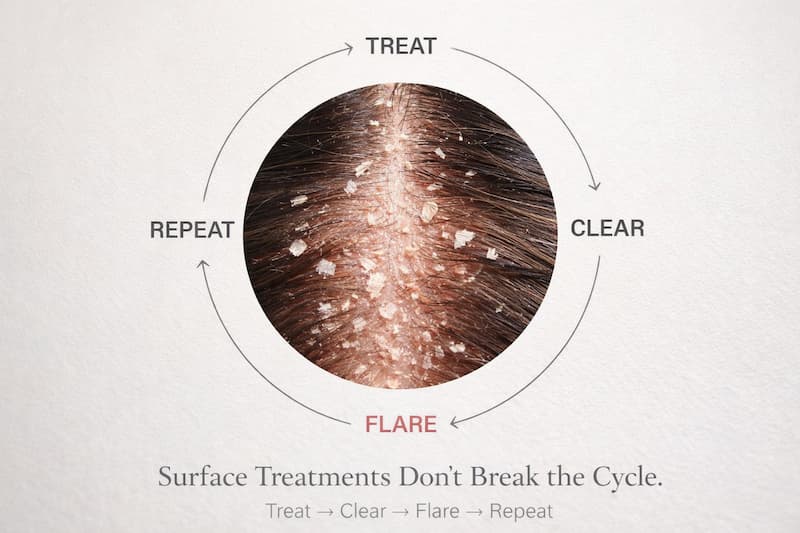
This creates a loop.
Treat → clear → flare → repeat.
Now here’s the shift.
The seborrheic dermatitis root cause is not just what you see.
It’s how your skin reacts internally.
So even when you remove flakes, the trigger is still active.
That’s why the cycle never ends.
If you have ever wondered why antifungal shampoos stop working after a few washes, the answer usually involves barrier damage and rebound inflammation.
Understanding the Biological Seborrheic Dermatitis Root Cause
The Malassezia Myth
Long-term irritation changes how scalp inflammation affects follicles, especially when flare-ups stay active for months.
You’ve heard it before.
“Yeast causes dandruff.”
But everyone has Malassezia on their scalp.
It’s normal.
So the real question is this.
Why do only some people react?
Host Response
Your body decides how to react.
That’s where things change.
When Malassezia breaks down scalp oils, it releases byproducts.
Your immune system can see these as threats.
- Inflammation increases
- Redness appears
- Flaking speeds up
So it’s not just the fungus.
It’s your body’s response to it.
What Happens Inside the Skin
Once inflammation starts, your skin speeds up its cycle.
- Cells grow faster than normal
- They don’t mature properly
- They shed in visible clumps
This is why flakes look bigger and more obvious.
Your scalp is rushing the process.
Before severe flaking starts, most people experience subtle early warning signs of barrier failure like tightness, heat, or prickling.
This explains why flakes become larger and thicker during active seborrheic dermatitis flare-ups.
Lipid Barrier Dysfunction as a Seborrheic Dermatitis Root Cause
The “Leaky Scalp” Theory
Your scalp has a protective layer.
It’s called the stratum corneum.
Think of it like a wall.
- Skin cells = bricks
- Lipids = glue
When the glue weakens, gaps form.
This is called a “leaky” scalp.
Now irritants can pass through easily.
And inflammation gets worse.
To stop the cycle permanently, you must identify the underlying causes of barrier failure instead of only treating surface flakes.
What Breaks the Barrier
Your scalp produces oil to protect itself.
But sometimes, that oil is unbalanced.
- Too many triglycerides
- Not enough protective cholesterol
This weakens your barrier.
And makes it easier for irritation to start.
External Triggers
Then external factors make it worse.
- Harsh shampoos strip your oils
- Hard water leaves mineral buildup
- Frequent washing weakens your acid mantle
If you’ve seen our guide on hard water and scalp health, you know how much damage this can cause.
So now your scalp is exposed.
And the seborrheic dermatitis root cause becomes stronger.
The Gut-Skin Axis and the Seborrheic Dermatitis Root Cause
The Internal Link
Your scalp reflects what’s happening inside your body.
This connection is called the gut-skin axis.
The connection between nutrition and scalp hydration becomes obvious when deficiencies begin affecting sebum quality and barrier repair.
When your gut is balanced, your skin stays calm.
When it’s not, inflammation spreads.
- Poor digestion → more inflammation
- More inflammation → scalp irritation
- Irritation → flakes and redness
So even if your routine is perfect, internal issues can keep the cycle alive.
The Cortisol Connection
Stress plays a major role.
When cortisol rises:
- Oil production increases
- Sebum becomes more reactive
- Flare-ups happen more often
This is why symptoms worsen during stressful periods.
During high-stress periods, many people notice stress-triggered shedding alongside increased scalp irritation.
Reversing the Seborrheic Dermatitis Root Cause Protocol
Now that you understand the cause, here’s how to act.
Step 1: Bio-Compatible Cleansing
Instead of stripping the scalp daily, focus on building a safe-wash routine that supports your barrier while controlling buildup.
- Use gentle, non-stripping cleansers
- Avoid harsh surfactants
- Wash based on need, not routine
This keeps your barrier intact.
And prevents rebound oil production.
Step 2: Nutrient-Dense Restoration
Your scalp needs the right building blocks.
- Restore missing fatty acids
- Support lipid balance
- Strengthen your barrier
Understanding how to hydrate the scalp correctly helps prevent the tight, reactive feeling that follows harsh cleansing
This helps your scalp hold moisture and resist irritation.
Many people recover faster when they combine treatment with natural scalp barrier repair methods that calm irritation gently.
Step 3: Microbiome Stabilization
You don’t need to kill all microbes.
You need balance.
- Support healthy scalp bacteria
- Reduce overgrowth conditions
- Maintain a stable environment
When balanced, Malassezia stops causing problems.
A major part of recovery involves understanding fungal imbalance and learning why the scalp reacts differently from person to person.
Mastering Your Scalp Health
Here’s what matters most.
The seborrheic dermatitis root cause is not one thing.
It’s a system.
- Barrier dysfunction
- Microbial imbalance
- Internal inflammation
Fixing only one layer won’t solve it.
What You Should Do Next
Start simple.
Focus on consistency.
- Protect your barrier
- Balance your scalp environment
- Support your body internally
Relief takes time.
But it becomes stable when you fix the root.
Your Next Step
Not sure what’s triggering your condition?
Take the Scalp Type Quiz to identify your profile.
Then build a routine that actually fits your biology.
Because once you understand your seborrheic dermatitis root cause,
you stop chasing flakes and start controlling them.