You keep washing your scalp, but the flakes still return.
At first, it feels like you just need a better shampoo.
However, the real issue might be deeper.
A seborrheic dermatitis vitamin deficiency can quietly drive inflammation from the inside.
So even when your routine looks perfect, your scalp keeps reacting.
Most people “mow the grass” with products.
But the roots stay untouched.
If you’ve tried every clinical wash with no results, this could be why.
Your body may lack the nutrients needed to protect your scalp.
In this guide, you’ll connect nutrition with scalp health.
And more importantly, you’ll learn how to break the cycle for good.
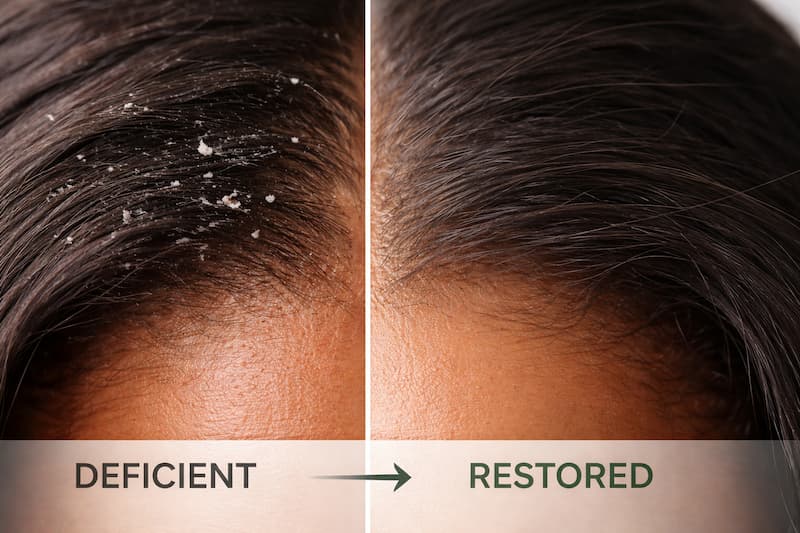
How a Seborrheic Dermatitis Vitamin Deficiency Disrupts the Barrier
Your scalp isn’t just skin.
It’s a system that depends on nutrients.
These nutrients act like helpers.
They support oil production and repair your barrier.
However, when they’re missing, things start to fail.
What Happens Without Key Nutrients
Your scalp struggles to produce protective oils.
This weakens your barrier.
- Lipid production slows down
- The acid mantle becomes unstable
- Moisture escapes faster
As a result, irritants get in more easily.
Why This Matters
Without proper lipids, your scalp can’t defend itself.
Oleic acid from Malassezia penetrates deeper.
- Inflammation increases
- Flakes appear faster
- Healing slows down
This leads to constant flare-ups.
At the same time, inflammatory cytokines increase.
And because epidermal turnover speeds up, flakes become visible.
So instead of smooth shedding, you get clumps.
That’s how a seborrheic dermatitis vitamin deficiency damages your barrier.
The “Big Four” in a Seborrheic Dermatitis Vitamin Deficiency
Now let’s look at the key nutrients your scalp needs.
Each one plays a different role.
Vitamin B-Complex
B vitamins control oil balance.
They help regulate sebum production.
- B2 and B3 support skin repair
- B6 helps reduce oiliness
- B12 supports cell renewal
Without them, your scalp becomes unstable.
Too much oil feeds yeast.
Too little weakens your barrier.
Zinc Picolinate
Zinc is powerful.
It supports your immune system.
- Helps control inflammation
- Acts like a natural internal antifungal
- Supports wound healing
Low zinc levels can trigger flare-ups.
Common zinc deficiency symptoms include:
- Slow healing
- Increased irritation
- Frequent scalp issues
Vitamin D3
Vitamin D acts like a hormone.
It controls how fast your skin renews itself.
- Slows down excessive shedding
- Supports immune balance
- Reduces inflammation
Without enough Vitamin D, flakes appear faster.
Omega-3 Fatty Acids
Omega-3s calm inflammation.
They support your whole system.
- Reduce oxidative stress
- Improve skin hydration
- Strengthen your barrier
Low omega-3 levels make your scalp more reactive.
The Gut-Skin Axis: Why Absorption Matters
Now here’s the hidden problem.
You can eat well and still struggle.
Why?
Because your body might not absorb nutrients properly.
The Hidden Trap
Your gut controls nutrient absorption.
If it’s not working well, nutrients don’t reach your scalp.
This is called nutrient malabsorption.
- Vitamins pass through unused
- Your barrier doesn’t get support
- Inflammation continues
Gut Dysbiosis and Leaky Gut
An imbalanced gut leads to bigger issues.
- Gut dysbiosis increases inflammation
- Intestinal permeability allows toxins into the bloodstream
- Your skin reacts as a result
So your scalp becomes a reflection of your gut health.
The Cortisol Link
Stress makes things worse.
It drains key nutrients from your body.
- B-vitamins drop
- Zinc levels fall
- Inflammation rises
This creates a secondary deficiency.
So even if your diet is good, stress can still trigger problems.
Reversing the Seborrheic Dermatitis Vitamin Deficiency Protocol
Now that you understand the cause, let’s fix it step by step.
Step 1: Bio-Available Supplementation
Not all vitamins work the same.
Some are easier for your body to absorb.
Focus on:
- High-quality, bio-available forms
- Balanced micronutrient intake
- Consistent daily support
This improves nutrient bioavailability.
And helps your scalp recover faster.
Step 2: External Support with ScalpRx
While fixing the inside, support the outside too.
Use ScalpRx to repair your barrier.
- Replenishes lost lipids
- Strengthens the acid mantle
- Reduces irritation
This creates a protective layer while your body heals.
For deeper understanding, check The Root Cause of Seborrheic Dermatitis guide.
Step 3: The Scalp-First Diet
Food plays a direct role in healing.
So choose anti-inflammatory options.
Focus on:
- Zinc-rich foods like seeds and nuts
- Omega-3 sources like fish
- Whole, unprocessed meals
Avoid triggers that increase inflammation.
This supports synergistic healing.
And strengthens your scalp over time.
Mastering Your Internal Ecosystem
Your scalp is not separate from your body.
It reflects what’s happening inside.
A seborrheic dermatitis vitamin deficiency is often the missing link.
Fixing it changes everything.
What to Remember
Healing takes time.
But it becomes stable when you fix the root.
- Support your nutrients
- Balance your gut
- Protect your barrier
This creates long-term relief.
Your Next Step
Still unsure what’s causing your flare-ups?
Take the Scalp Type Quiz to get a personalized profile.
Because once you understand your body,
you can finally move from short-term fixes to sustainable healing.