
Gut Health Seborrheic Dermatitis: Why Your Scalp Starts Inside
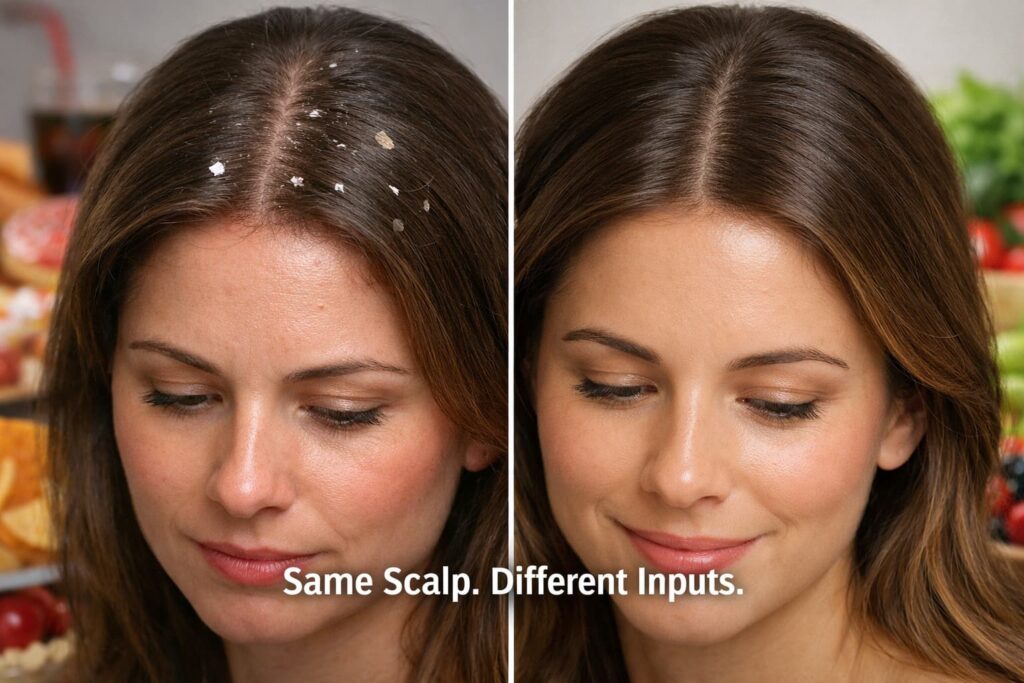
I. Introduction: The Internal Flare-Up Trigger
Gut health seborrheic dermatitis is the hidden reason your scalp keeps reacting.
Most people treat their scalp like it’s separate from the body.
But actually, your skin acts like a mirror of what’s happening inside you.
So, if your gut is out of balance, your scalp will show it.
If you’ve tried many shampoos and nothing works, that’s your clue.
Instead of adding more products, it’s time to look at your internal blueprint.
Because of this, understanding the gut-skin axis helps you move from guessing to real control.Before switching products again, learn the difference between dry scalp vs dandruff because treating the wrong condition can intensify the flare cycle.
II. The Science of the Gut-Skin Axis and Scalp Inflammation
The Signaling Pathway
Your gut and your skin talk to each other all the time.
However, when your gut lining becomes weak, it turns “leaky.”
Then, tiny harmful particles escape into your blood.
As a result, your body sends out inflammation signals to fight them.
Because of this, your scalp can turn red, itchy, and flaky.
So, the issue is not just on your head it starts deeper.
Inflammation rarely starts on the surface alone. Our guide on diet and seborrheic dermatitis explains how food choices can intensify scalp reactivity.
Immune System Overdrive
When your microbiome is out of balance, your immune system goes into overdrive.
Then, it releases chemicals called cytokines.
These cytokines cause redness and scaling on your scalp.
So, your body is basically overreacting to small triggers.
III. How Gut Health Seborrheic Dermatitis Affects Sebum Quality
The “Perfect Storm”
Everyone has Malassezia yeast on their scalp.
But your internal health decides if it stays calm or becomes a problem.
The Insulin-IGF-1 Axis: The Hormonal Engine of Scalp Inflammation
While most topical treatments focus on the presence of Malassezia yeast, the internal blueprint of a flare-up often begins with hyperinsulinemia. When you consume high-glycemic carbohydrates, your pancreas releases insulin to regulate blood glucose. However, chronic spikes in insulin do more than manage sugar; they trigger a systemic hormonal cascade that directly alters the environment of your scalp.
The Mitogenic Effect on Sebocytes
Insulin serves as a potent stimulus for the liver to produce Insulin-like Growth Factor 1 (IGF-1). In the context of gut health seborrheic dermatitis, IGF-1 acts as a powerful mitogen for sebocytes (the cells within your sebaceous glands).
Specifically, IGF-1 activates the mTORC1 (mammalian target of rapamycin complex 1) signaling pathway. This activation accelerates sebocyte proliferation and stimulates lipogenesis the production of sebum. This isn’t just “more oil”; it is a fundamental shift in the biological “flavor” of your scalp’s ecosystem.
Altering the Lipid Profile: Fuel for the Flare
Under the influence of elevated IGF-1, the composition of your sebum changes. There is often an increase in triglycerides and a relative decrease in protective long-chain fatty acids. This “dysfunctional sebum” is the preferred substrate for Malassezia yeast.
As the yeast metabolizes these specific triglycerides, it releases inflammatory byproducts most notably oleic acid. For an individual with a compromised barrier, this oleic acid penetrates the stratum corneum, triggering the redness, itching, and hyper-keratinization (scaling) that define a flare-up.
The Pro-Inflammatory Feedback Loop
Furthermore, IGF-1 suppresses the activity of FoxO1, a transcription factor that normally keeps inflammation and lipid production in check. When FoxO1 is “turned off” by high insulin levels, the scalp remains in a pro-inflammatory state, making it hyper-reactive to even minor environmental triggers like hard water or stress.
Expert Insight: Addressing gut health seborrheic dermatitis requires stabilizing this axis. By reducing the glycemic load of your diet, you lower systemic IGF-1 levels, effectively “starving” the yeast and allowing your sebaceous glands to return to a state of equilibrium.
IV. Identifying Your Gut Health Seborrheic Dermatitis Triggers
Food Sensitivities
Some foods can quietly trigger inflammation in your body.
For example, dairy, sugar, and gluten can upset your gut balance.
Then, your body reacts, even if you don’t notice it right away.
So, your scalp may flare up hours or even days later.
The Cortisol Connection
The Cortisol-Cytokine Connection: How Stress Dissolves the Scalp Barrier
When the brain perceives a stressor whether it is a deadline at work or a lack of sleep it activates the Hypothalamic-Pituitary-Adrenal (HPA) axis. While we typically think of this as a systemic “fight or flight” response, the skin (and specifically the scalp) possesses its own localized HPA axis. This means your scalp is not just reacting to systemic hormones; it is producing its own stress signals.
Stress can amplify inflammatory signaling dramatically. See how elevated cortisol affects scalp biology in our article about cortisol hair breakage.
1. CRH and the “Leaky” Scalp Signal
The process begins with the release of Corticotropin-Releasing Hormone (CRH). The scalp’s sebaceous glands and keratinocytes are equipped with CRH receptors. When stress levels rise, CRH binds to these receptors, immediately stimulating the production of pro-inflammatory lipids.
More importantly, CRH acts as a signal to mast cells in the dermis to release histamine and other inflammatory mediators. This is why “stress itching” feels so immediate it is a localized neurogenic inflammatory response.
2. The Inhibition of Lipid Synthesis
Cortisol is a “catabolic” hormone, meaning its primary job is to break things down for energy. In the context of gut health seborrheic dermatitis, elevated cortisol levels inhibit the enzymes responsible for synthesizing ceramides and cholesterol the “mortar” of your skin’s protective barrier.
When cortisol stays high, the stratum corneum becomes structurally porous. This leads to:
- Increased TEWL (Transepidermal Water Loss): The scalp becomes chronically dehydrated.
- Barrier Permeability: Irritants like Malassezia metabolites (oleic acid) can now penetrate deeper into the skin layers than they could during a state of calm.
3. The Th17 Cytokine Storm
The most destructive part of the stress response is the shift in the immune system. Chronic stress pushes the body toward a Th17-dominant immune response. This pathway is characterized by a surge in specific inflammatory cytokines, particularly Interleukin-17 (IL-17) and Interleukin-22 (IL-22).
IL-17 is a primary driver of hyper-proliferation. It tells your skin cells to divide too fast, leading to the thick, adherent “sticky” scales characteristic of a gut health seborrheic dermatitis flare. Instead of the healthy 28-day turnover cycle, your skin begins shedding cells in a matter of days, creating the visible “scabs” and flakes that topical shampoos struggle to clear.
Expert Insight: You cannot “scrub away” a cytokine storm. This is why a barrier-first approach using ScalpRx is critical during high-stress periods. While you work on lowering systemic cortisol, you must manually provide the biomimetic lipids (ceramides and fatty acids) that your body has temporarily stopped producing.
V. The Protocol: A Systemic Reset for Your Microbiome
Step 1: The Barrier-First Diet
Start by feeding your body the right nutrients.
Focus on zinc, vitamin D, and B-vitamins.
These help repair your scalp from the inside.
So, your skin becomes stronger and less reactive.
Step 2: Proactive Supplementation
Next, support your gut with targeted supplements.
Zinc picolinate helps calm inflammation.
At the same time, probiotics help balance your microbiome.
So, your gut sends fewer harmful signals to your scalp.
Step 3: External Shielding
While your body heals inside, protect your scalp outside.
For persistent inflammation, the 72-Hour Cooling Protocol helps lower scalp heat and reduce flare intensity.
This helps seal your lipid barrier and reduce irritation.
So, your scalp stays calm during the healing process.
VI. Conclusion: Mastering Your Internal Ecosystem
Your scalp is not the enemy.
Instead, it’s a signal that something inside needs attention.
So, when you fix your gut, your scalp starts to improve too.
Because of this, real healing comes from balancing your whole system.
In the end, gut health seborrheic dermatitis is not just about flakes.
It’s about understanding how your body works together.
If you’re ready to find your personal triggers, take the Scalp Type Quiz.
Then, download the 7-Day Systemic Reset guide to start your recovery.