
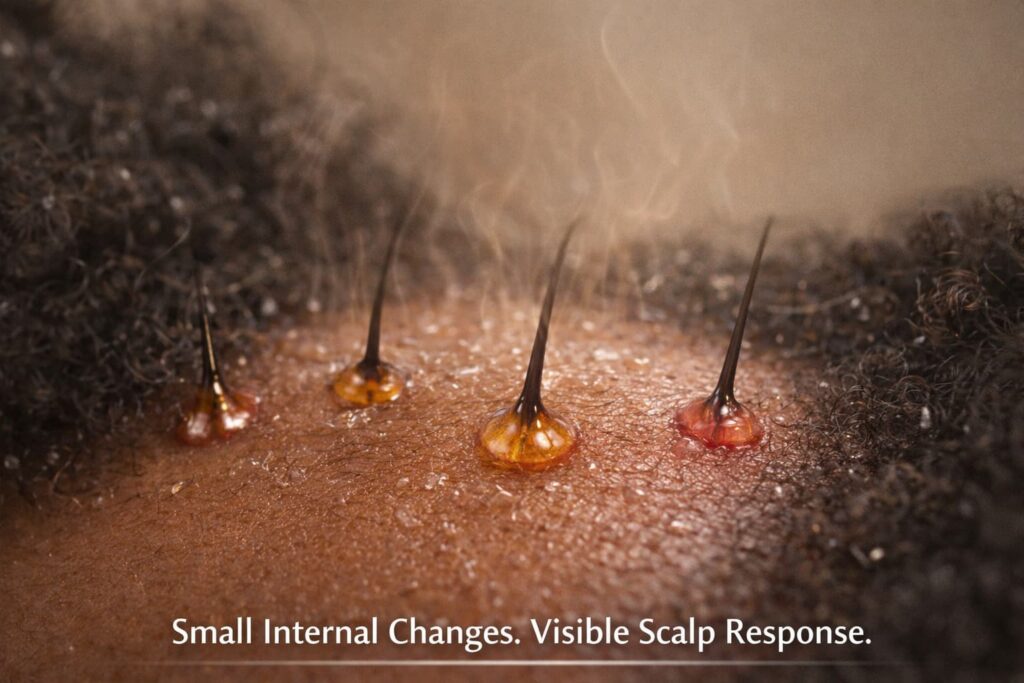
The Hidden Pattern: Why Hormonal Scalp Flare Keeps Showing Up
Your Scalp Isn’t Random—It Follows a Clock
Most people treat a flare like it just “happened.”
It didn’t.
Your scalp reacts to hormones the same way your skin and mood do.
So when things feel unpredictable, it’s usually because you’re not tracking the timing.
Think about it.
Have you ever noticed itching or oiliness showing up right before your period or during a stressful week?
That’s not coincidence.
That’s your biology running on a schedule.
Once you see the pattern, the chaos starts to make sense.
The Estrogen-Sebum Axis: Decoding the Chemistry Behind a Hormonal Scalp Flare
Estrogen is like a quiet protector.
It keeps your scalp balanced without you noticing.
When levels are steady, your oil stays light and spread out.
So your scalp feels normal, not greasy or dry.
Then the drop happens.
Right before your period—or during stages like perimenopause—estrogen falls.
At the same time, androgens (like testosterone) step in.
That shift changes your oil.
It gets thicker, heavier, and easier for yeast to feed on.
There’s another piece most people never hear about.
Your body uses something called SHBG to control how much “free” testosterone is active.
When SHBG is low, more of that hormone affects your scalp.
That’s when flare-ups feel stronger, not just more frequent.
How Life Stages Change Your Scalp Behavior
Your scalp at 16 is not your scalp at 30.
And it definitely isn’t the same after pregnancy.
Here’s how it usually plays out:
Puberty
Hormones spike fast.
Oil production increases before your skin knows how to handle it.
Pregnancy
Estrogen rises high.
So your scalp may feel calm, even if it wasn’t before.
Postpartum
Then everything drops suddenly.
That’s when shedding and flares hit hard.
Perimenopause
Estrogen becomes inconsistent.
So the scalp starts feeling dry, itchy, and harder to manage.
You might think your routine stopped working.
In reality, your biology changed.
The Progesterone Surge: How the Luteal Phase Heightens a Hormonal Scalp Flare
There’s a reason your scalp feels different mid-month.
After ovulation, progesterone rises.
And with it, your body temperature increases slightly.
That small change matters.
Warmer skin produces more oil.
More oil creates a better environment for irritation and yeast activity.
This is why your scalp might feel:
- Warmer than usual
- Slightly sore
- More reactive to products
It’s not in your head.
It’s a phase your body goes through every month.
A Simple Way to Predict What’s Coming
Once you map your cycle, patterns become clearer.
Here’s a quick guide:
- First half (after your period)
Your scalp is usually calmer and easier to manage - Second half (before your period)
Oil increases and sensitivity goes up - Low-estrogen stages (postpartum or perimenopause)
Dryness and itch become more common
So instead of reacting late, you can prepare early.
How to Stay Ahead of a Hormonal Scalp Flare
Waiting for a flare is the slowest way to deal with it.
Instead, small shifts at the right time make a bigger difference.
Before your high-risk days:
- Reduce sugar-heavy foods
- Focus on better sleep
- Keep your routine simple
During sensitive phases:
- Avoid hot water
- Use gentler cleansing
- Add light barrier support instead of heavy oils
When estrogen is low:
- Focus more on moisture and lipids
- Avoid over-washing
- Support your body from inside with nutrients like zinc and vitamin D
These aren’t random tips.
They match what your body is already doing.
What Changes When You Work With Your Cycle
At first, the difference feels small.
You notice less itching before your period.
Then you realize flakes don’t hit as hard.
Over time, the pattern softens.
Your scalp stops overreacting.
And your routine starts feeling predictable again.
Final Thought
A hormonal scalp flare isn’t something you fight blindly.
It’s something you learn to read.
Once you understand the timing, you stop guessing.
And when you stop guessing, you finally get control.
Next step:
Download the Hormonal Scalp Calendar and track your pattern for one full cycle.
That’s usually all it takes to see what your scalp has been trying to tell you.