
Table of Contents
- Introduction: The Conditioner Paradox
- Section 1: The Biology of the Rebound Oil Response
- Section 2: The Dehydration Trap — Why Your Scalp Is Actually Dry
- Section 3: The Regulation Strategy — How Conditioner Calms the Glands
- Conclusion: Breaking the Greasy Cycle
Introduction: The Conditioner Paradox
You skip conditioner because your hair gets oily fast. Logical move. Wrong outcome.
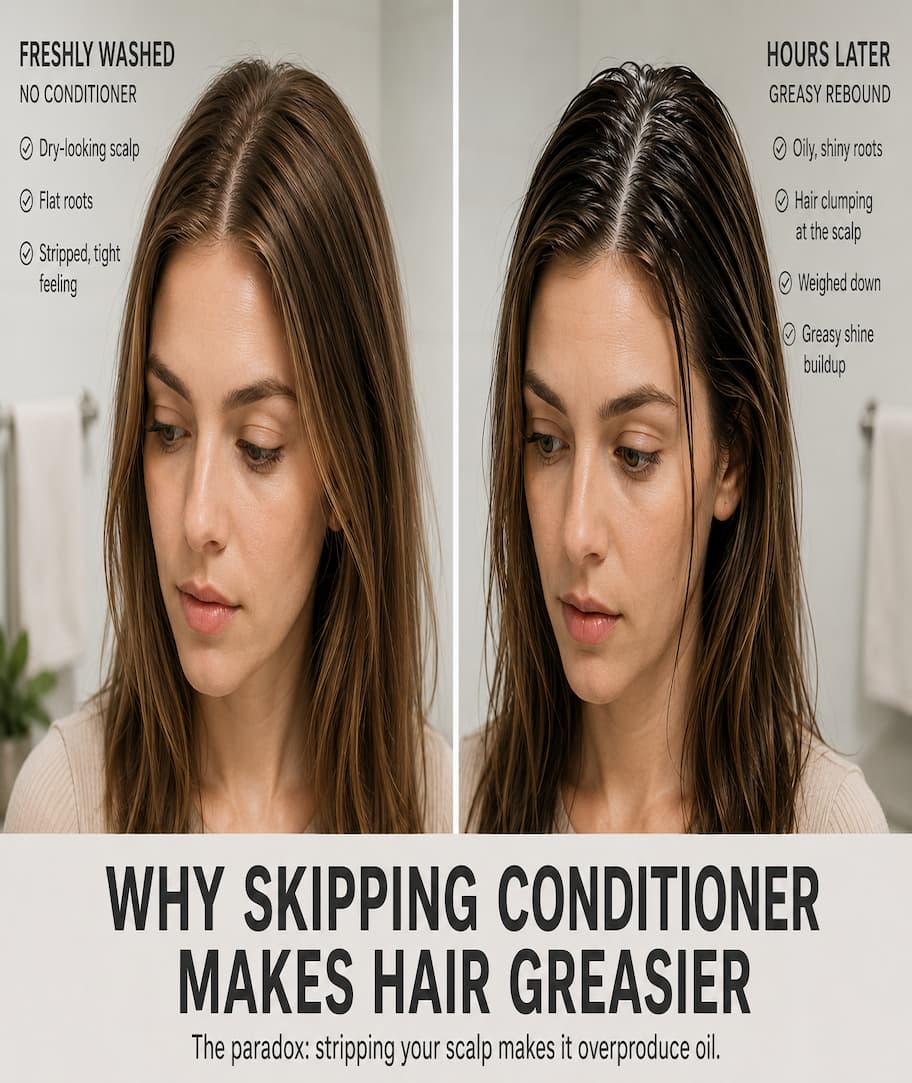
By mid-afternoon, your roots look greasy again. Not because your scalp “overproduces oil,” but because it’s reacting to being stripped and left exposed. When shampoo removes oil and nothing replaces that loss, the scalp reads it as damage. If your scalp gets greasy just hours after washing, The Big Shampoo Scam may already be controlling your routine.The response is immediate: ramp up sebum production to protect itself.
This is the conditioner paradox. Avoiding conditioner doesn’t keep hair cleaner longer. It triggers a rebound oil response that makes grease return faster and heavier.
Conditioner isn’t just cosmetic. It sends a signal. When the scalp senses restored lubrication and barrier support, oil output slows instead of spikes.
In this article, you’ll see how skipping conditioner destabilizes the scalp barrier, why that pushes oil glands into overdrive, and how a targeted conditioning routine actually keeps hair fresher for longer.
Section 1: The Biology of the Rebound Oil Response
The Stripping Cycle: Shampoo Without Relief
Shampoo does one job: remove lipids. That includes dirt, product residue, and your natural protective oils.
When cleansing strips these lipids and nothing replaces them, the scalp reads it as a threat. The barrier is exposed. Water loss increases. Nerve endings signal stress.
In response, the scalp activates an internal feedback loop. Sebaceous glands accelerate output to compensate for what was lost. This is the Rebound Oil Response — a protective reflex, not a flaw.
The problem isn’t cleansing. The problem is cleansing without relief. Without post-wash replenishment, the scalp stays in “damage control,” pushing oil production higher instead of stabilizing it.
Quality vs. Quantity: Why Panic Oil Feels Greasier
Not all oil behaves the same. Healthy sebum contains a balanced mix of wax esters, fatty acids, and lipids that sit close to the scalp and move slowly. Stress-triggered oil is different.
During rebound activity, glands release a thinner, more fluid oil. It spreads quickly along the hair shaft, collapses root lift, and creates visible greasiness within hours.
This is why greasy roots often appear faster on a stripped scalp than on a balanced one. It’s not excess oil alone — it’s low-quality oil produced too fast. Restore the signal, and oil production slows. Ignore it, and the cycle repeats daily.
Section 2: The Dehydration Trap — Why Your Scalp Is Actually Dry
Barrier Damage and “False Oiliness”
Greasy roots don’t always mean hydrated skin. In many cases, they signal the opposite. When you cleanse and skip replenishment, the outer barrier stays exposed. The surface loses water. Cells shrink. Micro-cracks form between them. To compensate, oil output increases and spreads across the scalp.
From the outside, this looks like excess oil. Underneath, the skin often feels tight, irritated, or flaky. This is false oiliness. Oil is acting as a poor substitute for water and structure. Without conditioning agents to reinforce the barrier, moisture keeps escaping and the stress signal never shuts off.
Oil rises. Hydration drops. The imbalance deepens.
Why Itch and Flaking Show Up Together
Healthy skin sheds invisibly. Damaged skin doesn’t. Without slip and flexibility from conditioning ingredients, dead cells cling instead of releasing cleanly. These cells mix with fast-moving oil and stay glued to the scalp surface.
The result is a sticky layer that traps flakes, heat, and microbes. Itch increases. Flaking becomes more visible. Washing more often only strips the barrier further.
This is why “oily dandruff” shows up most often on scalps that are actually dry underneath. Until the barrier is supported, oil and irritation will continue to coexist.
Section 3: The Regulation Strategy — How Conditioner Calms the Glands
Signaling the “Full” State
Oil glands don’t overproduce without a reason. They react to signals. When cleansing strips the surface and nothing replaces it, the scalp reads that as loss. The response is compensation. More oil. Faster flow.
A lightweight, pH-balanced conditioner changes that signal. Conditioning formulas contain lipids that closely resemble what healthy skin already uses. When these lipids sit on the surface, the barrier reads as complete. Hydrated. Protected. No emergency.
That feedback loop matters. Once the surface feels “full,” oil output slows back to baseline. Production stabilizes. Shine becomes controlled instead of runaway. Conditioner doesn’t add grease. It tells the glands to stand down.
The Application Protocol: Technique Over Avoidance
The mistake isn’t conditioning. It’s how people do it. You don’t need heavy masks or thick coatings at the roots. You need precision. Use a lightweight formula. Keep it simple. No heavy films.
Apply through mid-lengths first. Then, with what’s left on your palms, lightly feather over the scalp area. You’re not coating. You’re signaling. Finish with a thorough rinse using lukewarm water.
This small contact is enough to reinforce the barrier without weighing hair down. Skip the signal entirely, and the glands stay in emergency mode.
Conclusion: Breaking the Greasy Cycle
Greasy roots aren’t a cleanliness issue. They’re a communication problem. When you strip the scalp and refuse to replenish it, oil glands respond with overdrive. When you restore the barrier, they calm down. Conditioner and scalp oil balance works because the scalp responds to signals, not rules you set out of fear.
Once you stop treating conditioner like dead weight and start using it as a regulator, oil output stabilizes. Roots stay lighter. Wash days stretch naturally. This isn’t about adding more product. It’s about sending the right message.
Afraid of the grease? Start smart. Explore our Top 3 Lightweight Scalp-Safe Conditioners and reset the cycle.