
The Desiccation Audit: Understanding the Roots of Your Dry Scalp
1. Introduction: The “Invisible Fire” of Dermal Dehydration
For a long time, you may have thought a flake is just a flake. However, that small white speck is actually a warning sign. It shows your scalp is struggling to protect itself.
This is where the journey begins. You are not just dealing with a dry scalp as a small problem. Instead, you are looking at a deeper issue a breakdown in your skin’s defense system.
So rather than chasing quick shampoo fixes, you will start focusing on repair. Step by step, you move toward full control of your scalp health.
2. The Clinical Reality: What Is Dry Scalp a Symptom Of?
Your scalp has a top layer called the stratum corneum. Think of it like a wall made of tiny bricks. When this wall is strong, it keeps water inside your skin.
But when it breaks down, things change fast. The “bricks” loosen, and water escapes into the air. As a result, your scalp starts to feel tight and dry.
At the same time, your scalp may not produce enough oil. This creates a “lipid void.” Without that oil, there is nothing to seal in moisture.
So the problem is not just dryness. It is loss of protection.
To truly fix this, you need to understand the deeper causes behind it. Surface care alone will not solve it.
The Logic: Low Sebum +Alkaline pH = Epidermal Desiccation
A) The Scourge of Epidermal Desiccation
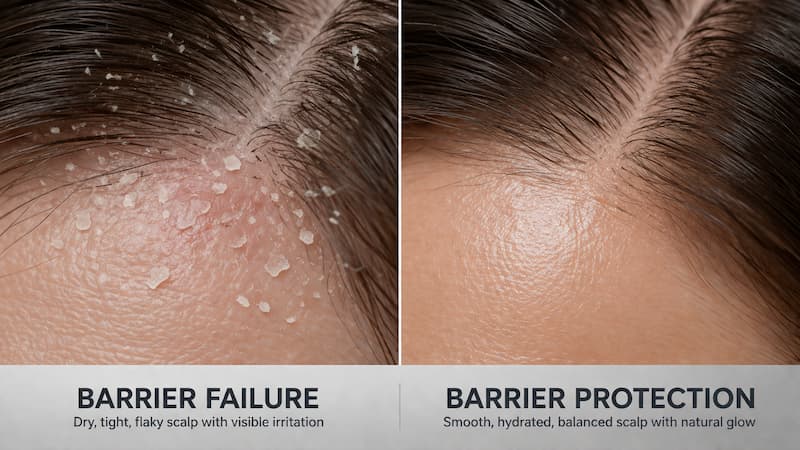
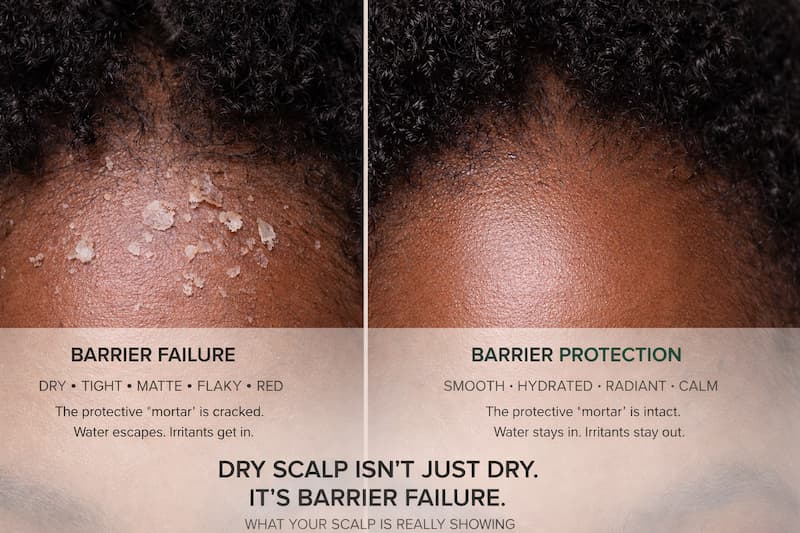
When your scalp is healthy, it works like a strong wall. The “mortar” between the skin cells stays thick and keeps water inside. At the same time, it blocks dirt and irritants from getting in.
However, things change when that barrier gets damaged. Harsh products or dry air can strip away that protection. Once the seal breaks, water starts escaping from your skin into the air.
This process is called Transepidermal Water Loss (TEWL). It may sound simple, yet the effect is serious. Your skin cells begin to shrink. Then small cracks form. After that, the surface becomes weak and uneven.
That is when the itching starts. It may feel like a light burn or a constant irritation. This is what we call the “Invisible Fire.”
B) The Lipid Void and the pH Paradox
Now, you might wonder why your conditioner is not fixing the problem. The answer lies in something called the Lipid Void.
Your scalp needs natural oils, called lipids, to stay sealed and protected. These oils only work well in a slightly acidic environment. The ideal level sits around a pH of 5.5.
However, many common products are too alkaline. When you use them, they push your scalp above its safe range. As a result, the “glue” that holds your skin cells together starts to break apart.
Instead of helping, these products make things worse. They remove the very lipids your scalp needs to hold moisture. Over time, this creates a cycle where dryness keeps coming back.
The Logic:
Ceramide Depletion + Alkaline pH Shift= Chronic Dry Scalp
C) Identifying the Hidden Triggers
Fixing what you see on the surface is not enough. You also need to look deeper.
Sometimes, the real problem comes from things you do every day. For example, hot showers, harsh shampoos, or even dry air can slowly damage your scalp.
Other times, the cause may be internal. Your diet, stress levels, or hydration can all affect how your skin behaves.
Because of this, long-term healing starts with awareness. You need to spot the patterns that keep triggering the problem.
Once you understand what is causing the damage, you can finally break the cycle. Then, instead of short-term relief, you start building a scalp that stays strong over time.
3. Common Dry Scalp Symptoms: Identifying the Scourge
The most dangerous trap in hair care is the “Snowfall Confusion.” Most people see a white flake and immediately reach for a harsh, zinc-based “Dandruff” shampoo. If you have a dry scalp, this is the equivalent of pouring salt into a wound.
To achieve Scalp Sovereignty, you must stop guessing and start auditing. Your symptoms are a biological language here is how to translate them tonight.
1. The Visual Audit: “Powder” vs. “Plate”
A dry scalp does not produce large, oily chunks. Instead, it sheds “Micro-Flakes.”
- The Appearance: Think of fine, white dust or “powder” that falls easily when you touch your hair.
- The Texture: These flakes are dry, translucent, and lack any “waxy” or yellow tint.
If you see oily, yellowish scales that stick to the hair shaft, you aren’t dealing with simple desiccation. Before you apply any topical “rescue,” you must perform a clinical audit to differentiate between dry scalp and dandruff to ensure you aren’t feeding the very problem you’re trying to kill.
2. The Sensation Audit: The “Tight Mask”
While dandruff is often characterized by a “greasy itch” or burning sensation, a dry scalp tells a different story. It feels like a mask that is two sizes too small.
- The Tightness: You feel a sharp, “pulling” sensation, especially after a hot shower or in low-humidity environments.
- The “Prickle”: Instead of a deep, thrumming itch, a dry scalp often produces a sharp, “prickly” sensation as the micro-fissures in the stratum corneum react to the air.
3. The Elasticity Test
A hydrated scalp is flexible and moves easily over the skull. A dry scalp becomes “fixed” and brittle. This lack of elasticity doesn’t just cause discomfort it leads to follicular stress, which can eventually impact the quality of the hair fiber itself.
The 0.01% Warning: > Treating a thirsty, dry scalp with antifungal surfactants ($pH$ 8.0+) will “unzipper” your remaining lipids and trigger a systemic barrier collapse.
| Symptom Check | Dry Scalp (Desiccation) | Dandruff (Microbial) |
| Flake Color | White / Translucent | Yellow / Opaque |
| Flake Texture | Dry / Dusty | Oily / Waxy |
| Scalp Feeling | Tight / Brittle | Greasy / Burning |
| Hair Quality | Often Frizzy / Dull | Often Oily at the Root |
4. The Proactive Detection: Catching the Early Warning Signs
In the Harbivaa philosophy, we do not wait for the “snowfall” to react. A dry scalp does not manifest overnight; it is the result of a 48-hour downward spiral of hydration. If you can identify these “Hidden Signals,” you can intervene with a lipid reset before the first flake ever touches your shoulder.
1. The “Prickle” Phase (T-Minus 48 Hours)
The earliest indicator of a dry scalp is a specific, sharp sensation that occurs immediately after a shower or when moving from a humid environment to an air-conditioned room. This isn’t a deep itch; it is a “prickle.”
This sensation is your nerves reacting to Micro-Fissures. As the moisture evaporates, the skin tiles begin to curl at the edges, exposing the sensitive nerve endings below to the air. If you feel this “static” on your skin, your barrier is already leaking.
2. The Loss of “Dermal Bounce” (T-Minus 24 Hours)
A healthy scalp has high “Turgor”—it is plump, flexible, and moves freely. When you are descending into a dry scalp flare-up, the skin becomes “fixed.”
- The Test: Using the pads of your fingers, try to move the skin on the top of your head in a circular motion.
- The Signal: If the skin feels “tight” against the skull or resists movement, you are experiencing Advanced Desiccation. The fluid between your skin cells has been depleted, leaving the tissue brittle and prone to cracking.
3. The Luster Audit
Because your scalp and hair share the same microbiome and nutrient source, your hair fibers often act as a “canary in the coal mine.” A sudden, unexplained dullness at the roots is a sign that sebum production has stalled. Without this protective oil, your dry scalp is left defenseless against the environment.
The Specialist’s Strategy: > “Most people ignore the ‘tightness’ until it becomes an itch. To maintain true sovereignty, you must learn to identify the early warning signs of scalp distress and deploy a lipid buffer the moment the ‘Prickle’ begins.”
5. Why Traditional “Moisturizers” Often Fail
Many people try to fix dryness by adding heavy oils or thick products. At first, this feels helpful. Yet over time, it creates new problems.
The Occlusive Myth
Heavy oils sit on top of the scalp. They block air and trap heat. Because of that, your follicles can feel suffocated.
The pH Paradox
Some “moisturizing” shampoos are too harsh. They raise your scalp’s pH level. This strips away the natural protective layer called the acid mantle.
So instead of healing, the scalp becomes even drier.
Common Mistakes and Fixes
| Common Mistake | Biological Cost | Expert Fix |
|---|---|---|
| Hot Water | Breaks down skin lipids | Use lukewarm water |
| Heavy Oils | Blocks follicles | Use light, bio-identical oils |
| Over-Washing | Removes natural oil | Wash less often |
6. Conclusion: Your Roadmap to Dermal Sovereignty
Today, you stop guessing. Instead, you start understanding what your scalp really needs.
Your dry scalp is not asking for more products. It is asking for repair.
Now you know the problem goes deeper than the surface. Because of that, your next step is to measure the damage.
Move forward to the next stage. Check your scalp closely and set your starting point for the next 29 days.