
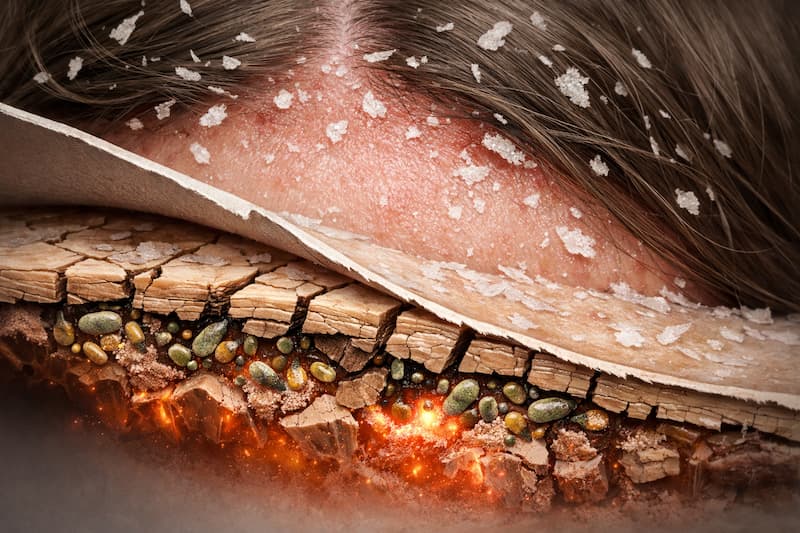
Introduction: Understanding Dry Scalp and Hair Shedding
When your scalp feels tight and flakes start falling, you might also notice more hair on your pillow.
So, that can feel scary, especially when you don’t know why it’s happening.
Even though dryness alone doesn’t kill hair roots, the reaction inside your scalp can.
Because of that, understanding the link between dry scalp and hair shedding helps you protect your hair early.
Instead of just adding moisture, you need to protect the root where hair grows.
So, the goal shifts from surface care to deeper follicle protection.
II.Dry Scalp and Hair Shedding: Direct vs Indirect Causes
First, let’s clear something up.
Dry scalp doesn’t directly pull your hair out.
However, the things you do because of dryness can cause damage.
The Mechanical Trauma
When your scalp itches, you scratch it.
So, that scratching can pull out hairs that were already loose.
Also, some hairs are in a resting stage called the telogen phase.
Because of that, they fall out more easily when you touch or scratch them.
Micro-Inflammation
At the same time, a dry scalp sends stress signals.
So, your body reacts by creating tiny inflammation around hair roots.
Because of this, the growth phase (called anagen) can become shorter.
And then, your hair may fall out sooner than it should.
III. The Biological Link: How Inflammation Affects Growth
Now, let’s look deeper inside your scalp.
Because this is where the real problem begins.
The Cytokine Surge
When your scalp barrier breaks, your body sends out “alarm signals.”
So, these signals are called inflammatory cytokines.
Because of that, they can slow down how fast your hair grows.
And then, your hair becomes weaker over time.
Oxidative Stress
At the same time, your scalp loses its natural oils.
So, without those oils, your hair roots are less protected.
Because of that, damage called oxidative stress can happen.
And then, the hair that grows back may be thinner or weaker.
IV. Barrier Failure and the “Miniaturization” Risk
Next, let’s talk about your scalp barrier.
Because this is like a shield for your hair roots.
TEWL and the Follicular Environment
When the barrier is damaged, water escapes from your skin.
So, this is called transepidermal water loss (TEWL).
Because of that, not only your skin dries out, but your hair roots do too.
And then, the environment around the hair bulb becomes weak.
The Scalp Microbiome
Also, your scalp has tiny helpful bacteria.
So, these bacteria protect your hair from harmful microbes.
However, a dry scalp often loses this balance.
Because of that, harmful organisms can grow more easily.
V.Dry Scalp and Hair Shedding: What’s Normal vs Not
Now, not all hair fall is bad.
So, you need to know what’s normal and what’s not.
The 100-Strand Rule
On average, losing up to 100 hairs a day is normal.
So, if you stay around that number, your scalp is likely okay.
However, if you notice sudden heavy shedding, something is wrong.
Visual Clues
Look at the hair you lose.
Because this gives you important clues.
- If you see a small white bulb → normal shedding (telogen hair)
- If hair looks snapped or broken → damage from scratching
- If hair falls with flakes and redness → inflammation issue
So, your scalp is telling you a story—you just need to read it.
Fixing Dry Scalp and Hair Shedding Step by Step
Now let’s fix the problem step by step.
Because stopping hair shedding starts with healing your scalp.
Step 1: Quenching the Inflammation
First, calm your scalp.
So, use biomimetic lipids like C8/C10 oils.
Because these act like your natural oils, they repair the barrier fast.
And then, the inflammation starts to settle down.
Step 2: Non-Aggressive Cleansing
Next, rethink your shampoo.
Because harsh shampoos strip away your protection.
So, avoid sulfates that make your scalp feel “squeaky clean.”
And instead, use gentle, non-stripping cleansers.
This helps your scalp heal instead of getting worse.
Step 3: Internal Support
Finally, support your body from inside.
Because your scalp depends on your nutrition.
Focus on:
- Vitamin D → supports hair growth cycle
- Zinc → helps repair skin and reduce inflammation
So, your body can rebuild stronger hair over time.
Bonus: External Shield
Also, using a barrier-repair product like ScalpRx helps a lot.
Because it protects your scalp while it heals internally.
VII. Conclusion: From Crisis to Consistency
So, dry scalp and hair shedding are connected.
Because both come from the same problem—barrier damage.
Instead of fighting your scalp, you need to support it.
And then, your hair gets the chance to grow normally again.
When you protect your scalp:
- Itch reduces
- Flakes slow down
- Hair shedding improves
So, your scalp isn’t the enemy.
It’s simply asking for the right kind of care.
Final Step
Still worried about your hair fall?
Then take the Scalp Type Quiz to understand what your scalp needs.
And if you want faster results, start the 7-Day Scalp Reset.
Because once you fix the barrier,
you protect the future of your hair.