
The Cleanse: Navigating the Best Dry Scalp Shampoos for Relief
Why Your Current Wash Is Part of the Problem
The shampoo aisle is often where hope goes to die. You grab a bottle labeled “moisturizing,” rinse, and ten minutes later your scalp feels tight and dry again. The issue isn’t bad luck. It’s chemistry.
Finding dry scalp shampoos for relief isn’t about fragrance or branding. It comes down to the surfactant-to-lipid ratio and how aggressively that formula strips your barrier. In 2026, cleansing isn’t just about removing buildup — it’s about calming the Invisible Fire while protecting the lipids your scalp needs to stay balanced.
The Selection Framework: What to Look For in Dry Scalp Shampoos for Relief
Choosing effective dry scalp shampoos for relief starts with a filter. Not every gentle label protects your barrier.
Think in terms of a simple “Safe List.”
1. Sulfate-Free Base
A quality sulfate-free scalp wash reduces aggressive stripping. Harsh surfactants increase water loss and weaken the lipid layer.
Look for:
- Coco-glucoside
- Sodium cocoyl isethionate
- Decyl glucoside
These cleanse without over-removing protective oils. Surfactant safety matters more than foam volume.
2. Pyrithione Zinc (Used Strategically)
When flakes are linked to inflammation or yeast imbalance, low-dose pyrithione zinc helps regulate the scalp environment.
Use in moderation:
- 1–2 times weekly
- Rotate with a gentler formula
Overuse can dry the scalp further. Balance is key.
3. Urea
Urea works as both a mild exfoliant and a hydration enhancer. It softens compact flakes and improves moisture retention.
Ideal for:
- Thick scaling
- Rough texture
- Stubborn buildup
If you want to understand why these chemicals matter, review our master list of essential ingredients in treatment shampoos (Day 23) to see the science behind the lather.
Top Professional Picks: High-Performance Dry Scalp Shampoos for Relief
Not all strong formulas are equal. High-performance dry scalp shampoos for relief fall into two main groups.
Clinical Class
These are often dermatologist-recommended shampoos designed for persistent symptoms.
Features:
- Targeted actives (zinc, ketoconazole, salicylic acid)
- Controlled surfactant systems
- pH-balanced scalp care (around 4.5–5.5)
The correct pH protects the acid mantle and reduces irritation after rinsing.
Best for:
- Chronic flaking
- Ongoing inflammation
- Recurrent itch
Drugstore Heroes
These are accessible but still effective when chosen carefully.
Look for:
- Sulfate-free bases
- Barrier-supporting ingredients
- Clearly labeled pH balance
Avoid formulas loaded with heavy fragrance or menthol-heavy cooling agents that irritate compromised skin.
Performance depends on formulation, not price.
The Green Choice: Transitioning to a Dry Scalp Natural Shampoo
Some prefer plant-based scalp relief. Botanical formulas can work when designed properly.
Effective organic dry scalp solutions focus on:
- Aloe vera – hydrates and calms irritation
- Jojoba oil – mimics natural sebum without clogging
- Oat milk or oat extract – soothes inflammation
Plant-based shampoos work best for:
- Mild dryness
- Sensitive skin
- Maintenance between medicated cycles
Natural does not mean weak. It means fewer synthetic actives and more botanical support.
For those avoiding synthetics, review our guide on natural ingredients for dry scalp (Day 14). It outlines the raw materials that provide relief without relying on heavy laboratory compounds.
The “Double Cleanse” Method for Maximum Scalp Relief
Most people wash their hair. They rarely wash their scalp.
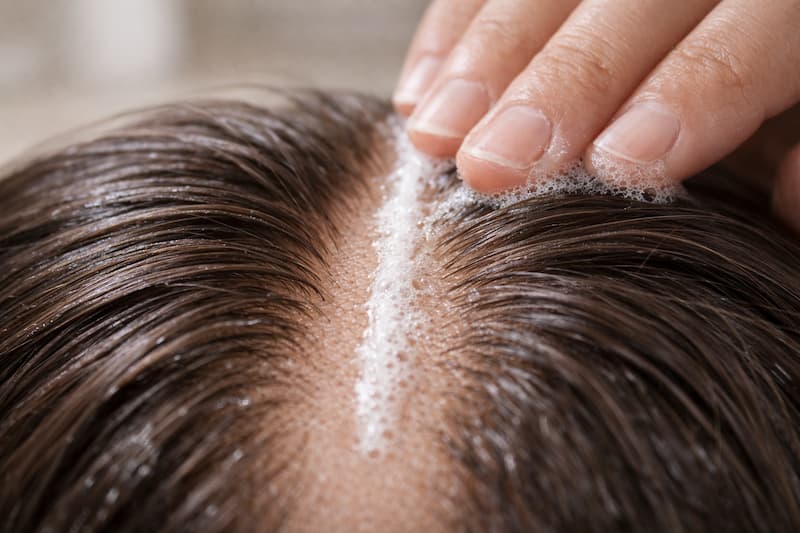
If you want real results from dry scalp shampoos for relief, your scalp washing technique must change. Application and timing determine performance.
Step 1: Targeted First Cleanse
Purpose: Remove surface oil and buildup.
How to do it:
- Wet hair thoroughly with lukewarm water
- Apply shampoo directly to the scalp, not the lengths
- Use fingertips to massage in small circular motions
- Focus on crown, temples, and nape
Rinse after 60 seconds. This first wash clears debris so actives can work properly in round two.
Step 2: Treatment Cleanse (The 3-Minute Rule)
Purpose: Allow active ingredients to function.
- Apply a smaller amount than the first wash
- Distribute evenly across the scalp
- Massage for 60–90 seconds
Then pause.
Leave the lather on for a full 3 minutes.
This increases surfactant contact time and allows zinc, urea, or other actives to interact with the skin. Rinsing too quickly reduces effectiveness.
Step 3: Lukewarm Rinse
Hot water increases dryness and disrupts the acid mantle. Use lukewarm water to rinse thoroughly without overstimulating oil glands.
Done correctly, this method improves performance without switching products.
Conclusion: Your Shampoo Is a Tool, Not a Cure
Even the best dry scalp shampoos for relief cannot fix a barrier that is stressed the other 23 hours of the day.
Your shampoo removes buildup and delivers actives. It does not:
- Repair chronic inflammation alone
- Control stress triggers
- Replace hydration layers
- Stabilize your microbiome long term
Relief depends on what you do after you towel dry.
To reduce relapse, integrate your wash step into our daily prevention routines (Day 17) for long-term barrier health.
Next, move to Day 22 for the full system breakdown and final strategy.
For a shortcut, download the 39-page PDF strategy guide. It includes our 2026 clinical-safety audit “Cheat Sheet” featuring the top 5 shampoos that passed strict barrier-protection standards.