
Table of Contents
- Introduction: When the Reset Backfires
- Section 1: The Failure Points — Why Clarifying Isn’t Working
- Section 2: The Red Flags — Signs Your Clarifier Is Too Strong
- Section 3: The Frequency Framework — Weekly vs. Monthly
- Conclusion: Master the Reset
Introduction: When the Reset Backfires
You did exactly what you were told. You reached for a clarifying shampoo to reset your scalp.
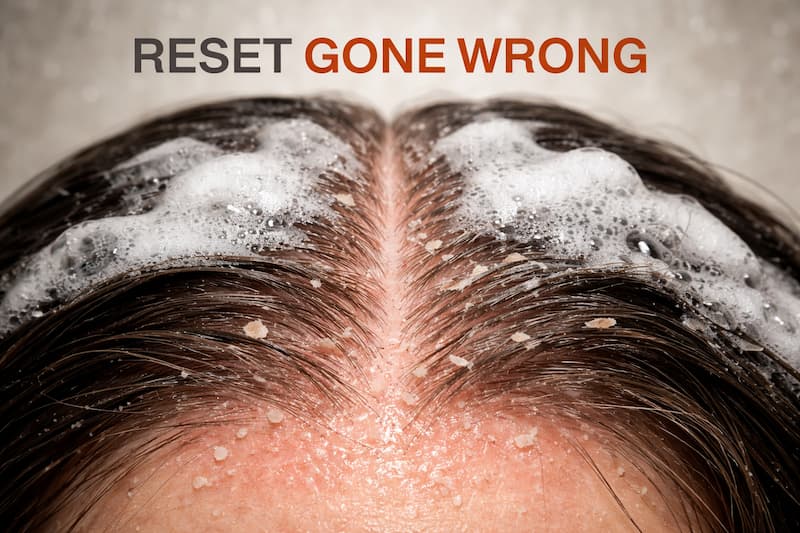
Instead of clean roots, you’re left with a tacky feel or an itchy, tight scalp that feels worse than before. That’s not bad luck. It’s a misapplied solution.
Clarifying is not just a stronger version of shampoo. It’s a chemical intervention. And like any intervention, it only works when it matches the problem. If buildup remains, you’re targeting the wrong residue. If irritation follows, your scalp barrier is already compromised and reacting to the assault.
Most people fail with clarifying shampoos for one reason: they treat all buildup the same and ignore what the scalp is signaling back.
This article breaks down Clarifying Shampoo Logic. You’ll learn why some cleansers never fully clean, how to spot the signs of over-clarifying, and how to set a frequency that clears buildup without triggering damage.
Section 1: The Failure Points — Why Your Clarifying Shampoo Isn’t Working
The Surfactant Mismatch (Oil vs. Minerals)
Most clarifying shampoos fail for a simple reason: they’re solving the wrong problem.
A standard clarifier is built to dissolve oils, waxes, and silicones. It works well for styling residue and heavy conditioners. But mineral buildup is a different chemistry entirely.
Hard water leaves behind calcium and magnesium. These minerals bind to sebum and shampoo residue, forming a rigid film that surfactants can’t lift. When you use a regular clarifier on mineral buildup, hair feels clean but oddly tacky, roots look dull, and the scalp never feels reset.
This is where chelating vs. clarifying matters. Mineral issues require chelating agents like Disodium EDTA, not stronger detergents. If the shampoo doesn’t target minerals, it cannot remove them—no matter how often you wash.
The Application Error (The “One-and-Done” Myth)
Even the right shampoo can fail if it’s used incorrectly.
Heavy polymers, polyquats, and waxes don’t dissolve instantly. A single wash only loosens the surface layer. It doesn’t clear what’s anchored around the follicle.
This is why using clarifying shampoo correctly often involves a double cleanse:
- First wash: Breaks surface tension and softens buildup
- Second wash: Fully emulsifies and removes residue from the scalp
This double-cleansing approach isn’t about harshness. It’s about chemistry and contact time. Skip the second wash, and buildup stays behind.
Section 2: The Red Flags — Signs Your Clarifier Is Too Strong
The Rebound Oil & “Squeaky” Warning
If your hair feels squeaky clean, that’s not a win. It’s a warning.
This texture means total lipid removal. Your scalp barrier has been stripped past its comfort range. Tightness appears within hours. Oil follows soon after.
These are classic signs of over-clarifying. When a clarifier outpaces barrier strength, oil glands switch on fast. Shine shows up within 24 hours, not because your scalp is oily by nature, but because it’s compensating.
Common damaged barrier symptoms include:
- Tight or stretched skin after washing
- Greasy roots the next day
- Hair that feels clean but won’t behave
“Squeaky clean” isn’t a goal. Lipids act as feedback. Remove all of them, and oil production spikes.
Micro-Inflammation and Increased Sensitivity
Another red flag shows up as irritation.
If you feel itch, warmth, or mild burning after clarifying, the formula is likely too alkaline. Many strong clarifiers run high pH. That lifts outer skin cells and creates gaps.
Once that happens, irritants get in. This explains itchy scalp after clarifying, redness along the hairline, and sensitivity to products you normally tolerate.
Micro-inflammation often feels subtle:
- Tingling after rinsing
- Light itch that builds through the day
- New sensitivity to familiar products
If cleaning leaves your scalp louder than before, the formula is doing too much.
Section 3: The Frequency Framework — Weekly vs. Monthly
Calculating Your Buildup Rate
Stop asking how often to clarify in general. Start measuring how fast buildup forms on your scalp.
Buildup rate depends on three inputs:
- Product load
- Environment
- Scalp oil output
Weekly clarifying
- Heavy silicone or butter use
- Regular swimming
- Very oily scalps in humid climates
Bi-weekly clarifying
- Hard water exposure
- Frequent workouts
- Moderate product use
Monthly clarifying
- Minimalist routines
- Dry or high-altitude climates
- Sensitive or dry scalps
If roots feel coated or tacky before they feel dirty, buildup rate is high. If tightness appears before grease, it’s low.
The Post-Clarify Re-Set
Clarifying is a removal step. It must be followed by repair.
After clarifying, the cuticle is open and the scalp barrier is vulnerable. Skipping recovery is how irritation starts.
Do this immediately:
- Apply a pH-balanced rinse, or
- Use a lipid-rich, scalp-safe conditioner or mask
This closes the cuticle, slows moisture loss, and calms nerve endings. Without it, oil rebound and sensitivity are likely.
Conclusion: Master the Reset
Clarifying Shampoo Logic is about precision, not force. When you match the right chemistry to your buildup type and respect your barrier’s limits, clarifying works with your scalp instead of against it.
Treat clarifying as a strategic reset. Remove what doesn’t belong, then restore what does. Respect timing, pH, and recovery.
Still feeling the buildup? Take our Scalp Type Quiz to find your perfect clarifying match.