
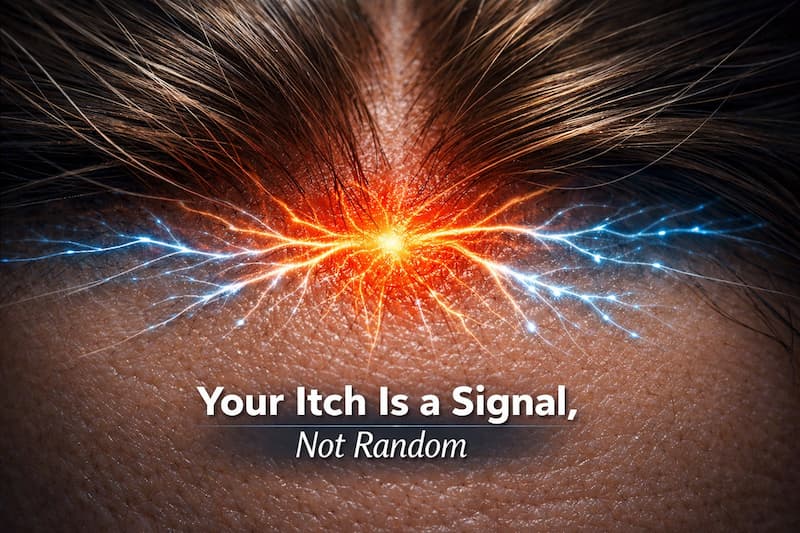
I. Introduction: The Neurology of the Itch
An itchy scalp red flag is not just a random feeling.
Instead, it’s your body sending you a message.
The itch you feel is called pruritus, and it comes from your nervous system.
So, when your scalp keeps itching, something deeper is going wrong.
Most people think it’s just dandruff.
But actually, it can mean your scalp barrier is weak or damaged.
Because of this, learning what your itch means helps you act early.
II. The Anatomy of an Itch: Why the Barrier Breaks
The Nerve-Lipid Connection
Your scalp has a protective layer called the stratum corneum.
However, when this layer loses its oils, it becomes thin and weak.
Then, your nerves get exposed to air, heat, and irritants.
As a result, they send itch signals faster than normal.
So, even small things can make your scalp feel irritated.
The Micro-Inflammation Cycle
When you scratch, it may feel good for a second.
But then, your body releases histamine, which makes itching worse.
Because of this, you enter a loop—itch, scratch, itch again.
So, the barrier gets more damaged each time.
III. The “Red Flag” Checklist: Triage Your Symptoms
Not all itching is the same.
So, you need to know when your itchy scalp is a red flag.
Adherent Yellow Scales
If your flakes are yellow and sticky, that’s not simple dryness.
Instead, it means there is too much oil and yeast on your scalp.
Erythema (Deep Redness)
If your scalp looks very red, your body is fighting something.
Then, inflammatory chemicals rush to the area.
So, this is a sign of active irritation inside your skin.
Localized Hair Thinning
If hair starts thinning in itchy areas, take it seriously.
Because of inflammation, your hair follicles can weaken.
So, this can lead to hair loss if ignored.
Tenderness and Heat
If your scalp feels sore or warm, that’s a warning sign.
Then, it may mean bacteria have joined the problem.
So, your body could be dealing with a stronger reaction.
IV. Folliculitis vs. Seborrheic Dermatitis: Identifying the Red Flag
The Pustule Problem
Sometimes you may see small bumps or pus.
Then, it’s not just flakes—it’s likely folliculitis.
So, this means hair follicles are infected, not just irritated.
The Scarring Risk
If this condition is ignored, damage can become permanent.
Because of that, hair follicles may stop growing hair completely.
So, early action protects your hair long-term.
V. The Systemic Blueprint: Gut and Stress Triggers
The Gut-Skin Axis
Your gut health affects your scalp more than you think.
If your gut is unbalanced, inflammation spreads through your body.
Then, your scalp reacts with itching and flakes.
So, fixing your gut helps calm your skin too.
The Cortisol Spike
Stress also plays a big role.
When you’re stressed, your body releases cortisol.
Then, your nerves become more sensitive to itch signals.
So, even small triggers feel much worse.
VI. The Barrier-First Recovery Protocol
Step 1: Quench the Fire
First, calm your scalp using oils that match your natural skin lipids.
These are called biomimetic lipids.
They cover exposed nerves and reduce irritation.
So, your itch starts to settle down.
Step 2: Bio-Compatible Cleansing
Next, stop using harsh shampoos.
Instead, switch to gentle, non-stripping cleansers like ScalpRx.
These clean your scalp without removing protective oils.
So, your barrier can rebuild safely.
Step 3: Internal Reset
Finally, support your body from the inside.
Focus on nutrients like zinc and vitamin D.
These help repair your skin and reduce inflammation.
So, future flare-ups become less likely.
VII. Conclusion: Listening to Your Scalp
Your itch is not random.
Instead, it’s your body asking for help.
So, scratching harder won’t fix the problem.
But understanding your itchy scalp red flags will.
When you act early, you protect both your skin and your hair.
Because of this, you stay in control instead of reacting too late.
If you think your symptoms are getting serious, take the Scalp Type Quiz.
Then, follow the 7-Day Scalp Reset to calm your scalp the right way.