
The Science of Topical Recovery and Scalp Barrier Repair
Day 3 leaves the scalp clean yet exposed. Residue is gone. However, the surface now lacks its natural seal. This is the moment scalp barrier repair begins.
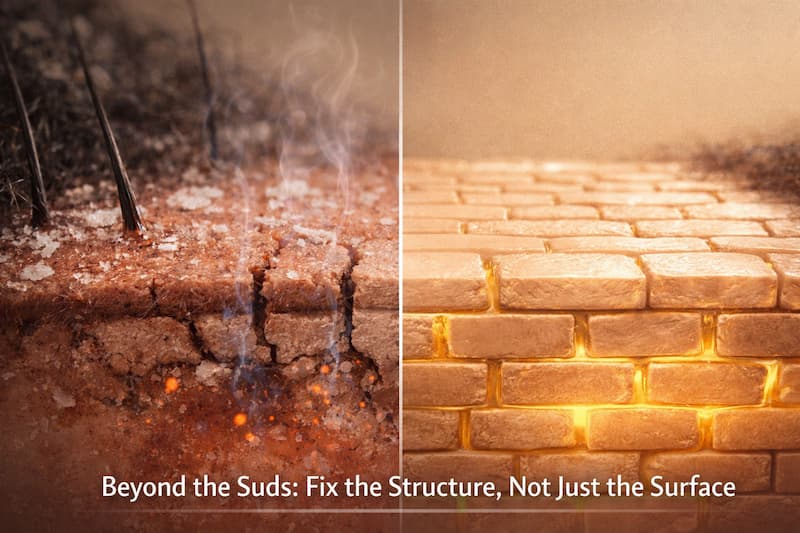
The stratum corneum works like a wall. Cells form the bricks. Lipids sit between them as mortar. When this structure holds, water stays in. Irritants stay out. Sensation remains calm. Yet once lipids are stripped, gaps appear. Moisture escapes. Reactivity rises. The microbiome shifts off balance.
So recovery depends on rebuilding that mortar. Ceramides must return. Free fatty acids must rebalance. Inflammation must settle around each follicle. Without this renewal, the wall stays porous. With it, the barrier regains strength and flexibility.
Therefore Day 4 shifts from cleansing to construction. Topical care now acts as instruction, not coating. Signals replace residue. Lipids reform. The scalp learns to seal itself again.
Niacinamide (Vitamin B3): Driving Lipid Renewal
Niacinamide works quietly. Applied in modest concentration, it enters the upper layers of the scalp and shifts metabolism toward repair. Studies show it increases the synthesis of ceramides and free fatty acids — the very lipids depleted by aggressive washing. Barrier cohesion improves. TEWL drops. The surface holds moisture again.
For reactive scalps, its anti-inflammatory action is equally important. The faint red halo around follicles — a sign of low-grade inflammation — softens. Sensation steadies. Sebum output, often erratic after barrier damage, moves toward balance.
Concentration matters. Around 3–5% offers the repair signal without provoking flush or sting. Higher levels can irritate sensitized skin, particularly on a scalp already stripped. The aim is restoration, not stimulation.
Niacinamide, in this context, behaves like a mason returning mortar to gaps: quiet, structural, cumulative.
Allantoin: The Ultimate Soothing Agent
Repair agents cannot penetrate through a surface clogged with retained scale. Allantoin addresses this gently. It is a keratolytic in the mildest sense — loosening the bonds of dead cells so they shed without abrasion. The scalp clears without friction.
This shedding opens space for barrier-restoring lipids and humectants to reach viable layers. Cell turnover normalizes. The surface smooths. Sensation calms.
Allantoin carries an additional resonance: it is derived from comfrey. The association matters to those who look for botanical lineage, yet its function remains clinical. It supports regeneration, encourages epithelial repair, and reduces the sting that follows washing on compromised skin.
Where niacinamide rebuilds mortar, allantoin clears debris from the wall face so rebuilding can proceed.
The Supporting Cast: Panthenol and Bisabolol
Barrier recovery rarely rests on a single molecule. Panthenol and bisabolol extend the work into hydration and neural quieting.
Panthenol (Pro-Vitamin B5) behaves as a humectant. It binds water, drawing it into the deeper layers of the stratum corneum. Hydrated cells swell slightly, closing micro-fissures and restoring elasticity. Panthenol also improves surface smoothness, which reduces friction during movement and grooming.
Bisabolol, derived from chamomile, acts further upstream. It dampens the itch signal at receptor level, moderating the cascade that follows irritation. Redness fades. Sensation steadies. Where inflammation once amplified, bisabolol lowers the gain.
Together they complete a triad: niacinamide rebuilds lipids, allantoin clears the path, panthenol hydrates, bisabolol quiets.
Once you’ve selected these ingredients, they must live within a stable routine — see Building a Sustainable Scalp Care Routine to anchor them into weekly care.
Maximizing Absorption in Scalp Barrier Repair: The Day 4 Massage Protocol
Topicals fail as often from poor delivery as from poor selection. The scalp is vascular, layered, mobile. Application must respect these properties.
Gentle massage increases microcirculation. Blood flow rises, bringing oxygen and nutrients toward the follicular bulb. Intercellular spaces open fractionally, allowing actives to disperse. The movement need not be forceful. In fact, pressure disrupts the barrier you are trying to restore.
Apply serums to a slightly damp scalp. Hydration swells corneum cells, easing molecular passage between them. This enhances follicular penetration without occlusion.
Technique remains deliberate: finger pads, slow circles, no nails. The goal is transport, not stimulation.
Before applying actives, confirm your wash environment is neutral — see How to Test Your Shampoo’s pH to avoid introducing alkalinity that would counteract repair.
Conclusion: Your Daily Nourishment Ritual for Lasting Barrier Health
Day 4 completes the arc begun with cleansing. Residues removed, triggers identified, the barrier now receives instruction and support. Niacinamide restores lipids. Allantoin clears and soothes. Panthenol hydrates. Bisabolol quiets. Massage delivers.
Over days, TEWL declines. Tightness after washing fades. The microbiome stabilizes. The scalp feels less reactive, more resilient — not coated, but rebuilt.
This is the Nourish pillar of the reset: daily, restrained, cumulative.
Don’t guess which serums to buy. Download the 5-day scalp reset guide for step-by-step relief and a curated list of ingredient-safe recommendations to sustain your results.