
The Real Reason Your Scalp Flakes Keep Coming Back
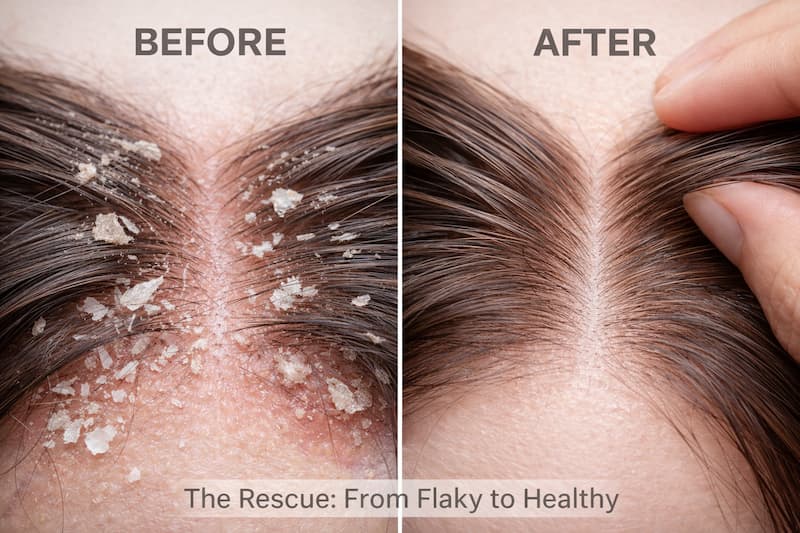
Introduction: The Exhausting Cycle of the “Shoulder Snowfall”
You’ve scrubbed, medicated, and washed multiple times.
Yet, flakes return by noon.
This isn’t a hygiene problem.
It’s your scalp’s barrier collapsing.
Your scalp flakes aren’t the problem they are the symptom.
A “leaking” barrier allows skin cells to detach in sheets.
Understanding this basement-level failure is the key to stopping flakes permanently.
The Clinical Reality: Why Your Scalp Flakes Refuse to Heal
Abnormal Desquamation
Healthy skin sheds cells invisibly, one by one.
On a compromised scalp, this changes.
- Cells detach in clumps
- Sheets fall onto shoulders and clothing
- Premature shedding becomes visible
This is called abnormal desquamation.
Without proper lipids, cells cannot hold together.
Flakes appear because your scalp cannot manage its own weight.
The Lipid Void
Your scalp needs C8 to C12 fatty acids to stay flexible.
Without them, your skin cracks and dries.
- Cracks form in the stratum corneum
- Water escapes faster than it can be replaced
- Flakes appear continuously
The logic is simple:
Low Lipid Density+High TEWL=Persistent Scalp Flakes
When the barrier fails, flakes return no matter how often you wash.
Identifying the Scourge: A Diagnostic Audit of Your Scalp Flakes
Visual Inspection
Not all flakes are the same.
Recognizing the type helps you act correctly.
- Dust flakes: tiny, white, translucent
- Plate flakes: large, opaque, silvery
- Waxy flakes: yellow, sticky, clumped
Each type signals a different biological cause.
Sensation Audit
Your scalp gives warning signs before flakes appear:
- Tightness or stiffness
- Persistent itch
- Dull discomfort
These symptoms often indicate dehydration or microbial shifts.
Flake Type Breakdown
| Flake Type | Visual Signal | Biological Catalyst | Expert Intervention |
|---|---|---|---|
| Dust | Tiny, white, translucent | Dermal dehydration | Re-lipidization |
| Plate | Large, silvery, opaque | Lipid void | Stratum corneum repair |
| Waxy | Yellow, sticky, clumped | Microbial shift (Malassezia) | $pH$ stabilization & microbiome support |
Correct identification prevents missteps.
Treating the wrong type can worsen the problem.
The Brutal Truth: Why Common Shampoos Fuel Your Scalp Flakes
Surfactant Sabotage
Most commercial shampoos strip oils aggressively.
Stripping triggers scalp flakes instead of preventing them.
- Temporary cleaning is misleading
- Barrier weakens after each wash
- Flakes return faster than before
The pH Trap
A healthy scalp is slightly acidic: pH 4.5–5.5.
Most anti-dandruff shampoos sit at pH ≥ 7.
- Alkaline cleansers unzip skin proteins
- Short-term clearing occurs
- Flakes rebound within 24 hours
Keywords to remember: anionic surfactants, moisture-retention failure, cellular cohesion.
Ignoring pH balance fuels the cycle of scalp flakes.
The Rescue Protocol: Breaking the Persistent Scalp Flakes Cycle
Thermal Regulation
Hot water dries the scalp.
Heat increases TEWL and flakes return quickly.
- Use lukewarm water
- Avoid steaming or prolonged heat
- Let skin absorb moisture before styling
Lipid Infusion
Your barrier needs oil to stay intact.
Bio-identical oils like Squalane work best.
- Locks in hydration
- Smooths the stratum corneum
- Reduces clumping of flakes
Acidic Calibration
Lower scalp pH to 4.5–5.5.
Acidity strengthens cohesion between cells.
Flakes become physically harder to detach.
Tip: If your flakes burn or itch, check the dry scalp and itching rescue matrix to stabilize nerves first.
Long-Term Sovereignty: Preventing the Return of Scalp Flakes
Environmental Control
Environmental factors dry your scalp further.
- Hard water strips natural oils
- Indoor heating dehydrates skin
- Low humidity accelerates flaking
Protect your scalp from these hidden triggers.
Hydration and consistent care make a huge difference.
Internal Support
Your diet directly affects your barrier.
Nutrients from diet and dry scalp choices strengthen your skin from the inside.
- Healthy fats support lipids
- Hydrating foods reduce TEWL
- Balanced nutrition supports stratum corneum repair
Even invisible changes matter.
Consistency ensures scalp flakes don’t return.
Conclusion: Ending the Fatal Cycle of Dehydration
Scrubbing won’t solve flakes.
Sealing, hydrating, and respecting pH will.
Your flakes are symptoms, not the problem.
Focus on basement-level healing.
Stop the cycle.
Let your scalp breathe.
[Download the “Flake ID Matrix” and 7-Day Reset Checklist Here]