
I. The Fallacy of “Normal” Pathology
Most lab results look “normal.”
That doesn’t mean your scalp is okay.
In clinical practice, those ranges are built to catch disease, not to fix chronic irritation.
So you can sit right in the middle of the chart and still deal with constant flaking.
This is where most people get stuck.
They trust the report, but their scalp tells a different story.
If your seborrheic dermatitis nutrients are only “average,” repair slows down.
And when repair slows down, inflammation stays active in the background.
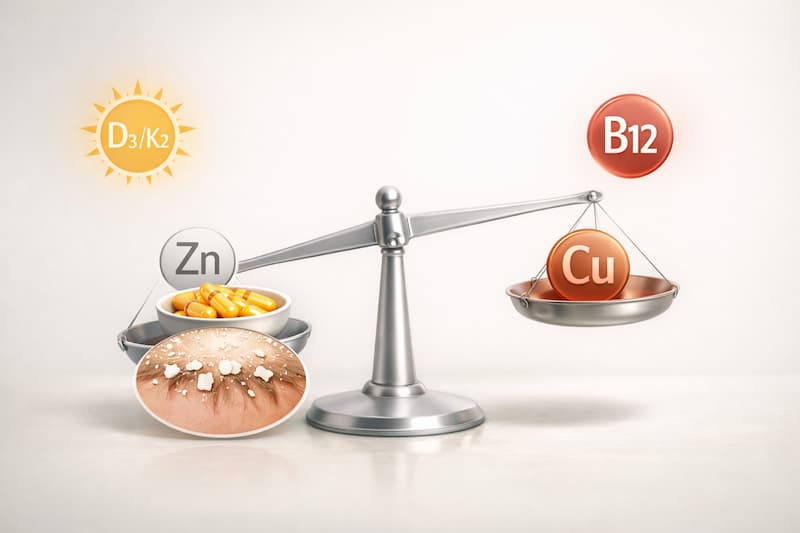
II. The Zinc/Copper Ratio: Where Most People Get It Wrong
You’ve probably heard: “Take zinc for your skin.”
That advice is incomplete.
Zinc doesn’t work alone.
It competes with copper for absorption.
Push zinc too high, and your body reacts.
It increases a protein called metallothionein.
That protein binds copper tightly.
So even if you eat enough copper, your body can’t use it well.
This is where things shift.
Hair starts thinning, and repair becomes inconsistent.
In practice, balance matters more than quantity.
A zinc-to-copper ratio between 8:1 and 12:1 tends to support stable scalp function.
Anything outside that range starts to create friction inside your system.
III. Vitamin D3 and K2: The Missing Link in Immune Control
Vitamin D3 acts like a control switch for inflammation.
When levels drop, your immune system becomes less precise.
Instead of regulating, it overreacts.
That’s when redness and flaking become persistent.
But here’s the part many miss.
D3 without K2 creates imbalance.
K2 helps direct calcium where it belongs.
Without it, calcium can build up in soft tissues instead of supporting structure.
Clinically, people feel better when D3 reaches around 60–80 ng/mL.
Below that, the immune response often stays slightly elevated.
You won’t always see this in obvious symptoms.
But your scalp will keep reacting to small triggers.
IV. B-Complex and the Methylation Factor
Your scalp renews itself every few weeks.
That process depends heavily on B vitamins.
When levels drop, cell turnover becomes uneven.
Some cells shed too early, while others linger too long.
That mismatch creates visible flakes.
It also disrupts how oil spreads across the scalp.
Here’s where quality matters.
Not all B12 is equal.
Methylcobalamin is already active.
Cyanocobalamin needs conversion first.
If your body struggles with that step, results slow down.
So even with supplementation, improvement feels delayed.
V. Normal vs. Optimal: The Gap That Keeps You Stuck
Most lab reports stop at “normal.”
They don’t show what’s optimal for repair.
Here’s the difference in simple terms:
| Nutrient | Standard Range | Optimal Range | Why It Matters |
|---|---|---|---|
| Serum Zinc | 60–120 µg/dL | 100–120 µg/dL | Supports oil balance and barrier repair |
| Vitamin D3 | 30–100 ng/mL | 60–80 ng/mL | Helps regulate inflammation |
| Vitamin B12 | 200–900 pg/mL | 500–800 pg/mL | Supports steady skin renewal |
You can be “normal” and still not healing.
That’s the gap most routines never address.
VI. How to Ask for the Right Tests
This part matters more than people think.
If you don’t ask clearly, you won’t get useful data.
Instead of general tests, be specific.
Request serum zinc with copper.
Also ask for 25-hydroxy vitamin D.
That’s the form that reflects actual status in your body.
Once you see the numbers, patterns become clearer.
You stop guessing and start adjusting with intent.
At the same time, support your scalp externally.
A barrier-focused product like ScalpRx helps reduce stress on the skin while internal levels improve.
VII. Conclusion: Systems Over Symptoms
Flakes are not random.
They’re signals from a system that’s slightly off balance.
If you only treat the surface, results won’t last.
The internal environment keeps pulling you back.
When seborrheic dermatitis nutrients reach the right range, things shift quietly.
The itch softens, the flakes reduce, and the scalp stabilizes.
It doesn’t happen overnight.
But it does happen when the system is supported properly.
If you want clarity, start with your data.
Then build from there.