
The Biological Mutiny: How to Vanquish the Stress & Scalp Health Connection Before It Sabotages Your Barrier
I. The Invisible Thread: Why the Stress & Scalp Health Connection Is Physical
The Stress & Scalp Health Connection is not just in your mind. Instead, it happens inside your body like a chain reaction.
When you feel stressed, your brain sends chemical signals. Because of that, your scalp environment changes fast.
So what does that mean?
- Your scalp becomes inflamed
- Oil production shifts
- Your barrier weakens
In simple terms, stress acts like a silent attack on your scalp.
Also, there is a delay. You may feel stressed today, but your scalp reacts days later.
This is the 72-hour lag.
II. The Cortisol Hijack: What Stress Does to Your Scalp
The Cortisol-Sebum Link
When stress rises, your body releases cortisol.
Because of this:
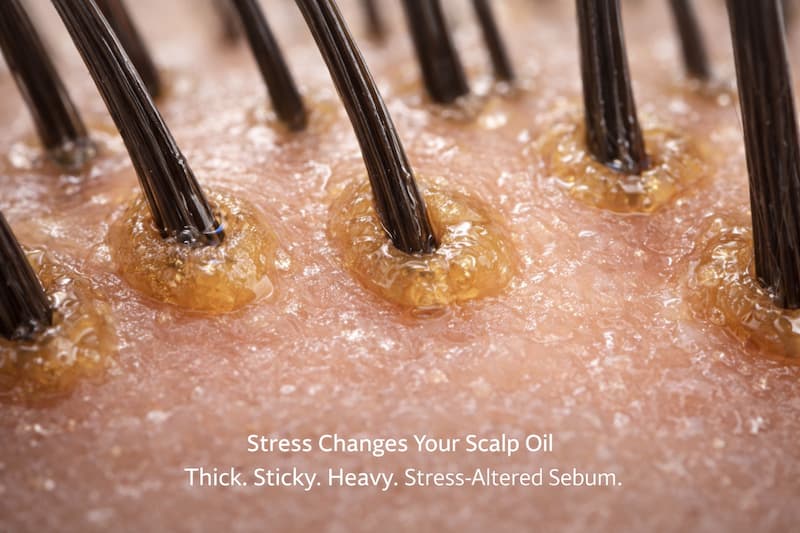
- Your scalp produces thicker oil
- That oil becomes sticky
- Pores get clogged
So, buildup forms and irritation starts.
The Barrier Breach
At the same time, stress reduces ceramides.
Ceramides act like glue in your skin.
Without them:
- Your barrier cracks
- Water escapes faster
- Irritants enter easily
So your scalp becomes weak and reactive.
The “Cortisol Steal”
Your body also shifts resources.
Instead of supporting your scalp, it focuses on survival.
Because of that:
- Nutrients like Zinc and B6 get diverted
- Your scalp receives less support
- Repair slows down
In other words, your scalp gets deprioritized.
III. Neuropeptides: How Stress Triggers Instant Itch
Substance P
There is a signal called Substance P.
It activates when you are stressed.
Because of this:
- You feel sudden itching
- Redness appears quickly
- Sensitivity increases
So even a small trigger feels intense.
The Micro-Inflammation Cycle
One stressful day can create a longer reaction.
So:
- Inflammation starts fast
- It stays active for days
- Your scalp struggles to calm down
This is why flare-ups feel random but last long.
IV. Recognizing the Crisis: Signs Your Scalp Is Under Stress
The “Tight Scalp” Feeling
Stress causes blood vessels to tighten.
Because of that:
- Less oxygen reaches your follicles
- Your scalp feels tight or tense
This is called vasoconstriction.
Sudden Shedding vs. Thinning
Not all hair loss is the same.
- Sudden shedding → often stress-related (Telogen Effluvium)
- Slow thinning → ongoing barrier damage
So, timing and pattern matter.
V. The Triage Protocol: Resetting the Stress & Scalp Health Connection
Step 1: The Temperature Truce
First, cool the scalp.
Because cooler temperatures:
- Reduce inflammation
- Slow down chemical signals
Use water below 20°C or a cool compress.
Step 2: The Lipid Anchor
Next, rebuild your barrier.
Use:
- Ceramides
- Barrier-repair products like ScalpRx
These seal cracks caused by stress.
Step 3: Vagus Nerve Reset
Now, calm your nervous system.
Simple methods:
- Deep breathing
- Gentle scalp massage
- Slow, controlled exhale
Because of this, your body exits “fight mode.”
VI. Stress vs. Scalp Biology (Quick Table)
| Stress Signal | Biological Result | Visible Symptom | What Helps |
|---|---|---|---|
| High cortisol | Oil overproduction | Greasy, flat roots | Gentle exfoliation |
| Substance P | Nerve irritation | Sudden intense itch | Cooling compress |
| Adrenaline | Reduced blood flow | Dull, thinning hair | Scalp massage / ScalpRx |
| Cytokine surge | Barrier breakdown | Scabs, red bumps | Lipid repair mask |
VII. The Internal Blueprint: Nutrients That Calm Your Scalp
Magnesium and Zinc
These help your body relax.
Because of that:
- Stress signals reduce
- Inflammation lowers
So your scalp gets relief.
Adaptogens for Your Hair
Certain herbs help your body handle stress better.
Examples:
- Ashwagandha
- Rhodiola
They support balance from inside.
So instead of reacting strongly, your body stays steady.
VIII. Conclusion: Bringing Your Scalp Back to Calm
The Stress & Scalp Health Connection is real and physical. Your scalp reflects what your body is going through.
So, treating only the surface is not enough.
However, when you calm the system:
- Inflammation drops
- Your barrier repairs
- Your scalp stabilizes
Next step:
- Take the Diagnostic Wheel Quiz
- Identify your “Stress Signature”
- Download your custom 7-Day Calm Scalp Protocol
Then, combine it with the 3-Day Scalp Reset to manage flare-ups fast.