
Oil Rebound After Dandruff Shampoo: Why Greasy Flakes Return Faster
The Squeaky Clean Deception
You scrub until your hair squeaks. For a few hours, your scalp feels light, fresh, and almost flawless. Yet by evening, roots feel slick, and by the next morning, the yellow flakes have returned.
This isn’t a failure of hygiene. It’s a defensive biological reaction. Known as oil rebound dandruff shampoo, this response occurs when your scalp overproduces sebum after harsh cleansing. Essentially, your skin tries to “waterproof” itself after the barrier has been chemically stripped.
Understanding this feedback is critical. What looks like a cosmetic failure is actually predictable biology. It’s the same mechanism that drives the hidden 48-hour dandruff cycle no one talks about, fueling repeated flaking despite regular washing.
The Feedback Loop: How Oil Rebound Dandruff Shampoo Works
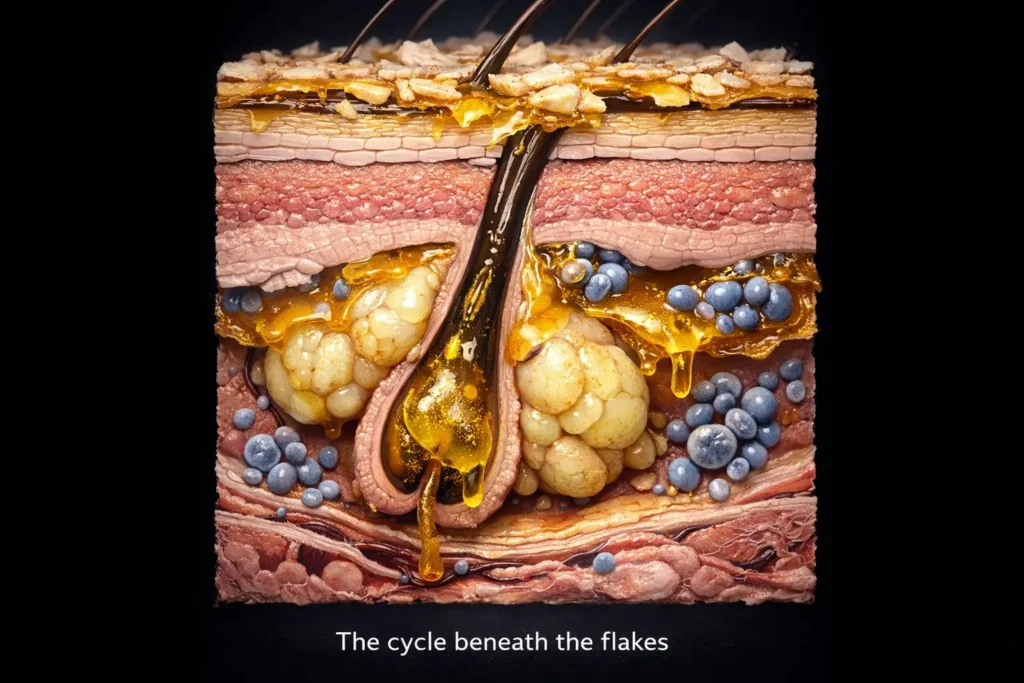
When your acid mantle is compromised, the sebaceous glands immediately compensate. This process, called sebum rebound, triggers lipid overproduction. Essentially, the scalp interprets stripping as a threat and produces extra oil to protect itself.
Over time, repeated over-cleansing teaches the scalp to produce oil aggressively. Even mild treatments can’t override this response if the barrier remains compromised.
This oil rebound dandruff shampoo cycle is why many people feel trapped in an endless wash-flake-repeat loop. It’s not that the shampoo is “weak.” The scalp is signaling a defensive overdrive to maintain barrier integrity.
For more on how aggressive shampoos feed this loop, see why harsh shampoos create the rebound cycle.
Malassezia’s Banquet: Why Grease Accelerates the Relapse
Dandruff relapse isn’t driven by fungus alone. It’s driven by what the fungus consumes. Malassezia depends on scalp lipids for growth. When sebum output rises, the organism gains immediate fuel.
The mechanism: triglyceride breakdown → oleic acid irritation
Sebum is rich in triglycerides. Malassezia secretes lipase enzymes that split these triglycerides into free fatty acids—especially oleic acid. On susceptible scalps, oleic acid penetrates the stratum corneum, disrupts barrier cohesion, and triggers inflammation. Irritation accelerates cell turnover. Corneocytes shed before they mature. Flakes appear.
Why excess oil speeds relapse
More sebum means more substrate for fungal metabolism. Population density increases quickly. Irritant by-products accumulate. Barrier disruption deepens. This sequence shortens the time between apparent control and visible flare.
The 48-hour lock-in
With abundant lipid supply, colonies organize into a protective matrix that adheres to the scalp surface. Treatments struggle to penetrate once this structure stabilizes. The relapse loop forms: oil feeds fungus; fungus drives irritation; irritation drives shedding; shedding exposes more lipid.
This flood of oil provides the raw materials for the biofilm shield that forms in those 48 hours.
The Workout Factor: Compounding Oil Rebound After Dandruff Shampoo
Exercise changes the scalp environment fast. Sweat output rises. Skin temperature increases. When this moisture mixes with rebound sebum from recent cleansing, it forms a thin sweat–sebum film across the scalp surface.
How sweat and oil create a flare-prone microclimate
Sweat alone evaporates. Sebum alone disperses. Together, they create a semi-occlusive layer that traps heat and moisture against the skin. As a result, the scalp microclimate shifts toward higher humidity and temperature conditions that favor Malassezia activity. At the same time, evaporation slows. The barrier stays damp longer. Irritation thresholds drop.
Why post-workout flares escalate quickly
After shampooing, sebaceous glands often compensate with increased output. If a workout follows within hours, fresh sweat blends with this oil surge. Consequently, fungal metabolism accelerates and irritant by-products accumulate. The scalp remains occluded under this liquid film, so inflammation amplifies instead of resolving. Flakes can reappear within a day.
Practical implications for timing and care
Because the sweat–sebum mixture stabilizes quickly, leaving it on the scalp prolongs the flare window. Rinsing soon after heavy sweating reduces occlusion and heat retention. On non-wash days, a brief lukewarm rinse or gentle blotting lowers moisture load without triggering further rebound. In contrast, delaying care allows the microclimate to persist.
This is why you notice dandruff returns after workout or stress so aggressively.
Breaking the Slick: Ending the Oil Rebound Dandruff Shampoo Cycle
Most dandruff routines focus on removal. They strip oil, suppress flakes, then wait for relapse. However, repeated degreasing destabilizes the scalp barrier and amplifies rebound sebum output. Lasting control requires a shift from oil removal to oil regulation.
From degreasing to rebalancing
Harsh surfactants dissolve surface lipids and raise scalp pH. In response, sebaceous glands increase production while the barrier weakens. Therefore, the first step is to stabilize scalp pH balance with non-stripping cleansers that preserve the acid mantle. When cleansing respects barrier lipids, compensatory oil signaling drops.
Restore the lipid barrier
Barrier repair reduces irritation and slows turnover. After washing, lightweight hydration followed by minimal occlusion helps rebuild lipid structure without clogging follicles. Over time, lipid barrier repair normalizes desquamation and reduces flake release. As stability returns, antifungal actives work more efficiently.
Introduce the Sebum Reset protocol
The Sebum Reset sequence in the 39-page guide phases cleansing frequency, supports pH recovery, and reinforces barrier lipids between washes. Gradual spacing lowers surfactant load while preventing occlusive buildup. Consequently, sebum output recalibrates instead of rebounding. The cycle weakens, then breaks.
Learn how to finally escape the “only works while I use it” trap (see Post 15).
Conclusion: Your Exit from the Greasy Relapse
A greaseless, flake-free scalp isn’t achieved by stronger detergents. It comes from barrier health, controlled oil production, and strategic fungal management.
Understanding oil rebound dandruff shampoo turns the cycle from a frustrating trap into a manageable pattern. Once you stabilize your scalp, even minimal intervention produces long-term clarity.
Start breaking the cycle today with actionable strategies in “how to go from 24-hour relief to 30-day clear scalp“, and see why the $20 billion dandruff industry doesn’t want you to escape in .