
The $20 Billion Cycle Explained: Why Big Shampoo Wants You Relapsing
The Most Profitable “Failure” in History
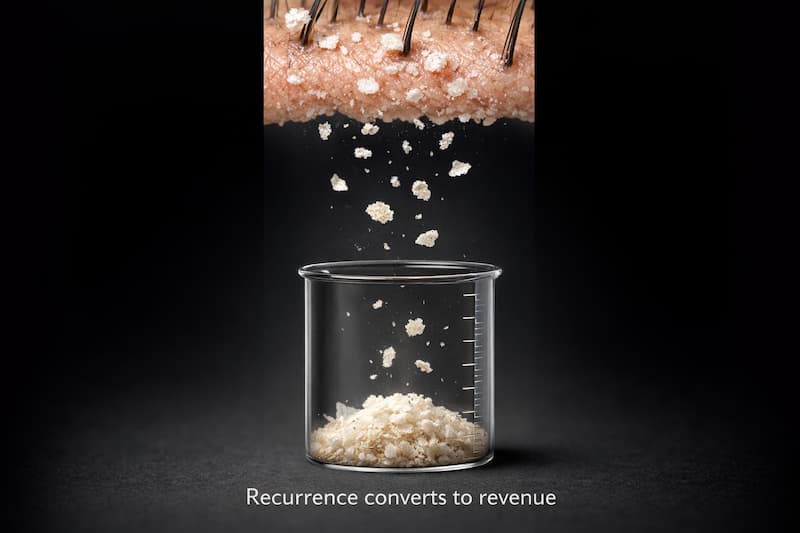
If a dandruff shampoo truly cured the condition, the business model would collapse. A cured user stops purchasing. Revenue ends immediately.
Therefore, from a commercial perspective, permanent resolution is undesirable. Sustained recurrence, however, is ideal.
This is the uncomfortable reality behind chronic dandruff care. Products are optimized for short relief. They are not optimized for remission.
That dynamic forms the dandruff shampoo cycle. Symptoms fall temporarily. Then they return predictably. Consequently, the next purchase feels necessary.
“…this economic model is built entirely upon the hidden 48-hour dandruff cycle no one talks about.”
The loop functions because biology cooperates. Harsh cleansing removes visible flakes quickly. Users interpret that as success.
However, underlying inflammation remains active. Barrier damage increases. Oil rebound accelerates fungal regrowth.
Thus, relapse becomes inevitable.
From the user’s perspective, failure appears personal. From the industry’s perspective, failure is retention.
That distinction explains why the cycle persists across decades.
The Engineering of the Dandruff Shampoo Cycle
At the center of the loop sits formulation design. Most medicated shampoos combine strong surfactants with antifungal actives.
On contact, these formulas perform aggressively. Lipids dissolve. Surface microbes drop. Flakes detach.
Relief follows quickly.
However, this same action strips the acid mantle. The scalp loses its primary defensive layer.
“As we’ve shown, this is exactly why harsh shampoos create the rebound cycle that fuels the next wash.”
Once stripped, the barrier enters emergency mode. Sebaceous glands increase oil output. Water loss rises. Sensitivity increases.
Within 24–48 hours, the environment shifts. Oil availability climbs. Irritation thresholds fall. Fungal growth accelerates.
Consequently, symptoms return faster than before.
This rebound is not accidental. It is predictable physiology.
High-pH surfactants amplify the effect. Acid mantle recovery slows in alkaline conditions. Lipid synthesis enzymes function poorly.
Therefore, repair remains incomplete between washes.
When the next wash occurs, the cycle resets.
Relief → stripping → rebound → relapse → repeat.
That sequence defines the dandruff shampoo cycle at a biochemical level.
The Cosmetic Lie: Treating Inflammation as “Dirt”
Another driver of the loop is classification. Dandruff is framed as a cosmetic cleanliness issue rather than inflammatory dysregulation.
This framing shapes behavior. Users believe flakes equal dirt. More washing appears logical.
However, flakes originate from accelerated cell turnover driven by inflammation. They are not environmental debris.
“By ignoring the chronic scalp inflammation that never fully resets, brands ensure you never reach true remission.”
When inflammation is mislabeled, treatment targets the wrong factor. Cleansing intensity rises. Barrier stress increases.
Consequently, relapse worsens.
This cosmetic narrative benefits frequency. Hygiene messaging encourages daily washing.
Yet frequent stripping maintains inflammation. Thus, the loop stabilizes.
The misunderstanding also masks symptoms. Tenderness, heat, and tightness persist beneath the surface.
Because flakes temporarily disappear, users assume resolution.
Therefore, the inflammation-as-dirt narrative sustains the dandruff shampoo cycle psychologically and behaviorally.
The Biofilm Blindness: Why the Dandruff Shampoo Cycle is Recession-Proof
Chronic dandruff rarely exists as isolated yeast cells. Instead, microbial communities organize into biofilm structures.
Biofilm behaves as a protective matrix. It anchors microbes to skin. It limits penetration of antifungal agents.
Consequently, surface killing occurs without colony eradication.
“This ‘blindness’ is why your dandruff treatment suddenly stops working after a few weeks—the biofilm stays intact.”
Addressing biofilm requires multi-step disruption. Chelation, keratolysis, and hydration cycling must occur sequentially.
However, such protocols are complex. They do not fit single-bottle convenience marketing.
Therefore, mainstream products omit biofilm targeting.
Without disruption, core colonies persist after each wash. Once actives disappear, regrowth begins immediately.
Relapse then appears as resistance. Users switch brands.
Yet switching actives without removing biofilm changes little.
Thus, biofilm blindness stabilizes the dandruff shampoo cycle structurally.
Because the underlying architecture remains intact, recurrence continues indefinitely.
Case Study: The Cost of Remaining in the Dandruff Shampoo Cycle
Chronic dandruff often begins in adolescence. Many individuals remain in treatment loops for decades.
Purchase frequency averages one medicated shampoo every 4–6 weeks. Over ten years, consumption reaches roughly 100 bottles.
At a conservative cost estimate, lifetime spend exceeds $2,000.
This expenditure produces intermittent relief only. Long-term remission remains absent.
“Contrast this with the results of users who move from 24-hour relief to 30-day control.”
In contrast, staged recovery protocols shift spending patterns. Initial investment occurs once. Maintenance costs drop sharply afterward.
More importantly, wash frequency declines. Dependence fades.
This difference illustrates lifetime consumer value. Recurring products generate predictable revenue.
Permanent solutions reduce lifetime purchases dramatically.
Therefore, the dandruff shampoo cycle is economically durable. It converts chronic biology into recurring sales.
The Behavioral Loop: Why Users Stay Trapped
Beyond formulation, behavior reinforces the cycle. Relief conditioning shapes expectations.
When symptoms disappear after washing, the brain associates the product with success.
However, delayed relapse disconnects cause from effect. Users do not link rebound to stripping.
Instead, relapse appears spontaneous.
Consequently, stronger cleansing feels necessary.
Switching products also creates novelty bias. New bottles feel promising. Temporary relief confirms hope.
Then relapse resumes.
Thus, the loop sustains itself cognitively.
Because each cycle begins with relief, users remain optimistic.
That optimism maintains adherence to the same strategy.
The 48-Hour Clock: Biological Timing of the Dandruff Shampoo Cycle
Relapse timing is not random. It follows physiological processes.
After washing, microbial load drops rapidly. Inflammation remains suppressed temporarily.
Within 12–24 hours, barrier disruption signals oil rebound. Sebum output rises.
Between 24–48 hours, fungal metabolism increases. Irritant byproducts accumulate.
At roughly 48 hours, inflammatory cytokines peak. Itch and flaking resume.
This timing matches common user experience precisely.
Therefore, the dandruff shampoo cycle aligns with natural skin kinetics.
Because the clock resets after each wash, recurrence appears unavoidable.
Only altering the environment can extend timing.
Why the Dandruff Shampoo Cycle Persists Across Generations
Several forces reinforce persistence.
First, cosmetic framing promotes lifelong washing habits.
Second, single-step products dominate retail channels.
Third, dermatologic guidance often prioritizes antifungal suppression alone.
Fourth, users interpret relapse as severity rather than rebound.
Together, these factors stabilize demand.
As long as remission remains rare, recurring treatment remains normal.
Therefore, the cycle continues across decades unchanged.
Breaking the Economic Logic: Why Remission Disrupts the Model
The cycle depends on recurrence. Remove recurrence, and purchasing falls.
Thus, remission is economically disruptive.
When the barrier stabilizes, wash intervals expand.
When inflammation falls, symptoms vanish.
When biofilm dissolves, regrowth slows.
Therefore, dependence disappears.
Users then shift from monthly purchase to occasional maintenance.
That shift reduces lifetime value dramatically.
Consequently, remission strategies rarely appear in mass-market messaging.
The Exit: Moving Beyond the Dandruff Shampoo Cycle
Escaping the loop requires sequential change.
First, structural shields must dissolve.
Second, inflammation must cool.
Third, barrier autonomy must return.
These stages alter relapse timing fundamentally.
Instead of 48-hour rebound, stability extends weeks.
Therefore, the scalp transitions from suppressed to self-regulated.
Once self-regulation returns, frequent medicated washing becomes unnecessary.
That transition ends the dandruff shampoo cycle biologically and behaviorally.
Conclusion: Breaking the $20 Billion Relapse Loop
Chronic dandruff persistence does not reflect personal failure. It reflects systemic design.
Formulations strip barriers. Messaging promotes over-washing. Biofilm remains unaddressed.
Together, these forces sustain recurrence.
The dandruff shampoo cycle therefore persists by structure, not accident.
However, biology also offers an exit. When environment stabilizes, relapse fades.
When relapse fades, dependence ends.
Therefore, remission is achievable.
Continue
- How to go from 24-hour relief to 30-day clear scalp (exact sequence)
- Download the 39-page PDF exposé and escape the cycle