
The Chemistry of “Clean”: Why pH Is a Scalp Dealbreaker
You want to know how to test shampoo pH — not just out of curiosity, but to protect your scalp. Every shampoo promises clean, but the truth is hidden in chemistry. Your scalp’s acid mantle, resting between 4.5 and 5.5 pH, keeps it healthy, flexible, and irritation-free. Introduce an alkaline formula — pH 8 or higher — and the cuticles swell, lipids dissolve, and cytokines trigger heat and itch. Learning how to test shampoo pH lets you see what your scalp truly encounters, so “clean” stops being guesswork and starts being safe.
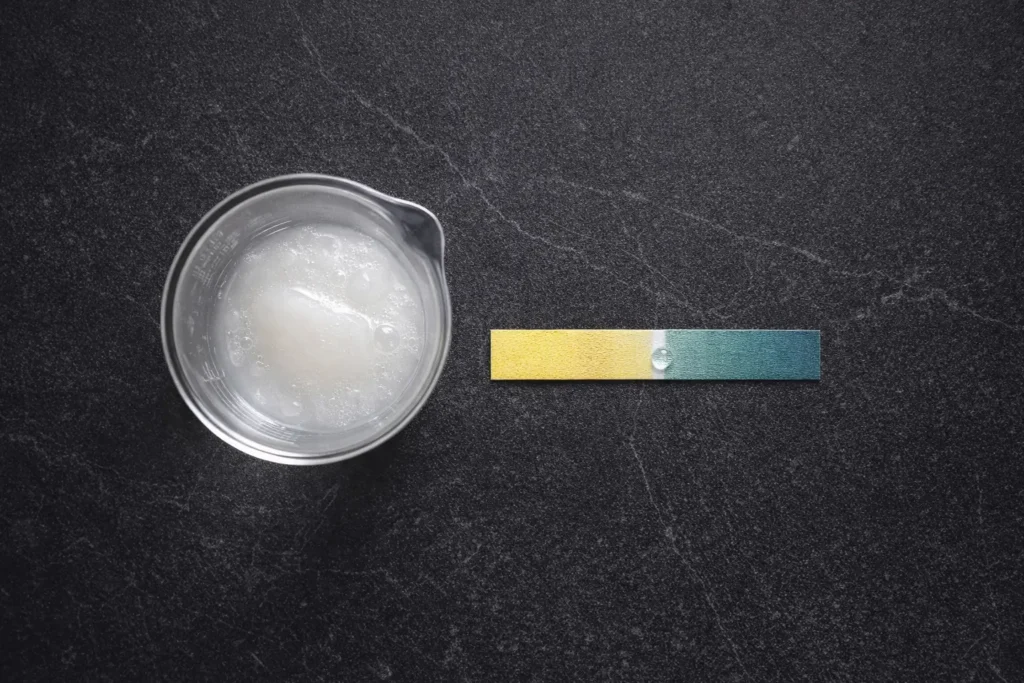
Tools of the Trade: What You Need
Precision matters. Universal pH strips spanning 1–14 may hint at trends, but they miss the subtle shifts critical to scalp health. Narrow-range strips calibrated 4.0–7.0, or an affordable digital pH meter, give readings you can act on. Medical-grade strips are inexpensive online or at laboratory suppliers — small investment, major insight.
Step-by-Step: How to Test Shampoo pH at Home Like a Pro
The Sample: Place a dime-sized amount of shampoo in a clean glass container.
The Dilution: Add a splash of distilled water (pH 7.0). Pure surfactants can give false highs; a controlled dilution stabilizes the reading.
The Dip: Submerge your strip for exactly two seconds.
The Comparison: Hold the strip under neutral light and match it to the chart immediately.
Once you’ve identified your alkaline triggers, follow up with calming ingredients to reverse damage. See Natural Ingredients for Scalp Barrier Repair.
Reading the Results: How to Test Shampoo pH to Find the Safe Zone
Green Zone (4.5–5.5): Your scalp’s sweet spot. Barrier intact, lipids preserved, tightness minimized.
Danger Zone (7.0+): Soap bars, clarifying shampoos, even some “natural” formulas drift here. High alkalinity swells the cuticle, disrupts the lipid layer, and primes itch — the tight, reactive sensation that returns after washing.
Testing is only the first step. To integrate your findings into a lasting routine, download the 5-day scalp reset guide for step-by-step relief and barrier protection.
Beyond pH: What Else Is Hiding in the Bottle?
pH tells part of the story. Surfactants, preservatives, fragrances, and hidden chemical irritants can continue the cycle of reactivity. The next step in your reset is a deeper product audit.
Don’t stop at pH. Download the 5-day scalp reset guide to identify triggers, calm irritation, and get the complete Ingredient Blacklist to rebuild a resilient scalp.