
Beyond the Bottle: Why Your Seb Derm Treatment Fails (And What Actually Fixes It)
The Real Problem Most People Miss
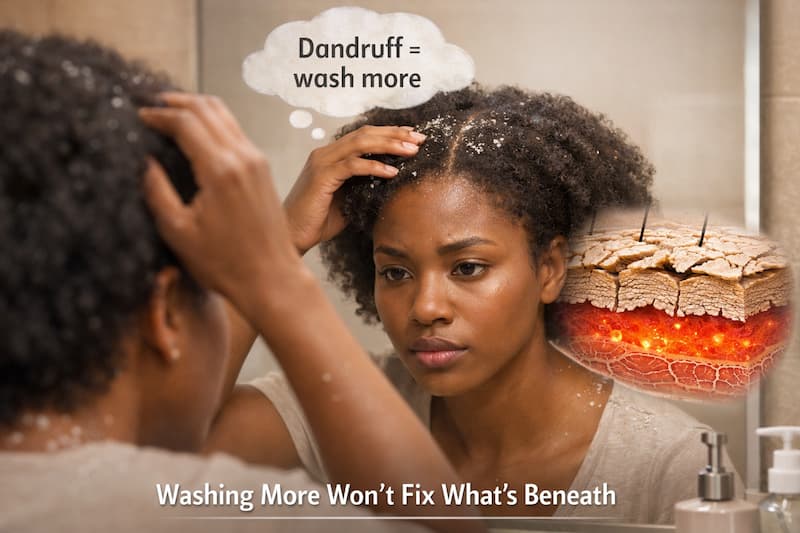
Most people assume more washing means more control.
It rarely works that way.
If you’ve been rotating medicated shampoos for months or even years you’ve likely noticed a pattern.
Things improve briefly, then everything comes back.
That cycle isn’t random.
It’s a sign the approach is incomplete.
Seborrheic dermatitis isn’t just a yeast issue.
It’s a system problem that happens to show up on your scalp.
Most recurring flares follow a deeper biological pattern underneath the surface. In many cases, the real seborrheic dermatitis root cause starts long before flakes become visible.
So when treatment focuses on killing yeast alone, it ignores the environment that allowed it to thrive in the first place.
And that’s why progress stalls.
The 6 Drivers Behind Every Flare
Instead of chasing symptoms, it helps to map what’s actually driving the flare.
In practice, most cases come down to a combination of these six factors:
- Microbial Overgrowth (Malassezia)
Present on every scalp, but becomes a problem when conditions shift in its favor. - Barrier Dysfunction
When the lipid layer weakens, irritants penetrate more easily and trigger reactions. When the scalp cannot hold moisture properly, the issue is often tied to weakened lipid structure. Without enough essential fatty acids for scalp health, the barrier becomes far more vulnerable to irritation. - Immune Reactivity
Some scalps respond aggressively, even to minor triggers. - Hormonal Signaling
Oil production is not random it’s influenced by internal signals like IGF-1 and androgens. For many people, flare-ups become more aggressive during periods of hormonal instability. A recurring hormonal scalp flare often shifts the scalp into a much oilier and more reactive state. - Nutritional Gaps
Low zinc or vitamin D levels quietly slow down repair processes. Slow healing and constant relapses sometimes point toward missing nutritional support underneath the surface. A hidden seborrheic dermatitis vitamin deficiency can quietly weaken repair processes for months. - Genetic Factors
Some people start with a naturally weaker barrier structure.
No single factor works alone.
Flares usually happen when multiple pieces line up at the same time.
Many recurring flare-ups are driven by smaller triggers people rarely notice at first. Stress shifts, hard water exposure, and product residue are some of the hidden seborrheic dermatitis triggers that quietly compound over time.
Why Medicated Shampoos Backfire Over Time
At first, anti-fungal shampoos seem effective.
They reduce flakes, calm itching, and give quick relief.
Then the rebound begins.
Many of these formulas rely on strong surfactants to “clean deeply.”
In reality, they strip away the same lipid barrier your scalp depends on for protection.
Once that barrier is weakened, two things happen:
- Moisture escapes faster
- Oil production increases to compensate
That excess oil becomes fuel for yeast again.
So the cycle restarts often more aggressively.
What feels like treatment resistance is often barrier damage in disguise. Many reactive scalps do not need stronger products. In reality, a gentle seborrheic dermatitis treatment often works better because it protects the lipid barrier instead of constantly stripping it.
Not Every Scalp Needs the Same Fix
One of the biggest mistakes is treating all flares the same way.
In reality, patterns differ.
Most chronic flares follow recognizable patterns once you know what to look for. A structured scalp condition checklist helps separate temporary irritation from recurring inflammatory cycles.
Some common profiles show up repeatedly.
Oily and Inflamed
- Fast oil buildup
- Redness around the hairline
- Flares tied to stress or diet
If flare-ups become worse after sugary meals or processed foods, the reaction may not be random. The connection between diet and seb derm often becomes easier to recognize once inflammation patterns repeat consistently.
This usually points to internal triggers driving sebum production.
Dry and Shedding
- Tight scalp
- Fine flakes
- Increased hair fall
Here, barrier damage is often the dominant issue.
Persistent and Unpredictable
- Flares that don’t follow a clear pattern
- Slow recovery
- Frequent relapses
This is where nutrient status and immune response tend to play a bigger role.
Understanding your pattern changes how you respond. When symptoms seem inconsistent, mapping the itch type, flake texture, and irritation zones often reveals a clearer pattern. A scalp symptom flowchart makes those hidden connections easier to recognize.
It also prevents unnecessary product switching.
Why Single Solutions Keep Failing
Most advice focuses on one layer of the problem.
That’s where things break down.
| Trigger | Common Approach | What Actually Helps |
|---|---|---|
| Microbial | Anti-fungal shampoos | Stabilizing the scalp environment |
| Barrier | Basic conditioners | Lipid-focused repair |
| Hormonal | Ignored | Dietary and stress adjustments |
| Nutritional | Generic supplements | Targeted correction |
Treating one layer while ignoring the others creates temporary wins.
Then the flare returns.
A More Effective Way to Approach Recovery
Instead of reacting to symptoms, structure matters.
Most long-term recovery plans work best when treatment layers are approached in the right order. The structure behind the scalp treatment pyramid explains why barrier repair should happen before aggressive active treatments.
A simple framework works better:
Start with the foundation
Lower internal triggers like poor sleep, high sugar intake, or chronic stress.
Protect the barrier
Use products that support not strip the scalp’s natural lipid layer.
Use actives strategically
Medicated treatments still have a place, but not as daily default tools.
When done in that order, the scalp stabilizes faster.
And more importantly, it stays stable longer.
What Actually Changes When You Get It Right
When the drivers are addressed together, the pattern shifts:
- Flares become less frequent
- Itching loses intensity
- Recovery time shortens
Over time, the scalp stops reacting to everything.
It starts regulating itself again.
That’s the difference between managing symptoms and restoring balance.
Final Thought
If your seb derm treatment keeps failing, it’s not a lack of effort.
It’s a mismatch between the approach and the biology.
Once you stop chasing flakes and start understanding the system behind them,
the next steps become much clearer.
Lasting control rarely comes from one product alone. A sustainable seborrheic dermatitis cure and prevention strategy focuses on keeping the scalp environment stable long before flare-ups begin again.
Next Step
If you want clarity on your specific pattern, take the Diagnostic Wheel Quiz and map your triggers.
It’s the fastest way to move from guessing to a structured plan.