
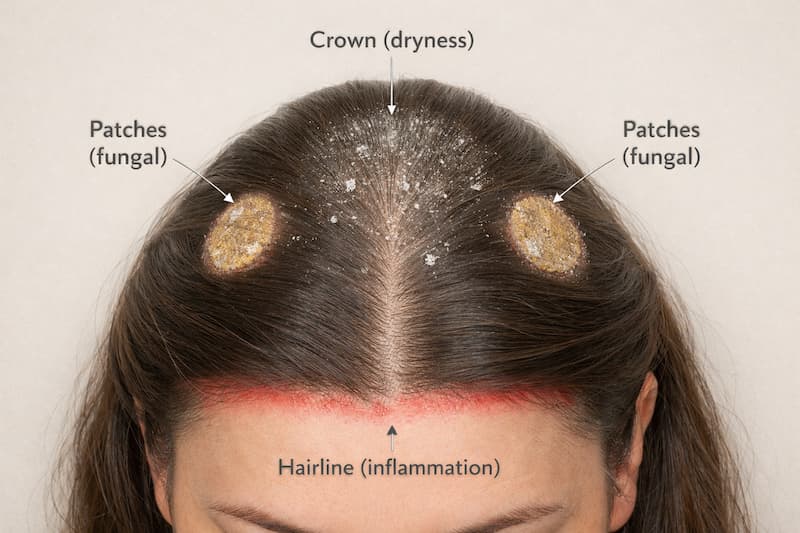
Scalp Symptom Flowchart: How to Decode What Your Scalp Is Telling You
I. Introduction: The Anxiety of the Unknown
When your scalp is irritated, it can feel confusing and stressful.
So, instead of guessing, you need a clear way to understand what’s happening.
Most people treat every itch the same way.
However, that often makes things worse.
If your scalp is dry but you use strong anti-fungal shampoos, you damage it more.
As a result, the irritation keeps coming back again and again.
This is why using a scalp symptom flowchart helps you stop guessing.
Because once you understand the signals, you can finally treat your scalp the right way.
II. Step 1: The Itch Profile — What Is Your Scalp Saying?
First, you need to pay attention to how your scalp feels.
Because the type of itch tells you a lot.
The “Tight” Itch
If your scalp feels like it is being stretched, that is a dryness signal.
So, your skin is lacking moisture and lipids.
The “Burning” Itch
If your scalp feels warm or stings, that points to inflammation.
As a result, this is often linked to seborrheic dermatitis.
The “Deep or Throbbing” Itch
If the itch feels deeper and stronger, that can be more serious.
So, this may be a fungal issue or deeper follicle irritation.
Therefore, always listen to the type of itch first.
Because your nerves are giving you clues.
A burning or throbbing sensation usually means the scalp barrier is already under stress. In many cases, an itchy scalp red flag appears long before visible flaking becomes severe.
III. Step 2: Flake Morphology — Texture, Color, and Behavior
Next, look closely at the flakes themselves.
Because how they look helps you understand the cause.
The “Snowflake”
If flakes are small, white, and fall easily, that means dryness.
So, your scalp is simply lacking hydration.
The “Plaque”
If flakes are yellow, oily, and stick to your scalp, that signals inflammation.
As a result, this is common in seborrheic dermatitis.
The “Grey Patch”
If flakes look dull, thick, and hard to remove, that is a warning sign.
So, this could point to a fungal infection.
Therefore, don’t ignore how flakes behave.
Because their shape tells the real story.
Grey patches and stubborn circular irritation can easily be mistaken for dandruff at first. The deeper differences inside scalp fungus vs seborrheic dermatitis usually become clearer once you study the flake behavior closely.
IV. Step 3: Location Mapping — Where Does the Irritation Live?
Now, check where the problem shows up.
Because location gives you another clue.
When flare-ups keep appearing in the same areas, there’s often a repeating trigger involved. Many people overlook the hidden triggers connected to stress, weather, hard water, and product buildup.
Hairline and Face Area
If flakes appear around your hairline, eyebrows, or nose, that suggests oil-related issues.
So, this often links to sebaceous gland activity.
Oil-heavy irritation around the hairline and face can sometimes point toward hormonal shifts underneath the surface. In many cases, a hormonal scalp flare changes how much sebum the scalp produces throughout the day.
All Over the Scalp
If the irritation is everywhere, that usually means dryness or environmental stress.
As a result, things like hard water or weather may be involved.
Small, Circular Spots
If you see round patches in one area, that is more serious.
So, this may be a fungal infection that needs medical care.
Therefore, always map where the irritation lives.
Because patterns matter.
V. The Official Scalp Symptom Flowchart
Now, combine everything you’ve observed.
Because this is where the flowchart becomes clear.
Path A: The Dehydration Loop
- Tight itch
- Fine white flakes
- Spread across the scalp
So, this means simple dryness.
Path B: The Inflammatory Flare
- Burning sensation
- Oily, sticky flakes
- Around the hairline or face
As a result, this points to seborrheic dermatitis.
Sticky flakes and recurring inflammation are usually signs of a deeper imbalance underneath the surface. In many cases, the real seborrheic dermatitis root cause begins with barrier breakdown and an unstable scalp environment.
Path C: The Fungal Invasion
- Deep, strong itch
- Grey or thick patches
- Localized areas
So, this may be a fungal infection that needs treatment.
VI. Restoring the Ecosystem: Targeted Recovery Protocols
Now that you know your path, you can fix it properly.
Because each condition needs a different approach.
For Dryness
If your scalp is dry, focus on restoring oils.
So, use light, bio-compatible lipids like C8/C10 oils.
This helps seal moisture into your skin.
As a result, flakes slowly disappear.
When the scalp cannot hold moisture properly, the issue is sometimes deeper than hydration alone. A lack of essential fatty acids for scalp health can weaken the barrier and increase irritation over time.
For Seborrheic Dermatitis
If your scalp is inflamed, avoid harsh stripping.
Instead, focus on calming the environment.
So, use gentle, balanced products that support your microbiome.
Because killing everything often makes things worse.
Many irritated scalps are not reacting to yeast alone. A gentle seborrheic dermatitis treatment focuses on calming inflammation without stripping away the protective lipid barrier.
For Fungal Issues
If you suspect a fungal infection, don’t rely only on home care.
So, this is where clinical treatment becomes necessary.
Because deeper infections need targeted solutions.
VII. Conclusion: From Mapping to Mastery
At first, scalp problems feel confusing.
However, once you map your symptoms, everything becomes clearer.
A scalp symptom flowchart turns guessing into understanding.
So, instead of random products, you follow a clear plan.
When you know the cause, fixing it becomes simple.
Because your scalp responds best to the right care, not more products.
If your scalp suddenly worsens after sugary meals or inflammatory foods, the reaction may not be random. The connection between diet and seb derm often becomes visible through repeated flare patterns.
Final Step
Still unsure about your scalp type?
Then take the Scalp Type Quiz for a detailed breakdown.
Also, if your results point to deeper inflammation, read:
“The Gut-Skin Axis” guide to understand internal triggers.
And if your scalp feels dry or irritated, start with the 7-Day Scalp Reset.
Because once you understand your scalp,
you can finally take control of it.