
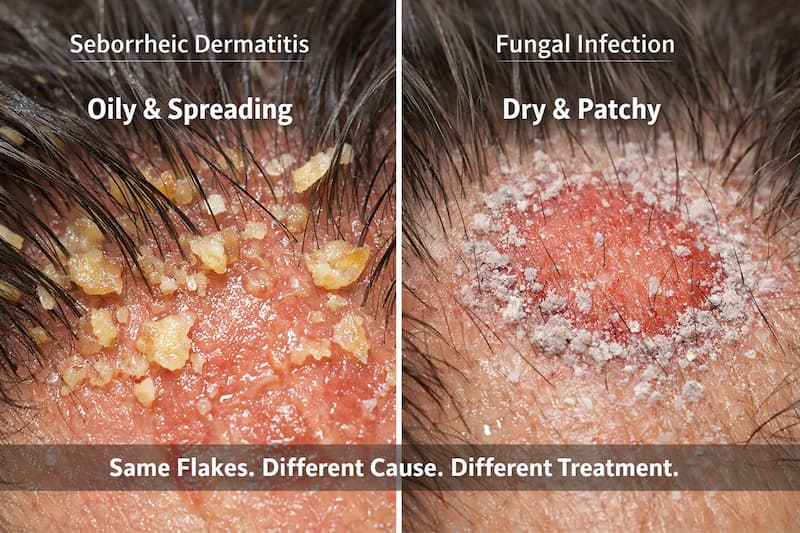
Scalp Fungus vs Seborrheic Dermatitis: Stop Guessing the Flakes
If you keep guessing what your flakes mean, then you might be making things worse. Instead of helping your scalp, you could be feeding the problem.
Now, scalp fungus vs seborrheic dermatitis is tricky because they can look similar. However, they need totally different care.
So, if you treat the wrong one, your scalp won’t heal. Instead, it stays irritated and confused.
That’s why this simple 5-point check will help you figure it out.
Flake Pattern in Scalp Fungus vs Seborrheic Dermatitis
First, look closely at your flakes. Because the way they look tells you a lot.
If you have seborrheic dermatitis, then your flakes are usually:
- Oily
- Yellowish
- Sticky and stuck to the scalp
But if it’s a fungal infection, then you may see:
- Grey or dull flakes
- Patchy areas
- Tiny black dots (broken hair pieces)
So, if flakes stick and feel greasy, think seb derm. However, if hair is breaking and patches look rough, think fungus.
Redness Differences in Scalp Fungus vs Seborrheic Dermatitis
Next, check the redness on your scalp. Because shape matters here.
If it’s seborrheic dermatitis, then redness spreads out softly. So, it often shows up:
- Along your hairline
- Behind your ears
- Around oily areas
But if it’s fungus, then redness looks different. Instead, it forms:
- Round or circular patches
- Clear edges or borders
So, if redness looks like a map, it’s likely seb derm. However, if it looks like circles, it may be fungus.
Itch Timing: How Scalp Fungus vs Seborrheic Dermatitis Feels
Now, think about your itch. Because timing gives clues.
If it’s seborrheic dermatitis, then the itch comes and goes. So, it may get worse when:
- You’re stressed
- You eat sugary foods
- The weather changes
If flare-ups seem worse after sugary meals or processed foods, your scalp may be reacting to internal inflammation signals. The connection between diet and seb derm becomes easier to spot once you start tracking food-related flare patterns.
Also, it feels like a burning itch.
But if it’s fungal, then the itch is different. Instead, it:
- Feels deep
- Stays constant
- Gets worse over time
So, if your itch changes often, it’s likely seb derm. However, if it won’t stop, it could be fungus.
If your itch suddenly worsens after stress, sugar, weather shifts, or certain products, there’s usually a trigger pattern underneath it. Many people miss the hidden seborrheic dermatitis triggers that quietly keep the cycle active.
Point 4: Scalp Shine — Oily or Dry?
Then, look at how your scalp looks after washing. Because shine tells a story.
If it’s seborrheic dermatitis, then your scalp looks oily quickly. So, it may feel greasy even after washing.
But if it’s fungal, then your scalp looks dull. Instead, the hair may seem:
- Dry
- Brittle
- Lifeless
So, if your scalp shines too much, think seb derm. However, if it looks flat and dry, think fungus.
An oily scalp that becomes greasy again within hours can sometimes point to more than overwashing. In many cases, a hormonal scalp flare changes how much oil your sebaceous glands release throughout the day.
Point 5: Wash Response — What Happens After You Wash?
Finally, notice how your scalp reacts after washing. Because this is a big clue.
If it’s seborrheic dermatitis, then washing helps at first. So, your scalp feels better right away. However, after 1–2 days, the flakes come back.
If your scalp improves for a day or two, then suddenly flares again, the issue may not be the yeast alone. The rebound pattern behind why seb derm treatment stops working usually begins when aggressive products weaken the scalp barrier over time.
This happens because oil comes back fast.
But if it’s fungal, then washing doesn’t help much. Instead, your scalp may feel:
- The same
- Or even more tender
So, if washing gives short relief, it’s likely seb derm. However, if nothing changes, it may be fungus.
Short-term relief after washing can sometimes signal a damaged barrier instead of a clean scalp. A gentle seborrheic dermatitis treatment focuses on calming irritation without triggering the rebound oil cycle afterward.
Why This Gets Confusing
Now, here’s the tricky part. Because both conditions involve fungi in some way.
What makes this confusing is that flakes are usually the final symptom, not the starting point. The deeper seborrheic dermatitis causes often begin with barrier damage, inflammation, and oil imbalance long before visible scaling appears.
Seborrheic dermatitis involves a yeast called Malassezia. However, fungal infections involve different fungi that go deeper into the skin.
Also, your scalp needs a slightly acidic balance to stay healthy. So, when your pH goes too high, both problems can grow.
That’s why balance matters more than just “cleaning.”
What Should You Do Next?
So, here’s a simple way to decide:
- If your scalp is oily, flaky, and follows your hairline → think seborrheic dermatitis
- If your scalp has circles, hair breakage, and deep itch → see a doctor for fungus
Because fungal infections need medical treatment. However, seborrheic dermatitis needs a barrier repair approach. Not every scalp issue should be treated the same way. The scalp treatment pyramid helps you decide when to focus on cleansing, barrier repair, microbiome balance, or professional medical care.
Once you recognize your scalp pattern early, you can usually calm irritation before the heavy flaking stage begins. Learning how to stop a seborrheic dermatitis flare up early changes the entire recovery process.
Final Thoughts
If you stop guessing, then you start healing. Instead of fighting your scalp, you begin to understand it.
So, once you know the difference between scalp fungus vs seborrheic dermatitis, your next steps become clear.
Some stubborn scalp symptoms continue even after changing shampoos. A hidden seborrheic dermatitis vitamin deficiency can quietly weaken the skin barrier and slow down recovery from inflammation.
Your Next Step
If you’re still unsure, then don’t guess. Instead, take the Scalp Type Quiz to get a clear answer.
Also, you can start the 7-Day Scalp Reset to calm your scalp while you figure things out.
Because once your scalp is balanced, everything else gets easier.